
Attitudes
Representational research - I
The Bombay Parsi community’s opinions were gleaned through a recent poll commissioned by Parsiana
As part of Parsiana’s 50th anniversary celebration, we commissioned the reputed Hansa Research Group (HRG) "to study the views, opinions and attitudes of Bombay Parsis (aged over 18 years) on matters concerning the community.” HRG, mainly owned by R. K. Swamy BBDO, had conducted the Indian Readership Survey for five years and has vast experience in the field of market research.
When providing an overview of the findings in "What people believe,” Editorial Viewpoint, Parsiana Congress Special, December 2013), we had explained, "The objective was to try and arrive at as impartial as possible and fair assessment of the local community’s opinions. Accordingly both the interviewer and the interviewees were not informed as to who had commissioned the study. Some parties shortlisted refused to be interviewed unless informed of the sponsor. Where the person was not available at the address stated or had expired, they were substituted by others. The BPP (Bombay Parsi Punchayet) list is not always up-to-date, an anomaly the trust will have to correct before the 2015 trusteeship elections. The researchers selected were bilingual in English and Gujarati.
"As this is the first such survey whose results have been published, it should be treated as a starting point. Subsequent surveys will show how accurate the findings are and the degree of variation over time.
"The poll results are not sacrosanct. The sample size was 500 in a Bombay Parsi population of 40,000 or so and was restricted to names (randomly) drawn from the electoral rolls (450 from the General Register of voters and 50 from the Donor Register). The number of questions were limited as the time for each interview was restricted to 15 to 20 minutes, due to budgetary consideration. A limited amount has been set aside for such activities during our 50th anniversary celebrations. But the community must not wait another 50 years for the next scientific study. Many more such polls at regular periods must be conducted. An all-India or a global poll should also be on the anvil. But for now this poll will hopefully present a scientific basis from which to approach community issues.”
When providing an overview of the findings in "What people believe,” Editorial Viewpoint, Parsiana Congress Special, December 2013), we had explained, "The objective was to try and arrive at as impartial as possible and fair assessment of the local community’s opinions. Accordingly both the interviewer and the interviewees were not informed as to who had commissioned the study. Some parties shortlisted refused to be interviewed unless informed of the sponsor. Where the person was not available at the address stated or had expired, they were substituted by others. The BPP (Bombay Parsi Punchayet) list is not always up-to-date, an anomaly the trust will have to correct before the 2015 trusteeship elections. The researchers selected were bilingual in English and Gujarati.
"As this is the first such survey whose results have been published, it should be treated as a starting point. Subsequent surveys will show how accurate the findings are and the degree of variation over time.
"The poll results are not sacrosanct. The sample size was 500 in a Bombay Parsi population of 40,000 or so and was restricted to names (randomly) drawn from the electoral rolls (450 from the General Register of voters and 50 from the Donor Register). The number of questions were limited as the time for each interview was restricted to 15 to 20 minutes, due to budgetary consideration. A limited amount has been set aside for such activities during our 50th anniversary celebrations. But the community must not wait another 50 years for the next scientific study. Many more such polls at regular periods must be conducted. An all-India or a global poll should also be on the anvil. But for now this poll will hopefully present a scientific basis from which to approach community issues.”
The community’s views on current matters facing the community, as graphically presented by the researchers, are being carried beginning with this issue. Featured here are the responses on social issues whilst those on religious practices; views on the BPP and general topics pertaining to the community will appear in forthcoming issues of Parsiana.
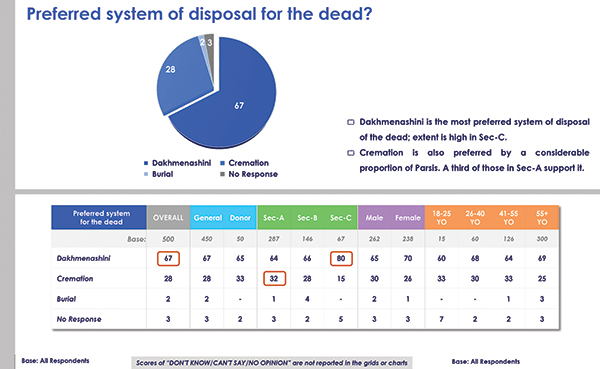
The findings are along expected lines but what is interesting are the undercurrents indicating a change in people’s outlook. For example, while dakhmenashini is the favored mode of disposal of the dead by 67% of the respondents, a surprising 28% favored cremation and two percent, burial. At present, around six percent of Bombay Parsis opt for cremation. As expected, those in the 18-55 younger age groups showed a higher preference for cremation (33%) as against 25% of those aged over 55. More men (30%) opted for cremation than women (26%). In the lower SocioEconomic Class (SEC-C) only 15% opted for cremation as compared to 32% in the higher socioeconomic group (SEC-A) and 28% in the middle socioeconomic group (SEC-B).
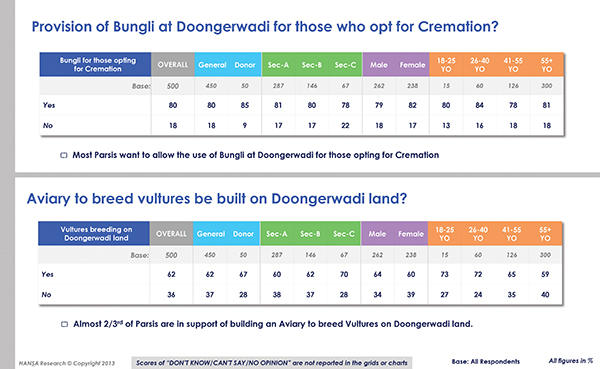
A whopping 80% favored a bungli at Doongerwadi being made available for four-day prayers for those opting for cremation. The figures were more or less consistent amongst all age and socioeconomic groups. At the same time 62% favored the construction of an aviary to breed vultures at Doongerwadi. The youngest in the 18-25 age group had the highest approval rate (73%) for an aviary while the eldest 55+ had the lowest (59%). More members of the lower socioeconomic category (70%) supported a vulture venture as compared to 60% of the higher socioeconomic category and 62% of the middle socioeconomic category.
Fifty-eight percent of the respondents were against the children of Parsi women married to non-Parsis being considered Parsis. Not surprisingly, a higher proportion of males (62%), as against 55% females opposed acceptance of such children. Most opposed to accepting these children are members of the lower socioeconomic group (72%) with the upper socioeconomic group registering 58% and the middle income group, 55%, indicating that the middle class were the most liberal. As expected the younger Parsis in the 18-25 age group had the lowest objection (47%) with those aged 41-55 showing the highest objection (61%), even more than those aged over 55 (58%).
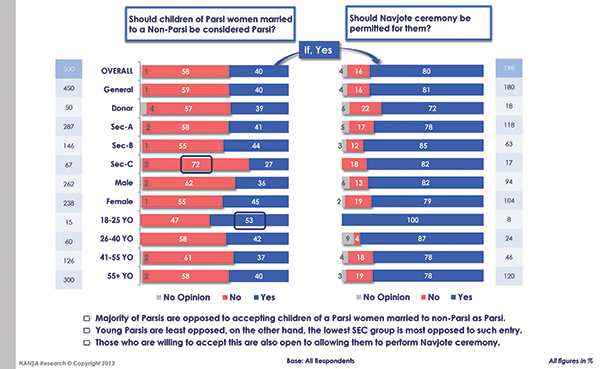
Amongst those who were willing to recognize these children as Parsis, 80% were in favor of permitting the performance of their navjote ceremony. As compared to 81% of the General Register, 72% of the Donor Register members said their navjotes could be performed. A comparison of the different age groups showed that 100% in the 18-25 group, 87% in the 26-40 group, and 78% in both the 41-55 and 55+ groups indicated that these children could be initiated. The maximum number from the middle socioeconomic category (85%) were in favor of performing the navjotes as compared to a low number (78%) from the upper socioeconomic category.
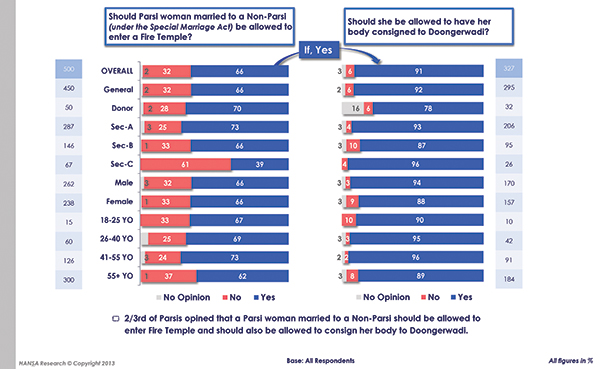
Nearly two-thirds of the respondents felt that a Parsi woman married to a non-Parsi under the Special Marriage Act should be allowed to enter a fire temple. Sixty-six percent of both males and females opined that a woman be permitted entry. Among the different age groups, most in favor of admitting them to the fire temple were those in the 41-55 group (73%) with those aged over 55 showing the lowest acceptance rate (62%). Those in the lower socioeconomic category were least willing to permit entry (39%) whilst those in the upper socioeconomic group showed a higher acceptance level (73%) and the middle socioeconomic group indicated 66% acceptance.
Of those who consented to an outmarried female entering a fire temple, 91% were in favor of permitting her to consign her body at Doongerwadi. As compared to 92% of the General Register respondents, only 78% of the Donor respondents supported this move. Surprisingly, 94% of the males as compared to 88% of the females stated that she should be permitted to consign her body at Doongerwadi. Whilst the lower socioeconomic category (96%) and upper category (93%) showed their willingness to permit her to consign her body, the middle socioeconomic category showed the lowest acceptance (87%). Even higher than those in the 18-25 group (90%) were those in the 41-55 age group (96%) and those in the 26-40 group (95%) who indicated their willingness to accept the body of an outmarried female at Doongerwadi. The lowest acceptance (89%) was from those aged over 55. To be continued
◆ ◆ ◆
From the archive