
Events & Personalities
Strategic philanthropy
"Spread over 16 states and 170 districts across the country, programs supported by the (Tata) Trusts reach over 8,00,000 households through a network of partner organizations. In order to enhance impact and ensure that interventions are sustainable, the Trusts have recently adopted a cluster-based approach, supporting multiple interlinked activities in identified clusters of contiguous villages across selected geographies,” wrote Ratan Tata, chairperson of the Sir Ratan Tata Trust and Navajbai Ratan Tata Trust in the annual Report for 2012-2013.
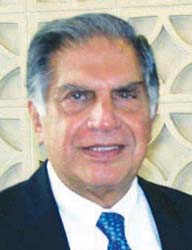
Ratan Tata
"Philanthropy today needs to take into account not only the needs of communities and the changing palette in which these are embedded, but also the rising awareness that strategic philanthropy is now becoming a part of the country’s larger development framework. This means we need to be responsive, effective and accountable,” Tata explains. "The focus is shifting from simple education to skills enhancement and employability, from supplying resources like water to communities reviving their own ecological systems, from merely providing health services to creating health through clean water, nutrition and precautionary systems,” the chairperson elaborates.
The Report deals in detail with institutional grants, the small grant program, individual grants and concludes with the financial highlights. Rural livelihoods and communities, education, health, enhancing civil society and governance and arts, crafts and culture come under the first head. The small grant program is used more to test new ideas and innovations, while individual grants are in consonance with the settlors’ inclination to help persons in need of assistance for medical, educational or other requirements.
From efforts to increase the crop of oranges in Mizoram, tomatoes, bitter gourd and other vegetables in Jharkhand and elsewhere, dairy based initiatives in Rajasthan, mills for husking red gram in Maharashtra, lobster farming in Gujarat to piggeries in Nagaland — these rural initiatives supported by the Tata Trusts have substantially increased incomes in this impoverished sector. Programs for early literacy, education for adolescent girls who would otherwise become domestic drudges, opening of libraries and instilling discipline make education work for the community. In the field of health care, the Tata Trusts work toward reducing the child mortality rate, tackling the specter of HIV-AIDS, helping children with special needs, providing mental health care and providing relief for children with cancer at a short-term residential facility.
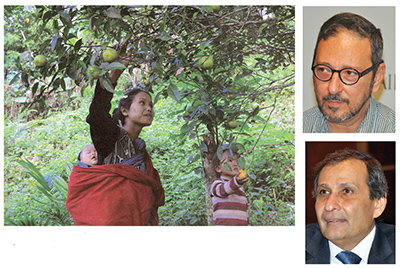
Clockwise from top: a Tata trusts initiative in Mizoram;
Firdaus Gandavia; Burzis Taraporevala
For enhancing civil society and governance, the Trusts encourage youth action for development and focus on strengthening community based organizations. To promote arts, crafts and culture, the major thrust has been to identify potential projects that would create and sustain livelihoods. Conservation and digitization of texts and records has also been undertaken for folk music, dance and theater. Crafts are encouraged and one program focuses on revitalizing handloom weaving in Andhra Pradesh.
Over the years the Trusts have made continuous efforts to hone systems that ensure a comprehensive, systematic, fair and humane approach to identify the needy, the Report conveys.
"We have made several significant changes to the design of the Report to enhance readability, whilst making use of text-boxes across chapters to highlight key facets of our initiatives,” writes Firdaus J. Gandavia, secretary and chief accountant of the Trusts in his covering letter. (Gandavia retired from the Trusts on December 31, 2013. Burzis Taraporevala has been appointed in his place.) The Report is replete with photographs and illustrations. An online PDF version is also available at http://www.srtt.org Indeed, the Report underlines not only how consistently the Trusts have honored the vision of Sir Ratan Tata, expressed in 1913 that the funds could be used "…for the advancement of education, learning and industry in all its branches, including education in economy, sanitary services and art, or for the relief of human suffering, or for other works of public utility…,” but shows how they have improved on it in many innovative ways.
Recently two of the Tata Trusts, the Jamsetji Tata Trust and Navajbai Ratan Tata Trust were the object of negative comment by the government, with the Comptroller and Auditor General (CAG) pulling up the Income Tax Department for allowing these, and some other charitable trusts, irregular tax exemption. The CAG report tabled in Parliament said that the Tata Trusts had "invested Rs 3,139 crore in prohibited modes arising from accumulation of capital gains which involved tax effect of Rs 1,066.95 crore” resulting in a "short levy of tax of Rs 1,066.95 crore.” The Trusts had earned Rs 1,905 crore and Rs 1,234 crore on account of capital gains during assessment years 2008-09 and 2009-10 respectively and "invested the same in prohibited mode of investment which is in contravention to the provisions of section 13 (1) (d) of the Income Tax Act (dealing with investment).” The Trusts deny any impropriety.
◆ ◆ ◆
From the archive