
10WZC
The history of the Hall
The National Gallery of Modern Art is lodged in the Sir Cowasji Jehangir Public Hall
The 1964 and the 1978 World Zoroastrian Congresses were held at the Sir Cowasji Jehangir Public Hall (SCJPH) opposite the Prince of Wales Museum (POWM). This December end the iconic Bombay architectural landmark, now converted into the National Gallery of Modern Art (NGMA), will host an exhibition of Parsi history to coincide with the hosting of the 10th World Zoroastrian Congress.
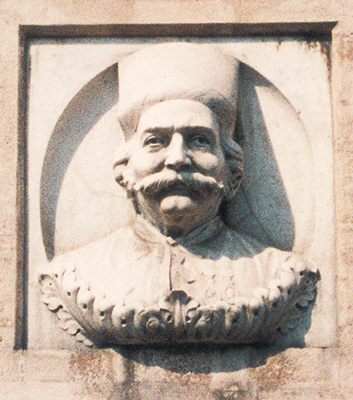
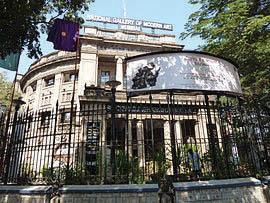
Bust of Sir Cowasji Jehangir and Hall named in his honor
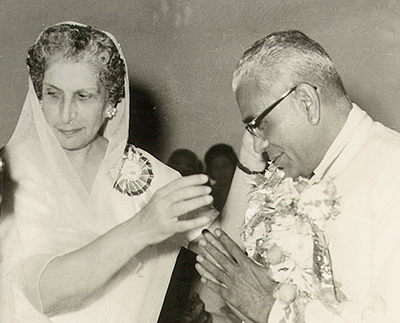
Lady Hirabai Jehangir with chief minister V. P. Naik at 2nd World Zoroastrian Congress
Part of the initial Royal Institute of Science block of buildings, the SCJPH was entirely funded by the first baronet Sir Cowasji Jehangir. The philanthropist gave Rs 8,00,000 of which Rs 3,25,000 was used by the government of the day to construct the Hall, Rs 75,000 was earmarked for a repair fund and the balance used for the Institute. The amount was given in 1908 and two years later the Hall opened. The renaissance revival style building was designed by architect George Wittet who also planned the POWM, according to Preeti Chopra, A Joint Enterprise: Indian Elites in the Making of British Bombay.
The government "gave the accounts as to what they spent to an anna,” the baronet’s great-grandson Adi Jehangir revealed. Sir Jacob Sassoon and Sir Currimbhoy Ibrahim contributed the balance Rs 11,00,000 to construct the complex which was completed in 1920.
Initially the government "wanted to construct a science college when the then Governor of Bombay Lord George Clark Sydenham proposed ‘why not a hall also?’” said Jehangir.
One of the conditions on making the donation was that "no change of user could be undertaken without the family’s consent,” Jehangir related and that the Bombay Parsi Punchayet (BPP) would use the Hall "free of charge” when required. Over the years the Hall fell into a state of disrepair and was used for holding sales, wedding receptions, etc. Thus when a proposal came from the Ministry of Culture, Government of India to convert it into a modern art gallery, then BPP chairman Jamshed Guzder agreed and put forth the proposal to the Jehangir family. The last family member to serve on the committee was artist Jehangir Sabavala who was dropped unceremoniously from the board in 1985 after the family consented to convert the Hall into the NGMA in 1985. "They made him work” to facilitate the change "and then they removed him,” lamented Jehangir whose father Hirji was Sabavala’s first cousin. "The gallery was supposed to open in 1987” but it opened in 1997 instead. The NGMA lease is for 30 years and will expire in 2014. "There is an option to renew it one more time,” says Jehangir. After that whether the Hall reverts to the state or the central government is unclear.
The government "gave the accounts as to what they spent to an anna,” the baronet’s great-grandson Adi Jehangir revealed. Sir Jacob Sassoon and Sir Currimbhoy Ibrahim contributed the balance Rs 11,00,000 to construct the complex which was completed in 1920.
Initially the government "wanted to construct a science college when the then Governor of Bombay Lord George Clark Sydenham proposed ‘why not a hall also?’” said Jehangir.
One of the conditions on making the donation was that "no change of user could be undertaken without the family’s consent,” Jehangir related and that the Bombay Parsi Punchayet (BPP) would use the Hall "free of charge” when required. Over the years the Hall fell into a state of disrepair and was used for holding sales, wedding receptions, etc. Thus when a proposal came from the Ministry of Culture, Government of India to convert it into a modern art gallery, then BPP chairman Jamshed Guzder agreed and put forth the proposal to the Jehangir family. The last family member to serve on the committee was artist Jehangir Sabavala who was dropped unceremoniously from the board in 1985 after the family consented to convert the Hall into the NGMA in 1985. "They made him work” to facilitate the change "and then they removed him,” lamented Jehangir whose father Hirji was Sabavala’s first cousin. "The gallery was supposed to open in 1987” but it opened in 1997 instead. The NGMA lease is for 30 years and will expire in 2014. "There is an option to renew it one more time,” says Jehangir. After that whether the Hall reverts to the state or the central government is unclear.
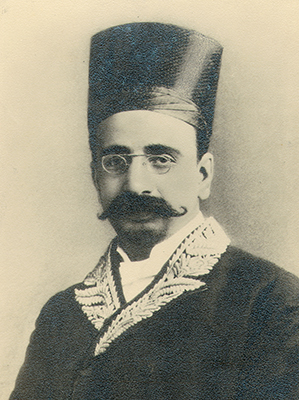
First baronet Sir Cowasji who funded the Hall
"Premium location”
"The only other public hall being Town Hall, the new Hall filled a vacuum in the city’s social life,” the NGMA’s website quotes its director Shivaprasad M. Khened as stating, "At the inauguration of the complex, Lord Sydenham said: ‘Bombay is fortunate in the possession of so many good citizens who, recognizing that great wealth carries obligations, have come forward to assist in meeting the various growing needs of the city.’
"Till the ’50s, C. J. Hall was the city’s premier location for concerts, political meetings and art activities but fell into disuse after the construction of Jehangir Art Gallery and air conditioned auditoriums like Tejpal, Birla and Patkar Hall which had better acoustics and lighting. Neglect led to deterioration and in the ’60s and ’70s it would be hired out for boxing matches, trade union meetings, wedding receptions, and discount sales of leather goods and readymade garments.
"The only other public hall being Town Hall, the new Hall filled a vacuum in the city’s social life,” the NGMA’s website quotes its director Shivaprasad M. Khened as stating, "At the inauguration of the complex, Lord Sydenham said: ‘Bombay is fortunate in the possession of so many good citizens who, recognizing that great wealth carries obligations, have come forward to assist in meeting the various growing needs of the city.’
"Till the ’50s, C. J. Hall was the city’s premier location for concerts, political meetings and art activities but fell into disuse after the construction of Jehangir Art Gallery and air conditioned auditoriums like Tejpal, Birla and Patkar Hall which had better acoustics and lighting. Neglect led to deterioration and in the ’60s and ’70s it would be hired out for boxing matches, trade union meetings, wedding receptions, and discount sales of leather goods and readymade garments.
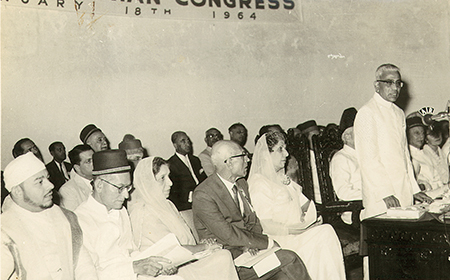
From right: Mme Arbab Guiv, Eruch Nadirshaw, Naik, Nadirshah Mulla (partly hidden), Hirabai Jehangir,
Arbab Rustam Guiv, Meherbai Mulla, Homi Banaji and Dastur Meherji Meherjirana
Three sepia photos: courtesy Adi Jehangir
"The artist community, led by the eminent sculptor, Piloo Pochkhanawala and the doyen of art, Kekoo Gandhy protested against the deterioration from culture to bazaar (which) resulted in the decision to convert the Hall into a museum for contemporary art. Introducing floor space into the cavernous high-domed interior of a hall designed along the lines of London’s famed Royal Albert Hall proved to be an architectural challenge. Not only could the outer shell not be touched according to heritage laws, but the foundation was also found to be weak being on a sandy base. Delhi-based architect Romy Khosla’s design involved constructing a structure within a structure to encase five exhibition galleries, one leading to another via a teak and chromium stairway, a lecture auditorium, a library, cafeteria, office and storage space for a permanent collection as well as traveling shows. The renovation has taken 12 years and cost Rs 3.5 crores but at the end of it all Bombay has an exhibition space which meets international standards for lighting, humidity and temperature control. The new art gallery will cater to a new generation examining paintings and sculptures in awe as they are informed about artists and art,” and the fast dying Parsi community as well.
◆ ◆ ◆
From the archive