
10WZC
Numbers do count
Unless the community has sufficient numbers, it is difficult to maintain its infrastructure
Having come up with a good program that is relevant to the present state of our community in India and abroad the Bombay Parsi Punchayet in its usual dysfunctional way voted to cancel the 10th World Zoroastrian Congress. But now it is on again because saner minds have prevailed.
Undoubtedly, the biggest problem facing our community is demographic, arising from the inter-related problems of our aging population, late marriages, no marriages and interfaith marriages.
With four sessions dealing with the decreasing numbers of the community, the Congress is attempting to address the situation though there should have been a session on interfaith marriages, because that is also a cause of our decreasing numbers. Roshan Rivetna’s demographic survey which is a herculean effort gives us an idea of the number of Zoroastrians in different parts of the world and an idea whether the communities are growing or decreasing. Her numbers are not actual counts but the best estimates of well-established Zoroastrians in each area. These numbers nevertheless are a good starting point for discussion about the future. We hope that the panel on "Demography and the Way Forward” will come up with practical solutions to some of the problems and furthermore the community will come up with a plan of action that will stop or at least decrease the rate of our falling numbers.
Undoubtedly, the biggest problem facing our community is demographic, arising from the inter-related problems of our aging population, late marriages, no marriages and interfaith marriages.
With four sessions dealing with the decreasing numbers of the community, the Congress is attempting to address the situation though there should have been a session on interfaith marriages, because that is also a cause of our decreasing numbers. Roshan Rivetna’s demographic survey which is a herculean effort gives us an idea of the number of Zoroastrians in different parts of the world and an idea whether the communities are growing or decreasing. Her numbers are not actual counts but the best estimates of well-established Zoroastrians in each area. These numbers nevertheless are a good starting point for discussion about the future. We hope that the panel on "Demography and the Way Forward” will come up with practical solutions to some of the problems and furthermore the community will come up with a plan of action that will stop or at least decrease the rate of our falling numbers.
It is very important to take this problem of decreasing numbers seriously. There is a rather untenable statement that has been going around that numbers do not matter and that it is quality that matters. Without numbers we cannot maintain our infrastructure. Without numbers there will not be enough priests or priest schools. Without numbers there will not be enough support for our temples. We have already lost some of our infrastructure. Today there is no school started by Zoroastrians that caters solely to Zoroastrian children, simply because we do not have enough school going children to fill such an institution.
On a recent visit to Iran we visited Yazd, which at one time was the center of Zoroastrians in Iran. Yazd has a number of holy fires in the neighboring villages, some of them of great antiquity. The history of these fires is forgotten and their present existence is only due to the unbelievable dedication of the individuals who take care of the fires. The majority of these individuals are old women; the few men who look after these fires do so while managing other jobs and visit the fire once a day to make sure it keeps burning. When questioned as to what will happen after they are gone, none knew the answer. This is the sad situation that comes about when the community loses its infrastructure. For now the Atash Behram in Yazd appears to be well taken care of, even though there is a question about the performance of the five boi ceremonies each day. In India a similar situation exists in the villages of Gujarat.
This is just one example of what is happening to our community, but there are many other signs of a failing community. The encroachment on our properties in India and Pakistan and our inability to do something about it is another, though the Federation of the Parsi Zoroastrian Anjumans of India tries to help.
The seriousness of the situation is highlighted by the Government of India recognizing that we are a dying community and offering help to increase our numbers. And this is happening in a country where the government is serious about birth control!
The question then is, why is the community not motivated to do something about it? I believe that in India the community has lost the will to survive together, the will to take any effective steps towards this goal. The will to think big, without the constraints of the past is what is necessary to avoid this catastrophe.
Here are some things we should be thinking about:
Religious education of the young should be such that the beauty of the religion and its usefulness and relevance, irrespective of the time one lives in, is brought out resulting in the young wanting to preserve the religion and the community. We need to create a fire in the hearts of the young with respect to our religion.
We need to educate the young to think about the future of the community in terms of numbers. This education should come at a relatively young age. They are the only ones who have the power to procreate enough and they must believe that it is the right thing to do. A birth rate of 0.8% is far from the minimum of 2.1% for the survival of the community. Those of us who are over the age of 50 should collectively admit that we and the generation before us dropped the ball when we had the chance. We were more interested in our personal standard of living and looking for a relatively easy life at the cost to the community’s survival. We over the age of 50 (with a few exceptions) cannot lead by example.
Our example should be the orthodox Jewish community. They have a culture where a large family size is regarded as a blessing and other considerations are secondary to that. In the US I am amazed by Jewish families walking to the synagogue on a cold Saturday with twin baby carriages, on one side is the newborn and the other side is a child less than two years old! At a synagogue near our home on a Saturday, their drive-way is lined not with cars but with baby carriages, single and twin!
We have to address the fact of interfaith marriages. The ideal should always be intra-faith marriages and this must be encouraged and its advantages taught to the young, but we have to accept that interfaith marriages are common. Demographically they can be a problem to the community because of the chance of the children of an interfaith marriage growing up as Zoroastrians is 50%. To think otherwise is to ignore the wishes and influence of the non-Zoroastrian spouse. Those of us taking the step of interfaith marriage should discuss the religion of the children before marriage and realize the consequence of the marriage to the future of the community. The community in turn has to accept that interfaith marriages are happening and take steps to minimize the problems. Interfaith marriages should be accepted, there should be no barriers to the children or the spouse choosing our religion if they want to. Once accepted into the religion there should be no discrimination in terms of entry to our temples, and even to our funds. Trying to live by a formula that was successful 50 to 100 years ago is a mistake and we are paying for it by not accepting that times have changed.
The problems of late marriage and no marriage that are also the cause of our demographic disaster are psychological problems and should be studied as such. The real causes of this behavior are not defined by any study that I know of, even though there may be many guesses. Eminent psychologists from the community or outside the community should do so. The causes could be many: high expectations about a marriage partner; high expectations of the family about a prospective marriage partner; the fear of losing one’s freedom after marriage; being afraid of going through a marriage when the financial outlook is not so great; being afraid of having children. There is a sickness in the community when it comes to marriages, we need to know the cause of this.
In contrast to the situation in India, the community in North America (NA) appears to be handling the situation in a better way. Only some of the increasing numbers may be due to immigration to NA, since this has slowed down considerably. There are fewer unmarried in the generation growing up and having two children per couple appears to be quite desirable. The attitude towards infrastructure seems to be, to build what we can handle and slowly improve what we have. Federation of Zoroastrian Associations of North America is starting to develop an infrastructure plan which includes things such as a consecrated fire temple, a central library, a seminary, a curriculum for religion classes, and dar-e-mehrs wherever possible and warranted.
Attitudes towards interfaith marriage and acceptance of the children and non-Zoroastrian spouses are quite different in NA. In most NA communities, the non-Zoroastrian spouses play important roles in the community and often serve on the boards that run them. The children of interfaith marriages are welcome to the religion classes and everyone is welcome to the dar-e-mehr and the prayer halls therein. The North American Mobed Council has taken many progressive steps befitting the North American community. These are permanent changes from which the North American community will not go back but will have to work very hard and very intelligently to make this new paradigm work. There are no guarantees of success but the intelligence of the new North American generation is the hope of our community.
In India the community still has the best chance of survival, it still has the numbers that other areas do not have, it has the financial resources and it still has the religious infrastructure. Does it have the will to make the change in attitude that is required?
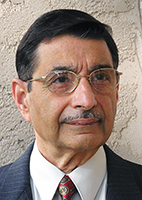
Founder member and one of the past presidents of the Zoroastrian Association of Greater New York, Dr Lovji Cama is currently chair of the Education, Scholarship and Conference Committee of the Federation of Zoroastrian Associations of North America. Besides serving as trustee of the Arbab Rustam Guiv Darbe Mehr in New York, Cama who has earned a doctorate in chemistry from the Columbia University has organized religious education classes for children and summer camps for the youth.
◆ ◆ ◆
From the archive