
Zoroastrians Abroad
Senior sports scribe
"I will always treasure this award as one of the high points of my life. I am really overwhelmed and I am deeply grateful to the Indian Journalists Association (IJA) for this recognition,” remarked veteran sportswriter and commentator Dicky Rutnagur who was honored with the Lifetime Achievement Award by the London based IJA for his outstanding contribution to sports journalism. Whilst the IJA presented him a Waterford crystal bowl, former Indian test player Dilip Doshi gifted him a Mont Blanc fountain pen as a symbolic gesture to indicate that on occasions "the pen is mightier than the bat,” reported The Telegraph of Calcutta in its issue of September 18, 2010.
The sports scribe laid down his pen metaphorically speaking after a career spanning nearly six decades during which he covered 300 tests, writing incisive articles on cricket for leading national dailies like the Hindustan Times, The Mail, The Hindu and its sister publication Sport & Pastime. As a freelancer based in the UK Rutnagur covered cricket, squash and badminton for The Daily Telegraph from 1966 to 2005. Author of Khans Unlimited: A History of Squash in Pakistan, Rutnagur had earlier co-edited The Indian Cricket-Field Annual and was a regular contributor to Wisden Cricketer’s Almanac.
The 79-year-old veteran who was helped to the stage by his son Richard, an Oxford cricketing Blue, was presented the trophy in London in September 2010 by Srichand and Gopichand Hinduja, chairman and president respectively of the Hinduja Group. Also present at the felicitation was the Indian High Commissioner Nalin Surie, Britain’s secretary of state for business, innovation and skills Dr Vince Cable and the only Indian origin minister in the British government, Shailesh Vara.
Reporting on the event organized by the 63-year-old IJA, The Times of India’s UK correspondent Ashis Ray wrote, "Its 55 odd members today — embracing local scribes of Indian origin in addition to representatives of India-based media — have just reminded everyone who is anyone on London’s Anglo-Indian scene that it remains as vibrant a body as any of its contemporaries.” He went on to describe the event as "either black tie or band gala; and ladies in party finery. Ceremony blended with champagne. The national anthems of the two countries interspersed a reception and sit-down dinner in a chandeliered ballroom of one of the most coveted venues west of Suez — the stately Grosvenor House hotel. The top table was an array of current and rising British political stars. The round tables stretching in front seated 450, reflecting the cream of the UK and India’s corporate world…”
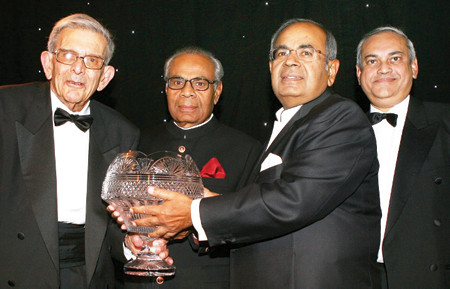
From left: Dicky Rutnagur, Srichand and Gopichand Hinduja, and Ashis Ray
The doughty commentator was "on best behavior” when he was given the award. "He used neither ‘bloody’ nor ‘bastard’ two of his favorite words,” reported The Telegraph adding, "There is probably no one with his encyclopedic knowledge of Indian cricket or his ability to file accurate match reports on time.” In his candid style the correspondent had in an earlier interview with The Telegraph conveyed, "What the game has lost is its dignity to some extent with the colored clothing and all the trappings of one-day cricket. Commercialization has come in and it has damaged the image of cricket in eyes as old as mine. But it had to come for the survival of the game.” It was during his college days at St Xavier’s that he became a protégé of Russi Modi, the former Test player. In England since 1966, his original agreement required him to work every day during the summer covering county matches for The Daily Telegraph and to go abroad in winter to cover Test matches.
Amongst Vijay Merchant, Sunil Gavaskar and Sachin Tendulkar, Rutnagur’s favorite was undoubtedly Merchant, making the commentator declare, "If I had to pick an Indian batsman to play for my life I would pick Vijay Merchant.” He was very fond of Nari Contractor too as also Mansur Ali Khan Pataudi making him declare, "If he had not lost his eye (caused by a car accident during his Oxford days) he would have been one of the two greatest batsmen of his time, the other being Sobers.”
With Rutnagur’s eyesight failing him in the last few years he has been able to find time to pursue other pastimes, listening to jazz and his favorite composers Mozart, Rachmaninov, Tchaikovsky and Beethoven. Insisting on identifying himself as a Zoroastrian rather than a Parsi who does not permit members of other faiths into his fire temples in India, the commentator believes, "Anybody who excludes anyone from a place of worship has to be bigoted…”
◆ ◆ ◆
From the archive