
Heritage
Motor models and memorabilia
Besides building up his collection of cars, Karl Bhote also preserves photos and other mementos connected with automobiles of yore
These cars are indeed national heritage and must be treated accordingly,” declares Poona based Karl Bhote whose aim is "to preserve a part of history by acquiring one of each model sold in India... The emphasis now is only to collect Indian built brands like Fiat, Ambassador, Hindustan Landmaster, Jawa, Lambretta, Vespa, etc which are fast disappearing.” His collection though includes Standards and a VWBeetle, besides some bikes like a Triumph Tiger and scooters.
For the 28-year-old collector who is a petroleum engineer by qualification and has been working with Skoda Auto as a product planner for four years, his hobby extends to determining the history behind his vehicles and even of its past owners. "I always try to get a car with documented history,” mentions Bhote who values files with maintenance records, previous paperwork related to insurance, bill of sale, etc, citing the instance of the first insurance policy of his 1962 Vespa scooter amounting to "a princely 22 rupees.”
For the 28-year-old collector who is a petroleum engineer by qualification and has been working with Skoda Auto as a product planner for four years, his hobby extends to determining the history behind his vehicles and even of its past owners. "I always try to get a car with documented history,” mentions Bhote who values files with maintenance records, previous paperwork related to insurance, bill of sale, etc, citing the instance of the first insurance policy of his 1962 Vespa scooter amounting to "a princely 22 rupees.”
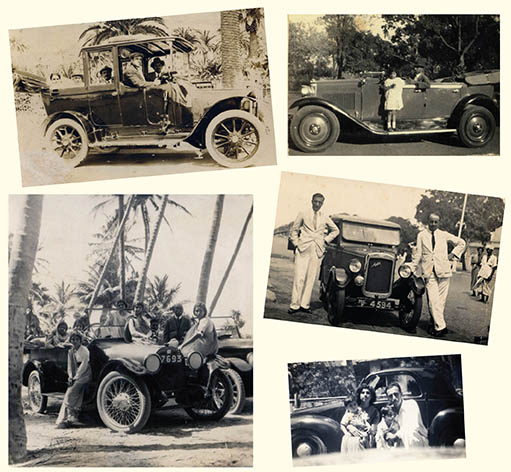
Above: Photographs in Karl Bhote’s collection offer "a wonderful insight into these simple times"
When perusing the ownership records he realized that he was "lucky to get my hands on a 1955 Fiat that belonged to the legendary photographer Homai Vyarawalla. She drove it from 1955 for over 50 years to replace it with a Nano.” He has learnt too that "all our cars and bikes were sold new in India except the 1956 VW Beetle which was imported from Africa in 1967 and then went through many subsequent owners before we bought it in 2001.” The first owner of their Triumph bike was the commissioner of police in Bombay; their 1955 Hindustan Landmaster was delivered new to the chief secretary of the erstwhile Bombay State with a VIP registration number BML 9999.
"Of particular interest to me is registration numbers,” states Bhote, observing, "India has had various series of registration numbers over the last 100 odd years, changing with cities, regimes and so on. Royal families would have personalized plates like ‘Rajkot 26’ or ‘Kutch 20.’ The plate often helps identify the age of the car… Asking people the registration numbers of the cars they once owned gives clues to filling up the missing history on some cars. Amongst the earliest known series in Bombay was ‘BOM 1234’ or ‘BOM Z 6789.’ At some time in the 1920s these cars were re-registered as ‘X 1234’ or ‘T 6789’ etc.”
Car registration plates have also helped Bhote ascertain the age and location of the nearly 50 old photographs that are included in his automobile memorabilia collection. The photographs "give a wonderful insight into those simpler times,” says the youngster who is interested in Parsi history and culture but is not presently involved in any community activity. The backdrop of many photos indicate areas in the city that can be recognized. Whilst some reveal certain identifiable architectural structures, traffic, road signage, billboards and advertisements, yet others reflect on the sartorial style. Ladies and even teenaged girls demurely draped in saris worn Gujarati style, young boys wearing shirts with floral prints, men impressively attired in suits stare out from many of these photos. Equally fascinating are the vintage cars in different shapes and sizes in the background, bearing an assortment of headlights and tyres with spokes that would appear more suited for bicycles and bullock carts than automobiles. The ubiquitous footboard extending from the cars appears to be the favorite platform for many family members posing for the camera.
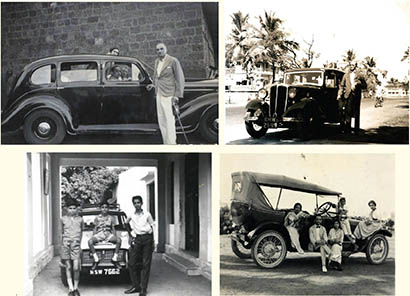
From BMW to MSW, car registration numbers help
determine the date of the photos
The photos in Bhote’s collection have been gleaned from family members and extended family albums as also from friends. He believes in placing them in dry storage in albums where they would not stick. "I always make a digital copy of each image in case they are damaged later,” he reveals. One of his friends, Harit Trivedi, "has hundreds, maybe thousands of car pictures, many of them showing Parsi families.”
Whilst storing photos is not difficult, finding abodes for the automobiles (from 1910s to 1960s) in his collection "is not so simple because sheltered parking is of prime importance to preserving the cars.” Besides his own residence, he has to depend on the goodwill of relatives, friends and of course kind neighbors.
Yet another major hurdle is restoration of these prized possessions due to paucity of funds and labor. Bhote mentions that he decided "to collect as many as I could while they were still affordable (prices have now shot up) and restore later. The cars came from the family, or were purchased over the last 10 years, one by one, usually directly from the first owners… There are very few people who will deliver quality work on an older car as it consumes much more time and effort. Spares are also a problem. We often have to import or improvise.”
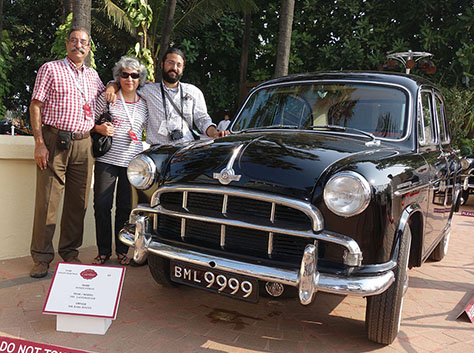
From left: Bomi, Rita and Karl Bhote with their 1955 Hindustan Landmaster at the
Third Cartier ‘Travel with Style’ Concours d’Elegance
Photo: Xerxes Adrianwalla
Financing the collection "is a burden,” admits Bhote, "though I have had tremendous support from my family without which it would not be possible. On only one occasion did I sell a car to finance other acquisitions.” His family includes father Bomi from whom "I have probably inherited the craze” and mother Rita, a homemaker. Attached as he is to his automobiles, Karl asserts, "The cars will not be sold as far as possible.”
◆ ◆ ◆
From the archive