
A tale of two cities
Both Singapore and Hong Kong have plenty to offer business people by way of opportunity
"Singapore has emerged as the second largest source of foreign direct investment (FDI) in India and the largest investor among the 10 [Burma (Myanmar), Cambodia, Brunei, Indonesia, Laos, Malaysia, Philippines, Singapore, Thailand and Vietnam] ASEAN (Association of Southeast Asian Nations) countries, noted the global WZCC president Minoo Shroff addressing the gathering at Singapore’s posh Hotel Marina Mandarin. "It is an ideal place to live and work in because of its excellent infrastructure and the sense of welcome and friendship which it extends to one and all…Today it is a flourishing metropolis with a standard of living which equals that of the highly developed economies with a per capita income of US$ 43,000... It ranks among the top three countries in the world in respect of ease of doing business, infrastructure, legal system and the quality of financial services. It is a free trade model with a very congenial business environment and a strategic location to reach out to the fastest growing region (ASEAN) in the world.
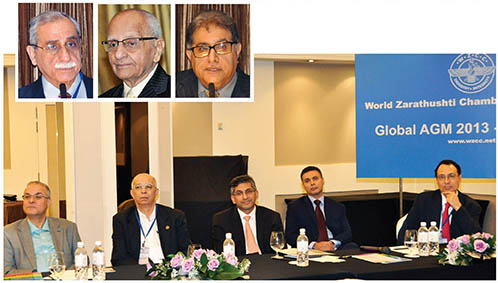
"It was hence our obvious choice to hold this meeting here, having held the previous ones in India and the USA. Singapore and Hong Kong have very small but vibrant Zoroastrian communities. They have thrived both in business and the professions.”
WZCC global vice president Rustom Engineer while noting "this is the first time we are holding the AGM in Southeast Asia,” added that it is no surprise that Singapore was selected. The city state "is counted among the least corrupt countries in the world and ranked number one in Asia…Zarathushtis have traded with Southeast Asian countries for centuries and we are no strangers to this part of the world.
"I am very excited about a new dimension we have added to this AGM. It is about having an economic forum as part of this meeting. The idea of exploring synergy between successful, influential and resourceful Zarathushti business leaders and to seek their support to energize Zarathushti entrepreneurial spirit was envisioned by Rohinton (Rivetna). Thanks to the support from president Shroff, starting this year we plan to make the Global Zarathushti Economic Forum an ongoing part of the AGM program.”
President of the Zoroastrian Charity Funds of Hong Kong, Canton and Macao Neville Shroff moderated the discussion between the proponents of the two business city centers. He runs a trading and manufacturing business in HK, Shroff and Company and holds various positions in the HK General Chamber of Commerce, "the largest and most influential” in HK, with a membership of over 4,000 corporate members.
From his travels to Vietnam, Laos, Cambodia and recently Burma meeting with various business and government officials, Neville shared his observations on the economic development of the four countries.
"Vietnam already is a highly developing country, in terms of infrastructure, logistics, education, with a skilled and large labor force, ranging from IT (information technology) to manufacturing consumer products. (It’s) probably 15 to 20 years behind China today.
"Cambodia… is probably 10 years behind Vietnam with a large semiskilled workforce but predominantly specialized in garment production and some toys.
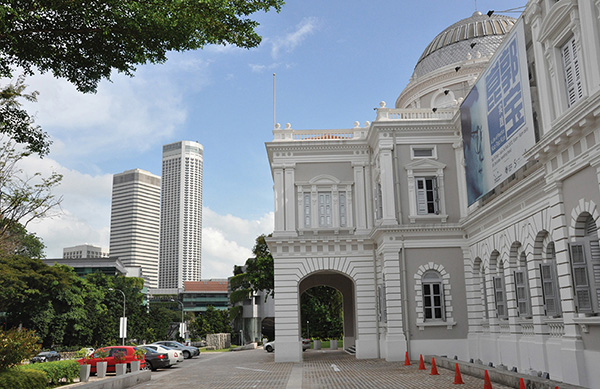
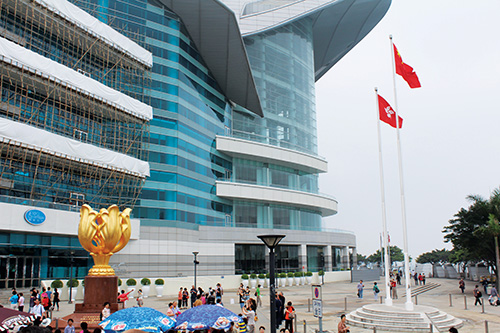
"Laos has a very pro-business government… It is already being strongly looked at by Singapore, HK and Thai companies. It has a poor infrastructure and is a landlocked country… (but) they have the lowest labor cost in the region.”
With the lifting of sanctions (Myanmar) will be one of the most promising of the new emerging markets because it has a highly educated skilled and abundant workforce. It provides immense opportunities for investors but is not without its challenges. One of the main sectors posing difficulties is in the financial area. "Banks are still not allowed to trade freely with the outside world. So can anyone tell me how can we do business with Myanmar?” queried Neville.
"This is where Singapore plays a significant part in Myanmar’s development. The only way to do business in Myanmar at present is through Singapore banks. Singapore has left every country including HK behind, when trading with Myanmar…
"When we talk of business in Southeast Asia, we cannot talk without mentioning China. When we talk of Singapore it is difficult to talk without mentioning its biggest competitor in the region; and that is of course HK. When I talk of HK’s great success story, I inevitably base it on simplicity, i.e. a non-interfering and business friendly government, with a simple tax and legal system.
"Singapore and HK have been competing for years to achieve dominance as Asia’s best place to invest in and to do business. In surveys conducted, HK is known as the freest economy in the world for the past decade, but Singapore has been voted as the easiest place to do business in the world.
"HK is considered to be one of the most corruption free economies in Asia. In fact, I chaired a meeting just a month ago (for) the ministry of interior of Indonesia who came to HK to learn from us, as they considered HK as being the most progressive country on (countering) corruption, being even ahead of Singapore.
"Singapore has positioned itself as the most competitive country in Asia. Singapore has a young, talented multicultural population, and an infrastructure second to none. Singapore is within four hours’ flight to half the world’s population, but HK is considered Asia’s world city and the gateway to the enormous China market.
"(HK) has an aging population, and a high cost of living — pollution and schooling are also major issues that need addressing, leading to FDIs (foreign direct investment) thinking twice when considering HK. This has definitely affected HK’s reputation as a business hub, and a place to invest in.
"Singapore, on the other hand, has addressed most of these concerns, and is becoming the preferred inter-national business center of the region.
"In conclusion, HK is preferable when doing business in China and North Asia. But Singapore is definitely the preferred choice when doing business in Southeast Asia and the ASEAN countries.”
Risk factors
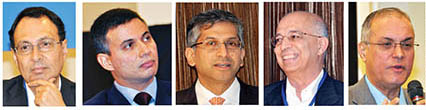
Kai Taraporevala, leading venture capitalist, founder and managing director, Tethys Ventures while extolling the virtues of Singapore spoke about the risks and opportunities in doing business in the ASEAN countries which have a combined population of over 600 million.
The advantages were a productive and young workforce, and improving infrastructure. The manufacturing, services, agriculture/commodities markets were all developed. "Not many regions have all three,” observed Taraporevala.
On the downside there were five major "risks.” These pertain to knowledge of the markets, culture, what to manufacture, in which country and where to sell. For example Indonesia being a predominantly Muslim country, one wouldn’t attempt to sell alcohol there. One has to be aware of the various customs. He cited the example of an Indonesian company which hired many Indian managers who were not sensitive to the local environment. As a result the company had to face a violent strike by the workers. Indonesia requires companies to hire Indonesians as human resource managers.
Taraporevala noted Singapore had simple rules, people spoke English, the schools were good but it was not always easy for people from elsewhere to enter.
He advised against taking partners. "Do it yourself 100 percent.” In case one requires partners for purposes of finance, contacts, etc, one should do so with caution.”
Except for Singapore there was a "lot of corruption” in Asian countries, he noted. He advised: "Just don’t do it (corruption).” There were long-term benefits in being straightforward and honest but one needed tremendous patience and financial staying power. Once one started down "the slippery slope” of degradation there, one would be known among the bureaucracy as "just another company” which could be constantly badgered for money.
He advised businesses to avoid politics and not side with any political party. "Stay below the parapet… be neutral... The political situation can change” at any moment.
Doing it right
Rajeev DeMello, an investment banker and head of Asian Fixed Income, Schroders Investment Management informed the gathering about "what’s going on in the region” in the currency markets. What had they done right? The region has observed "caution” after the 1997-98 global financial crises. There is "less spending… fiscal balance… small debt compared to GDP (gross domestic product) and a banking system that has worked very well… high savings rate resulting in a lot of self-financing.”
Foreign exchange has significantly increased in the area. Reserves have accumulated. The Central Banks have been successful in controlling inflation between one to three percent. Stronger institutions are emerging. ASEAN bonds are doing well. The investment ratings of Indonesia and the Philippines are going up, revealed DeMello.
The low interest rate in the area has been beneficial to growth. While Europe is lagging in growth, "Asia has an advantage over the US, Europe and Japan.”
On the negative side has been a slowing down of the economies of India and China. China however has an advantage of low deficit, he pointed out.
Hoshi Deboo, president, Asia Pacific and Japan, Esko Singapore observed, Singapore is "rated number one in the world by the World Bank for ease of doing business and is ranked the third wealthiest nation in the world by Forbes magazine.
"Corporate tax rates are about 8.5 percent up to S$ 3,00,000 profits and a flat 17 percent above that. There are no dividend or capital gains taxes in Singapore. There is no estate/death/inheritance tax… Personal income tax has a tier system that starts from just zero percent and goes up to 20 percent for income above S$ 3,20,000. In 1998 Deboo left Singapore for the USA but returned in 2009. "Yellow fever” made him come back, he joked. To his surprise he received a refund on taxes he had paid. He had "overestimated what was due. I didn’t ask them for a refund. I didn’t know it was due.” The Singapore tax department sent the cheque regardless.
"In stark contrast to many western nations, it only takes about one to two days to incorporate a company in Singapore, with the government providing assistance along the way. Simply stated, Singapore is the easiest place in the world to set up and manage a business.”
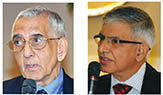
Rustom Ghadiali (left) and Sam Bulsara: costing and market size
Singapore has "a relaxed immigration policy,” making it easier for foreign professionals to gain permanent residence. The state boasts the ‘Best Labour Force in the World’ in the latest rankings.
It has "excellent public and private transportation, top quality healthcare, a safe and healthy living environment, easy access to many other nations, excellent schools, an outstanding support system for businesses, entrepreneurs and corporations and an endless selection of cultural and educational opportunities.”
Deboo prefaced his talk stating he decided to side with Singapore in the discussion "to p#*s off Neville.”
"Can we help you?”
Describing himself as a "great votary of Singapore,” Dorab Mistry, director, Godrej International Limited and Godrej International Trading and Investment Limited, a United Kingdom resident, spoke about the Godrej group’s involvement in the area. He noted that the Godrej office in Singapore was close to the Parsi Road and Mistry Road. But that was not the reason for the location, jested Mistry, a former president of the Zoroastrian Trust Funds of Europe. "Parsis and Zoroastrians are very much accepted in Singapore which may not always be the case in HK (laughter).”
Former Godrej group chairman the late Sohrab Godrej was a friend of Malaysia’s first prime minister Tunku Abdul Razak so Godrej began their investment during his tenure in that country. They have manufacturing units in Malaysia and Singapore but due to the high cost in Singapore they have been moving their low paying manufacturing (metal fabrication, etc) elsewhere, he observed. In the 1990s Godrej invested in Vietnam but as a Singapore company. Today they have back offices in the Philippines and Malaysia.
"If you want to do business in Indonesia, Malaysia, Cambodia or Laos the place to be in is Singapore. For doing business in China, HK rules the roost.”
Noting that he had worked in Godrej all his professional life, Mistry stated he was a chartered accountant by profession but specialized in commodities. "I have been a commodities trader all my life… Singapore is a gateway to the commodities. If you want to trade in metal and such things HK is the place.”
He said in Singapore there was honesty and transparency. A foreign investment bureau set up by the government was constantly asking Godrej, "`Can we help you?’ We replied ‘We don’t need any assistance because doing business in Singapore is so easy.’”
The expatriates in Singapore "especially the white collar ones,” comprise 33 percent of the work force. Locals believe that this "is suffocating opportunity for them,” noted Mistry.
Noting that people from Tamil Nadu constituted a large percentage of Singpore’s population, Mistry said that Chinese Singaporeans had a "mutual respect for Indians” which was not found in HK.
Singapore taxation policy favored business. "They don’t believe in taxing people at more than one place.” In 2012, 1,000 Indian entities (big and small) set up shop in Singapore every month.
During the question answer session Mistry clarified that Singapore was "phasing out low paying manufacture.” Pharmaceutical, biotechnology and high value manufacturing items were encouraged as well as high paying jobs.
In reply to a question whether a lack of democracy in the region affected investments inflows, Taraporevala and DeMello replied that the rule of law was more important than democracy. They noted that China was not democratic but attracted considerable investment. Countries that were highly undemocratic may lose out on capital inflows as the danger of political problems could arise subsequently. But even in democracies, political uncertainty existed. What is important is financial transparency, they stressed.
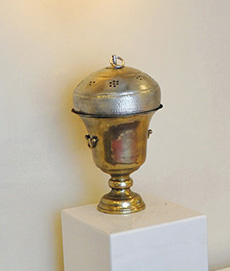
Afarganiu in Singapore Zoroastrian Center
Rustom Ghadiali, a Singapore resident of 37 years with vast business in the region and former president of the Parsi Zoroastrian Association of Singapore, advised would-be investors to "do your costing carefully. He noted that in Singapore certain zones permitted a 10-year tax-free period. He cited example of a Japanese company that took advantage of the tax break in Singapore then moved the same plant to Malaysia and then Indonesia and so on, taking advantage of the 10-year tax holidays in each country.
"Corruption is part of life in Southeast Asia,” Ghadiali observed. Corruption was also subjective. What was considered corruption in one country may not be so in another. He cited the example of China where you may invite a business associate or bureaucrat for lunch or dinner which was acceptable business practice but he may end up bringing 10 uninvited guests! "That’s corruption,” he observed.
Regarding a question on biofuels Mistry noted "the boom in biofuels is over.” Subsidies once provided by governments were no longer available.
Advertising expert Sam Bulsara from Bombay noted that while the speakers made a pitch for Singapore what counted for business people was the market size and potential. He urged the gathering not to be "carried away by the superficial bells and whistles.” Cleanliness and low taxes are an attraction but "businesses go where the markets are. If in 2007 the smart guys went to Singapore, then in 2017 they will go to India.”
Neville interjected "that’s why you should be in Hong Kong,” because of its proximity to China, one of the largest markets in the world.