
Politics and Policy
An assault on assets
The new property tax will have to be borne by the occupants, it was conveyed at the Samast Anjuman Meeting
Many of those residing in flats in Bombay will have to pay double the property tax with three years’ arrears to boot. Even religious institutions have not been spared. Property tax is now levied on the capital value of the premises with retrospective effect from April 1, 2010, announced Bombay Parsi Punchayet (BPP) chairman Dinshaw Mehta addressing a specially convened Samast Anjuman Meeting attended by all seven trustees on May 25, 2013 at the Rustom Baug Pavilion.
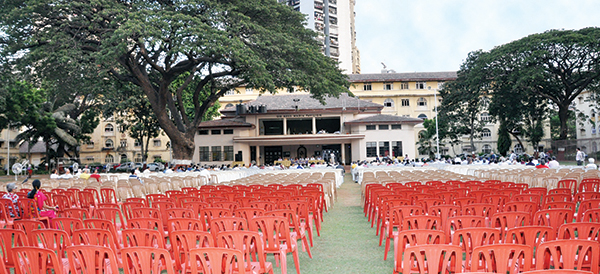
Meet in progress at Rustom Baug Pavilion grounds
Although chairs had been laid out to seat 2,500 community members barely 25 percent were occupied when an audience poll was conducted on whether the BPP should go to court on behalf of its tenants/licencees/occupants to seek a stay order. With almost all hands raised to support this stand, the next question posed was whether the occupants of the flats would be willing to bear 50 percent of the legal costs that could work out to Rs 500-1,000 per flat. Once again there was an overwhelming show of hands causing the evening’s master of ceremonies Jim Vimadalal to comment, "That’s great… a big hand for all of us.”
"The BMC (Bombay Municipal Corporation) with the State Government has imposed this tax,” stated Mehta explaining how the property tax is now being calculated on the basis of capital value system (the sale price of the flat) and not rateable value (the rate at which the premises can be rented). The basic premise of this argument is flawed, alleged Mehta, because the flats in the control of the BPP are not owned by the occupants. The BMC claims for Rs 99 lakhs as property tax including arrears for the last three years for the 5,500 or so flats owned by the BPP is to be recovered fully from the occupants.
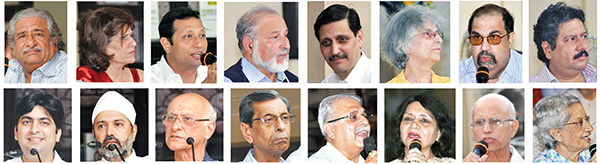
From left (top row): Dinshaw Mehta, Arnavaz Mistry, Jimmy Mistry, Khojeste Mistree, Yazdi Desai,
Armaity Tirandaz, Muncherji Cama and Mehli Colah; (2nd row) Jim Vimadalal, Ervad Rohinton Pavri,
Fali Poncha, Adi Engineer, Rohinton Mehta, Faranak Contractor, Gayomard Kathawalla and Kumi Daroowala
The new system of taxation will be implemented in such a way that "in the first five years the tax will be double the current tax. Thereafter it will be again doubled. When will the full impact be felt, we don’t know. When will it be implemented in toto? Ultimately it could be between 20-50 times the current value. If it becomes 30 times the current rate, it will be unbearable,” elaborated Mehta in his 15-minute introduction after which members of the audience were free to seek clarifications.
The private builders, owners, developers are "very happy” claimed Mehta because if the occupants are not able to pay up the revised tax they can be eventually evicted for non payment of rent. In a "very calculative move,” the Municipality has kept out of the purview of this new system of taxation the slums and chawls where the built-up area of each tenement does not admeasure more than 500 sq ft.
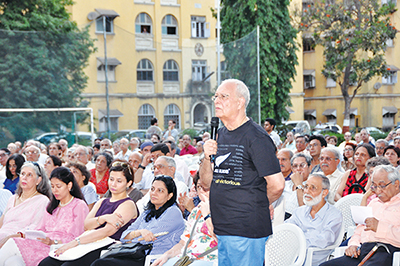
Rustom Jasoomoney raises a question
Determined to go up to the Supreme Court, if necessary, the BPP is trying to work out all forms of strategies in conjunction with other community trusts like the Garib Zarthostiona Rehethan Fund to see "if they can minimize the tax burden if not eliminate it,” said Mehta. "Their method of calculation is not transparent as per the gazette and has to be challenged,” stressed BPP trustee Jimmy Mistry. In some cases landlords/tenants are even due refunds!
Among the residential properties where tax will increase substantially, Mehta cited the instance of Rustom Baug, Bldg No 1, which until now was taxed at Rs 8,500 per annum, but with the capital value derived at Rs 3.69 crores, the property tax will rise almost 15 times to Rs 1,28,000 per annum. For the entire Rustom Baug where the prevalent tax was five lakhs, the tax has been hiked to Rs 37 lakhs. For the Rustom Baug Pavilion itself where the tax used to be Rs 16,000, the new tax demanded is Rs 3,70,000 per annum, its value now standing at Rs 2.84 crores.
Some flats in Nowroz Baug measuring less than 500 sq ft will not be affected. Cusrow Baug though will be the worst affected for on flats exceeding 1,000 sq ft, the new tax demanded is in the region of Rs 2,00,000. "No one seems to realize the long-term implications,” regretted the chairman.

Residents of Dadar Parsee Colony, Panthaky Baug, A. H. Wadia Baug, Khareghat Colony, Rustom Baug,
Nowroz Baug, Jer Baug, Cusrow Baug seek clarifications
Mehta further referred to the newly conceived Atashbehrams, Agiaries and Religious Institutions Welfare Society (AARIWS, see "To pay or not to pay,” pg 26) whose members have banded together, regularly meeting over the last month to consider the options before them. Unlike the BPP which can pass on the tax burden to the occupants of the flats, agiaries and atash behrams will have to bear the additional liability themselves and "have no source of income from which they can recover.” He cited the instance of the H. B. Wadia Atash Behram where compared to the earlier annual tax of Rs 14,900, the revised tax demand is Rs 64 lakhs. The capital value of the fire temple has been computed as Rs 22 crores. Under the guidance of senior counsel Aspi Chinoy, and BPP solicitors Burjor Antia and Homiar Vakil of Mulla and Mulla, AARIWS will apply to the Court for a stay.
For residential properties, the BPP was considering paying up the current demand of Rs 99 lakhs by June 30 lest a default in payment attract a penalty of two percent per month which Mehta referred to as "Lala interest.” Fali Poncha of Ness Baug wondered whether paying up the first demand could go against them in court on the grounds that "if the system is accepted for five years, it can’t be challenged. The courts give scant respect” to payments made "under protest,” he claimed. He appealed to those in the audience to convince and persuade their neighbors to contribute to the Litigation Fund. Even if 60 percent (of the occupants of the 5,500 flats) were to contribute a sum of Rs 1,000, the BPP could collect Rs 35 lakhs which would be matched by an equal amount from the BPP funds. On behalf of Ness Baug’s 74 flats, he guaranteed payment from 60. "We are sleeping. We will have hell to pay. We will leave a rotten legacy for our children and grandchildren,” feared Poncha.
When questions, rather than suggestions, were invited from the floor, most preferred to speak directly into the mike instead of following the protocol of sending in the question on a sheet of paper with one’s name and colony identification specified. Questions were to be restricted strictly to the new tax levy. Also disregarded were Vimadalal’s repeated requests to the dispersed gathering to move closer to the front: "Pankhaa chhori déo (forget the convenience of pedestal fans); matters are more important.”
When Dinyar Sethna from one of the Punchayet colonies enquired why there had been no communication from the BPP on this important matter he was referred to the chairman’s statement in recent issues of The BPP Review and the announcement of the Samast Anjuman Meeting in the Jam-e-Jamshed Weekly. Why had there not been any demands for the new taxes from the BPP? Responded Mehta, "We feel the tax is not legal/not lawful. We don’t want your funds to go into the coffers” of a government known for corruption. "If we don’t get a stay we will send you a communication.” The BPP was also hopeful that Parsi lawyers like Chinoy, Antia and Vakil would do the work gratis just as they are doing for AARIWS. "We would rather err on the side of caution” than be accused of fabricating stories to solicit funds.
Sheriar Khambatta from Wadia Baug enquired whether the BPP will work in conjunction with other communities like Jains and Christians who also have temples on large properties. Mehta reported that they were in touch with the Christian Missionaries and others who wanted the BPP to take the lead, saying they were willing to join in the fight. On behalf of the occupants of Kapadia Building at A. H. Wadia Baug, audience member Govekar assured the BPP one additional rent.
Rustom Jasoomoney of Rustom Baug asked whether the new property tax was only applicable to Bombay and which political party was responsible for introducing it. According to Mehta it was not only the Shiv Sena-BJP (Bharatiya Janata Party) combine that heads the BMC but also the Congress and NCP (National Congress Party) led state government which has passed this amendment that is applicable only to Bombay. As explained by BPP trustee Muncherji Cama, the municipality, being a state subject, governs the affairs within the city limits whilst the rest of the state is controlled by the Nagar Palika or Zilla Parishad. There is no knowing whether the rest of Maharashtra will also choose to levy property tax on the basis of capital value system instead of rateable value. Cama further referred to the landmark judgment in the 1992 case of Rati Kapadia (who had property on the Bandra seaface) where it was held that tax liabilities cannot be computed on the basis of the market value of the land. Although this law continues to be repeatedly cited in different property cases, the "rapacious government with its scant respect for the law” persists in disregarding the judgment which means that individuals have to approach the courts to get a verdict in their favor whilst the government is not even penalized for its conduct.
Rohinton Anklesaria of Rustom Baug wondered if there would be "a greater burden on the tenants” if the BMC gets the stay vacated and decides to charge interest on the tax levied. "We cannot have the luxury of not paying,” he felt.
"It is surprising as to why there has been no agitation about this new system that has come into effect with retrospective effect from April 1, 2010,” said Mehta comparing the tepid response to the tax with the citywide agitation launched by wholesalers and retailers against the Local Body Tax (LBT) that is to replace octroi effective October 1 this year. The opposition compelled the chief minister "to reconsider” the modalities of LBT, noted Mehta. "We should channelize our energies for demonstrations,” recommended Gayomard Kathawalla of Nowroz Baug.
"People will wake up only if they are told they have to pay.” "Send letters regarding hiked taxes very soon to awaken community members.” "Perhaps people are not aware of the implications.” Repeatedly members of the audience urged the BPP to issue a communique. Although the demand for each flat is known by the BPP, they will need to engage temporary staff to calculate the financial implications that will additionally have to be borne by flat occupants. It is not practical to complete this task by mid-June, remarked Mehta. The BPP is the largest non-government landlord in the city.
Leave and licence occupants as also those staying in tenements of less than 800 sq ft will not fall within the ambit of the herculean tax structure, believed Dr Viraf Kapadia of Godrej Baug. But whilst studying the documents proffered by Kapadia, Mehta insisted that leave and licence holders would also have to bear the burden as all those residing in flats with a built-up area of more than 500 sq ft. (The document that Kapadia had in his possession was the Brihanmumbai Mahanagarpalika’s "Rules for fixation of capital value of lands and building.” This is different from the section dealing with the tax computations.)
A question on behalf of Freny Dubash was voiced: "Does the BMC have the right to levy a retrospective tax from 2010?” Vice chairman of the Poona Parsee Panchayat Adi Engineer observed, "We should be aware of the ground reality. The government is going bankrupt… There are not many communities that are left with large accommodation.” In a "very crafty” move, the Municipality has left the rich and the poor out of the net so "it is only the middle class that is sandwiched and has its neck pinched.” He was of the view that two separate petitions should be made on behalf of the temples and residential properties as the court may leave one or the other issue out of its ambit in light of courts being accused of judicial overreach in recent times.
If one trust obtains a stay order would it be applicable to all in Bombay? This query from a Jer Baug resident earned a clarification from Cama who stated that if a stay is obtained on recovery, it would be applicable only to the particular trust, and if a stay is brought on implementation of the new tax structure, it would cover all bodies.
The Bombay Property Owners Association constituting private landlords is independently going ahead with a writ to challenge the BMC demand, stated Cama. In response to a query from Yasmin Vasania of the Dadar Parsee Colony, it was suggested that those occupying ownership flats in buildings exclusively for Parsis should join this group that will be taking action in mid-June under the guidance of the legal firm, Mulla and Mulla.
If the proposed tax structure is allowed to go through, by 2020 the money flowing out of the community could be Rs 12-15 crores, pointed out Poncha, criticizing the BMC’s "senseless expenditure of Rs 2,600 crores on (pedestrian) skywalks that no one uses.” According to Google, the BMC and MMRDA (Mumbai Metropolitan Region Development Authority) are among the top 20 richest organizations in the world, claimed Poncha. He referred to the Public Premises (Eviction of Unauthorised Occupants) Act that sought to oust tenants on government property. After several court cases and intervention by Members of Parliament, the draconian aspects of the law were toned down to some extent. Refusing to be bowed down by an arrogant government, he was insistent, "Let us fight for our rights. We are not asking for favors… Let us not be defeatist.”
If funds donated to a charitable trust are siphoned off as taxes, this defeats the objects of a trust which under section 36A of the Bombay Public Trust (BPT) Act is obligated to honor the donor’s request, pointed out Faranak Contractor of Nowroz Baug. She was of the view that the BPP should use this line of argument as there is a clash between the Property Tax Act which is a General Act and the BPT Act. The BPT Act being a welfare legislation is a Special Act and since it is negated by the Property Tax Act, the BPP can under section 56A approach the courts seeking directives, she added. However Rohinton Mehta, also of Nowroz Baug, doubted whether this argument would hold considering that the Municipality is determined to cover all flats whether they are owned, leased or rented. He wondered whether the Public Interest Litigation will come up within a month in the lower court and whether it will leave them with time to approach the Supreme Court if the ruling goes against them. To all these observations Mehta responded: "We will act on the advice of our legal counsel.”
Anosh Siganporia of Cusrow Baug reminded the trustees of the Vodafone case where after the Supreme Court ruled that the company did not have to pay Rs 12,000 crores as tax, the government initiated a legislation with retrospective effect authorizing its claim. The bill was subsequently amended/withdrawn when Pranab Mukherjee was removed as the head of the finance ministry and made President of India. "Who knows whether there will be some other rabbit that will be brought out from the BMC hat?” wondered Siganporia.
When he observed that dinner would have been the icing on the cake for the few members who had taken the trouble to attend, Poncha countered, "Why should you bribe someone to protect his own financial interests?” He was supported by Kumi Daroowala of Rustom Baug who stated, "Feeding people was a wrong precedent. Those who are here are the right people. This crowd is the strength of the community.” BPP tenant Homi Malloo urged the trustees to hold one more meeting in North Bombay for the convenience of suburbanites who have commuting problems.
Gauging the supportive tenor of the audience, Mehta chose to reinforce, "Let us be grateful to the Punchayet for what it is trying to do honestly for the community instead of showing teeth because of some blunders. We are humans. We are burdened with litigation… Our efforts are channelized in unproductive work… Whilst 90 percent of the community is full of gratitude, the remaining 10 percent is threatening…to disrupt the working of the Punchayet.” He referred to activists like Jehangir Gai who are instigating community members to not renew their leave and licence agreements with the Punchayet and seek tenancy rights instead. "We request all community members: Help us to help you.”
◆ ◆ ◆
From the archive