
Zoroastrians Abroad
Preposterous patents!
Scientific researcher Dr Pervez Bamji maintains records on ‘goofy’ patents with questionable utilitarian value
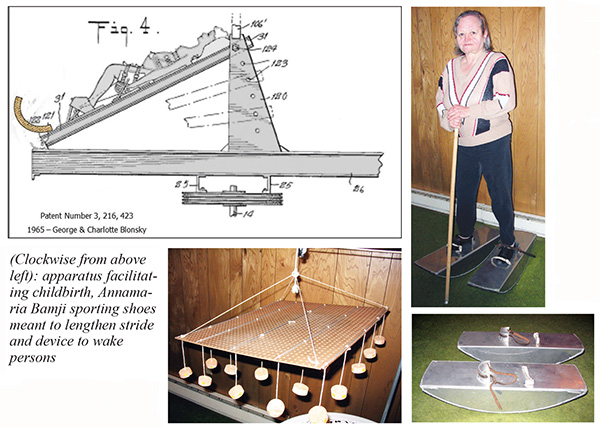
Unable to wake up to the lilting or shrill tone of an alarm? Would a gentle blow to the face better serve the purpose? A device invented by Samuel Applegate bears a light frame with a series of corks placed directly over the head and face of the person sleeping. Attached with a cord to an alarm clock or a burglar alarm, when activated the frame is designed to rouse a person with a mild jolt.

Dr Pervez Bamji
Meant for the convenience of hearing impaired individuals, this apparatus that earned a patent in 1882 features in the list of under 100 "incongruous inventions” that scientific researcher and consultant trainer Dr Pervez Bamji, now based in British Columbia, Canada has identified during the nearly 40 years of pursuing this hobby. His interest was sparked when watching a weekly BBC television program called "It’s Patently Obvious” where a scientist, an engineer and a non-technical person were invited to the show to guess and discuss the invention on display before them. "The device was usually incongruous, it was patented and its utilitarian value was questionable! Within a year I had a collection of such ‘goofy patents’ and even had ‘working models’ of some,” writes Bamji.
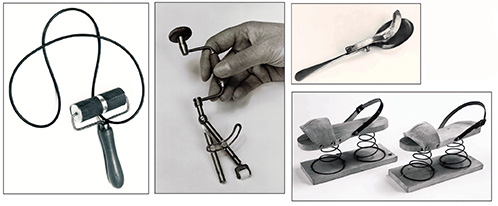
Collection of patents (above, from left) beard grinder, dimple maker,
soup spoon for men sporting handle-bar moustache; footwear to prevent sea sickness
Novelty, ingenuity and utility are the three characteristics sought by patent examiners. In addition, the idea has to be original and not in the public domain (in print or audiovisual format). Patent examiners do not normally grant patents which have no utilitarian value. However utility can be subject to interpretation and a good patent agent could word the claims of the invention in such a manner that the examiner could be convinced of its utility. "Sometimes the utilitarian value of a device is questionable and at times downright absurd and out of whack,” mentions Bamji in response to Parsiana’s email queries, adding, "The best example of incongruity is a US Patent No. 3,216,423 granted to a husband and wife for ‘An apparatus for facilitating childbirth.’” The expectant lady is to be placed on a large revolving wheel and whirled around at high speed. When the centrifugal forces thus generated exceed the childbirth resisting forces, the baby is propelled onto a padded net which then actuates a switch to stop the wheel and simultaneously rings a bell to announce the happy event!
Some of the other unbelievable patents of the late 19th century are a beard grinder invented by Samuel Bligh wherein sandpaper is mounted on a rotating cylinder that is set in motion via a rubber belt attached to a sewing machine. As the cylinder rotates, the user is expected to grind away the facial hair! In his sub-classification of beauty aids also features a dimple producing device by Martin Goetze that looks like a carpenter’s brace. The end of one leg has a rotating cylinder made of ivory, marble or rubber and attached to the end of the other leg is a steel ballbearing that is pressed on the cheek where a dimple is desired. The repeated turning of the brace with the rotating cylinder was meant to tone the facial muscles!
Besides beauty aids, Bamji has other patents grouped under health, sports, aids to household chores, culinary and dining, gardening, aids for pets, transportation, naughty ones ("strictly for private shows”) and miscellaneous. Depending on the audience, the venue and the time allotted to him, over the years Bamji has given countless talks with the aid of Power Point slides illustrating the patents or carrying some ‘working models’ built by his colleague, the late Tom Garrett of the UK.
Included in his collection of 25 ‘working models’ was a 1904 British patent No. 27,253 granted for a pair of shoes "For increasing the length of stride in walking.” Made from aluminium and each weighing about five pounds, the three-foot long shoes "are so cumbersome that they actually slow the pace of walking,” relates Bamji. He would carry the model shoes in the boot of his car for local lectures but not when he was required to fly. On retirement, when he moved from Kingston, Ontario to Victoria, British Columbia, he eventually donated this pair to the Bata Shoe Museum in Toronto!
When Bamji started his hobby there was no internet to assist his search so he approached Colin Godman, the producer of the BBC program "It’s Patently Obvious” who referred him to two books: Inventions Necessity is Not The Mother Of! by Stacy V. Jones and Why didn’t I think of it first? by Adrian Hope. Thereafter friends and acquaintances felt obliged to keep him updated with articles and stories on patents. In the early 1990s he belonged to a professional organization called The Licensing Executive Society of USA and Canada and their conferences afforded opportunities to interact with patent lawyers and agents who from time to time would keep him posted of such goofy patents. That was also the time when he worked as technology licensing manager in the International Property Division of Alcan International (a large multinational aluminium company) where each week they received a copy of The US Patent Gazette. In the course of their duty on collecting patenting activities by competitors, the staff members who came across whacky patents would invariably leave a copy on his desk for his perusal resulting in "a general chuckle in the department — a great bonding exercise,” recalls Bamji explaining how he was able to add to his collection.
Bombay born Bamji had graduated in physics after which he did his MSc and PhD in electrical engineering. During his 28-year career with Alcan he started as a research engineer and ended as a senior technology manager, accepting assignments in England, Japan and Canada. Thereafter at the Queen’s University School of Business, Kingston, Ontario, Bamji worked as associate professor and director of Small Business Consulting for 11 years, and also served as trustee and senator there. Currently he is president of Pennatech Incorporated, a consulting and training company that he established in 1994, facilitating workshops, courses and training sessions in project management and in acquiring soft skills such as leadership, team building, business etiquette, presentation skills.
A chartered engineer and a Fellow of the Institution of Engineering and Technology, England, he was president of the Institution of Electrical Engineers in Rugby, England when he first gave an informal lecture on goofy patents in 1978. An active Rotarian for the last 23 years he has frequently given talks on this subject at different Rotary Clubs. Bamji was also a board member of the Greater Kingston Chamber of Commerce, vice president, Research of the Canadian Council of Small Business and Entrepreneurship, and on the board of the Kingston General Hospital Foundation.
Married to Annamaria Carnelos, an art historian from Italy, whom he met 45 years ago when she was a student at Oxford, Bamji does not know of any adventurous Parsis who may have invented and patented incongruous gizmos and gadgets in the hope of becoming rich and famous.
In recent times, the escalating fees for the patent agent, patent examination and the cost of maintaining the patent over its lifetime have put a damper on people applying willy-nilly, explains Bamji. With his hands-on experience in research and project management, technology transfer and management of intellectual property he has several technical publications and 12 patents to his credit although "none of them can be classified as ‘whacky!’”
◆ ◆ ◆
From the archive