
In Memoriam
From layouts to lyrics
Died: Adi Rustom Kanga, 90, mathematician, engineer and a visionary, on April 1, 2013 in Sydney.
A week before Kanga passed on he could not remember what he had eaten for breakfast but he could explain to you Pythagoras’ theorem. Kanga’s main hobby was mathematics and he wrote 12 books on the subject outstanding among which was Number Mosaics: Journeys in Search of Universals that continues to be read two decades after its publication. He made new discoveries, including several extensions to Pythagoras’ theorem, which were hailed as "ground breaking.”
A week before Kanga passed on he could not remember what he had eaten for breakfast but he could explain to you Pythagoras’ theorem. Kanga’s main hobby was mathematics and he wrote 12 books on the subject outstanding among which was Number Mosaics: Journeys in Search of Universals that continues to be read two decades after its publication. He made new discoveries, including several extensions to Pythagoras’ theorem, which were hailed as "ground breaking.”
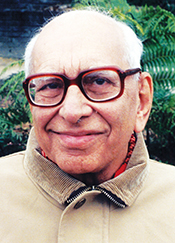
Adi Kanga
A progressive planner, he was among the few who came up with the concept of building a new city, New Bombay, on the mainland across from the island city to accommodate the large number of migrants who were drawn to Bombay, the commercial capital of India. Observing that the available infrastructure in Bombay was unable to cope with the rising numbers, in the late 1960s Kanga and his group of friends convinced the Indian Government of their plan. With his engineering skills Kanga drew the plans for New Bombay at home on his dining table, hand-coloring it to beautify it and sell the concept.
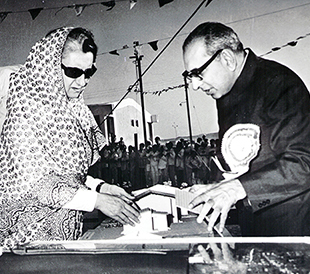
Adi Kanga with Indira Gandhi
The Government set up the City and Industrial Development Corporation (CIDCO) with Kanga as its first general manager. Since the land owners were not interested in selling their agricultural holdings for urban development and there was no direct transport link from Bombay, Kanga decided to reclaim sea land, off the mainland, and planned a huge bridge from the island of Bombay. Today New Bombay, also known as Navi Mumbai or Vashi, with a population of around 7.5 million people, is more populous than New Zealand. The new city is serviced by trains and buses and the bridge that was once perceived as a bridge to nowhere is so crowded that there is a demand for a second crossing. Continuing to lead CIDCO, Kanga contributed his expertise for the starting of four other new cities including New Aurangabad and New Nasik.
President of the Indian Water and Waste Water Association in the late 1960s, Kanga had started his professional career with the Water Works Department of Bombay after completing his early education from St Xavier’s School, graduation in science from Bombay’s St Xavier’s College and civil engineering from Poona. He was instrumental in building a network of pipelines and two huge water supply dams attempting to meet the city’s growing need for clean water. Thereafter his services were loaned to the Commonwealth Scientific and Industrial Research Organisation (CSIRO) to establish the National Environmental Engineering Institute. He is also known to have developed applications software for India’s first major computer system at the Tata Institute of Fundamental Research.
On retirement he moved to Sydney with his wife Vira (née Vazifdar, who passed away a year before they could celebrate their golden wedding anniversary) to join their sons, Rustom and Darab, who had previously immigrated. The fourth of five children, Bombay born Adi’s elder brother, the late Homi was a renowned professional violinist playing in the London Philharmonic Orchestra (see "Beckoned by the bow,” Parsiana, March 2005). Adi played the piano and mandolin although not professionally. During his last few years which he spent at the Lady Gowrie Nursing Home in Sydney he was well known for entertaining his friends with his piano playing which he continued to do despite loss of hearing.
Before the nonagenarian became immobile he was active at the Australian Zoroastrian Association (AZA) functions, frequently preparing artistic props for plays enacted by the children. He had also composed the English lyrics for Chhaiyé Hamé Zarthoshti that were popular at community gatherings and social events in Sydney. Moderate in his views on religion, he believed in treading the middle course. Over a decade ago the AZA felicitated him with their Zoroastrian of the Year award.
Adi hailed from a family of cricket legends. His uncle Dr Homi D. Kanga had represented All-India during the tour of England in 1911 as the vice-captain and scored a century against Leicestershire. Homi was also the first Indian batsman to score a double century in a first-class match, 233 for Parsis against Europeans at Poona in 1905. Unfortunately, Test cricket came too late for him as India played her first Test in 1932. A cricket library in Bombay is named after him. Earlier, Adi’s grand uncle, Pestonji D. Kanga had captained the team that toured England in 1888 and playing with him on the same team was another grand uncle Merwanji D. Kanga.
During his younger days Adi was active with the 8th East Bombay Scout Troop and additionally enjoyed dramatics and elocution. A firm believer in education, Adi had once told his son that he was unlikely to leave him any money or property when he died so the best investment he could make was in his education. It pleased him to learn that four of his six grandchildren were currently working on PhDs in fields as diverse as music, science, law and architecture. Known to lead a very simple life, his friends remember him for his gentleness and integrity.
The last time he went out was a fortnight before he passed away when the family had a get-together to celebrate his 90th birthday. The family treasured his many talents for being a prolific artist, he would create handmade cards for relatives and close friends. He also enjoyed creating comic strips. His numerous paintings adorn homes around the world. He wrote poetry too and illustrated his poems with drawings which are treasured possessions.
The talented engineer is survived by his sons Rustom and Darab, daughter Prochie Shiavux Mulla and sister Avan Shroff.
◆ ◆ ◆
From the archive