
Zoroastrians Abroad
New Millennium Song
"Zarathostis of the world, come! This new millenium greet,/Eyes fifed upon the future, standing firmly on our feet./Having crossed the seven seas, we now dwell in many lands,/Welcomed where’er we go, the jewel of friendship in our hands.
"Joyful and courageous, truthful one and all,/Generous, kind and gentle, ever ready to meet the call/For help from those who need it, but we seek no reward,/What more could we desire when Ahura Mazda is our Lord?
"Zarathostis of the world, now prepare to take a leap,/There’s so much to be done, there is no time to sleep./Spreading goodwill is not easy, ne’er was and cannot be,/It needs the sort of love embracing all humanity.
We may not have the numbers, we surely have the strength,/Victory will attend the pure-in-heart at length./Keep walking on the path of righteousness always,/May Ahura Mazda bless and keep us all throughout our days.”
The above original composition by poet Adi Kanga of Sydney, Australia, is said to have been prompted by a letter from Jehangir Medhora of Toronto, Canada ("New community anthem,” Readers’ Forum, Parsiana, May 2003) which Kanga says he chanced upon while browsing through the old issue in early 2004. Medhora, who had earlier created the Zoroastrian flag, had suggested that the familiar refrain Chhaiyé Hamé Zarathosti be recast in English to suit the language most commonly spoken by the community all over the world, and set to a new melody to avoid embarrassment to those living in the diaspora as the old tune belongs to the song, The Blue Bells of Scotland.
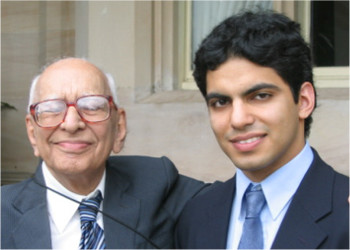
Adi and Zubin Kanga: a new Zarathosti song
Pondering on how the entire world has changed in so many different ways in the latter half of the 20th century, reflected too in the manner in which Zarathushtis have adapted to the new environment, Kanga recounts the many countries which gained independence after World War II, the bloodshed, ethnic cleansing and unending strife following political changes in the Middle East. "Terrorism became rampant, the value of human life diminished as the level of mass hysteria rose, whipped at times into sharper fury by the atrocities revealed on television screens.”
Though Kanga has created a poetic translation of Chhaiyyé Hamé... in English, capable of being sung to the original tune, he felt that the English rendition brought its out-datedness into sharper focus. "With so many changes all around us, it is hardly possible for a microscopic community like ours to remain un- affected, or to pretend that we can rest on our laurels singing songs in praise of past glories,” he writes, adding, "That we have to keep pace with world events if we have to survive is obvious, and the fact that so many of us are now already carving out our futures in new lands all over the world, is a sure sign that we are ready to face challenges as always.”
To Kanga, "a nation without geographical boundaries is a boon and a marvel. The fact that we are such a nation actually makes us all the first true citizens of the world.” Avoiding the patriotic fervor of most national anthems, carrying "our little portable ladder of good thoughts, words and deeds...with the help of which we can attain great heights,” he weaves into his Song "our noble and unique philosophy of the need and ability to choose between right and wrong, to do good deeds for their own sake, without expecting a reward now or in the future, implying that we understand the true nature of happiness which resides in the performance of the act itself.” He notes happily, "there is the sense of divinity residing in all of us which cannot fail to inspire wonder, if nothing else.”
A new melody composed by Kanga and arranged by his grandson Zubin Kanga, accompanies the Song, but to which Chhaiyé Hamé... can also be sung.
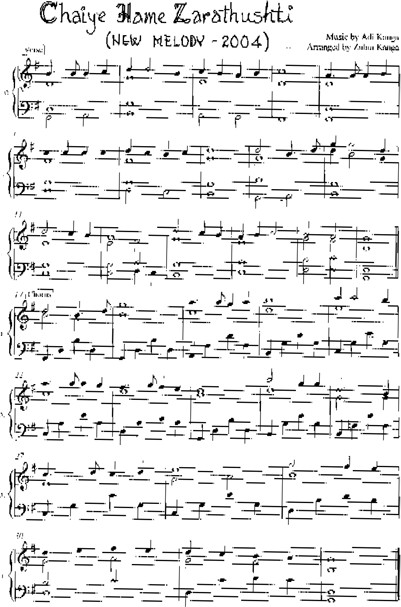
Kanga has created four more devotional songs in English, with melodies to match, under the generic name Ustana Zasto, meaning "with hands uplifted” in the language of the Gathas (Yasna 28.1) dedicated to his deceased wife Vira, née Vazifdar, who traced her ancestry to the illustrious Dastur Meherji Rana of Navsari. A booklet with the songs and the music scores accompany Kanga’s work. Though the Song of the New Millennium is yet to be sung in public, Kanga’s letter to Parsiana of September 27, 2004 states that two Bombay groups are practicing to sing the English version of Chhaiyé Hamé...for functions later this year.
Younger brother of noted London-based violinist Home Kanga, Adi was general manager of CIDCO in the formation stages of New Bombay. Mithi Daver of Sydney informs Parsiana that Adi’s passion for maths has resulted in several mathematics books. He is also an artist who paints his own greeting cards, prized for their meticulous execution. When the Australian Zoroastrian Association had presented a stage production of Rustom and Sohrab, "he had painted all our sets,” writes Daver. In his grandfather’s footsteps Zubin is studying music, computer science and philosophy for a combined degree at the University of Sydney, is a gold medalist at the piano and plays the saxophone professionally.
◆ ◆ ◆
From the archive