
Zoroastrians Abroad
Mission Mandarin
"Considering myself reasonably fluent in Mandarin, both written and spoken, I realized that if I was to make my way in a foreign country I had to actually think in Chinese so that I could deal with visas and bureaucracy, public transport and phone cards, meals and accommodation — all issues that a 17-year-old student away from home has to manage. No quick calls to my parents for help, no local friends to turn to. This forced me to become independent overnight, think on my feet and be resourceful.” Melbourne based Shahzad Bilimoria who had won a scholarship from the Chinese government to study Mandarin for a semester at the Beijing Language and Culture University (BLCU) in 2012 recalled his experience that he described as "amazing, opening my eyes to an ancient culture and a modern economy with traditions and progress being two facets of an emerging superpower…
"My classes consisted of understanding Chinese history, culture, business, Chinese concepts and the requirements of today’s world. The constant use of Mandarin inside the classroom as well as outside helped me to fast track my fluency in a very difficult language with an unfamiliar script,” acknowledges the teenager, adding, "I had classmates from USA, Canada, Europe, Australia, Africa, Korea, Japan, Singapore, etc. The teaching course was quite intensive, starting at 8 a.m. every day. The Chinese culture demands discipline in the classroom, more so than in many western nations…One of my first purchases was a second-hand bicycle that allowed me flexible travel using the special broad bicycle lanes across major roads.
"My classes consisted of understanding Chinese history, culture, business, Chinese concepts and the requirements of today’s world. The constant use of Mandarin inside the classroom as well as outside helped me to fast track my fluency in a very difficult language with an unfamiliar script,” acknowledges the teenager, adding, "I had classmates from USA, Canada, Europe, Australia, Africa, Korea, Japan, Singapore, etc. The teaching course was quite intensive, starting at 8 a.m. every day. The Chinese culture demands discipline in the classroom, more so than in many western nations…One of my first purchases was a second-hand bicycle that allowed me flexible travel using the special broad bicycle lanes across major roads.
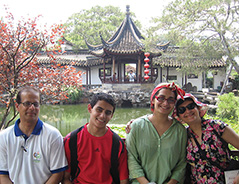
Shahzad Bilimoria with his family in China
"Public transport in China is efficient… The road and rail infrastructure is developing at a rapid pace with criss-crossing of bridges and rail tracks looking like a bowl of noodles. And that brings me to the food of China. At least 25 varieties of noodles mixed with different meats and seafood, bubbling soups and gelatinous desserts means that you can never go hungry in China. According to folklore, you are not a true Beijing local until you have tasted the Peking duck. For the more adventurous, the snack market in Beijing invites you to taste fried scorpions, sheep genitalia and roasted starfish!
"Having spent many holidays in Bombay, I was not fazed by the density of population but to my friends from less populated countries it was a real culture shock. When it comes to friendliness and helpfulness, the Chinese man on the street is like anyone anywhere in the world. Talking and laughing with classmates and teachers, cracking jokes with taxi drivers, bargaining with shopkeepers, I was surprised at how quickly I had improved in Mandarin in six months, thanks to the total immersion in Beijing life, something I would never have achieved studying Chinese in a Melbourne classroom.”
At the end of his semester, Shahzad graduated with flying colors. To celebrate his 18th birthday, his parents and elder sister Friyana joined him in Beijing. The family made a hectic trip of China, first seeing all that Beijing had to offer, then travelling to Xi’an, Shanghai, Nanjintg and finally on to Suzhou. Imprinted on his memory are "the sheer size and magnificence of the Great Wall of China… the snow-capped mountains in winter, followed by the purple-pink blossoms of spring… the tranquillity of the Summer Palace and the intricate artwork of the Temple of Heaven in sharp contrast to the vastness of Tiananmen Square and the hustle and bustle of the Forbidden City.”
Back in Melbourne, studying for a double degree in engineering and commerce at Monash University, Shahzad maintains, "Though I’m not of Chinese heritage, I know that my future is linked to China and I will return for study and work there in the near future.”
Nearly three years ago Parsiana had featured Shahzad (see "Champion in Chinese,” Zoroastrians Abroad, July 7, 2010) for not only his Mandarin language skills but also his Chinese fan dance which had won him an award from the Chinese Consulate in Melbourne. In February, Shahzad was invited to perform the traditional and ceremonious tai chi kung fu fan dance for the Buddhist Temple Chinese New Year festivities in Melbourne. He then visited the Chinese Home for the Aged where the residents seemed half asleep and supine. But one crack of the ‘magical fan’ and the melodious chimes and gongs of the accompanying music got them energized. Enthralled by his graceful and athletic movements they started thumping their chairs and yelling out encouragements. Xiexie and zaijian, thank you and goodbye, Shahzad.
◆ ◆ ◆
From the archive