
Business
Cafe century day
The 100-year-old Sassanian Boulangerie is among the few Irani restaurants surviving in the city
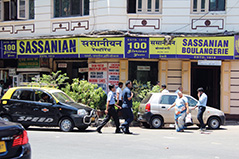 It has been giving people their daily bread since 1913! "K. R. Sasanian, Bakery and Restaurant, High-Class Baker and Refreshment Caterer,” proclaimed their poster of the early days. "Before trying elsewhere, please give us a trial,” it appealed, noting that the eatery was run "under the proprietor’s personal supervision.” Much has changed since then — an extra ‘S’ has been added to its name, the menu has moved from the brun-maska-chai (crisp bread, butter, tea) of the typical Irani cafe to Parsi and Chinese dishes and sizzlers as well! The personal supervision remains. "Our mava and plum cakes, bread pudding, khari (biscuits), dhansak, hot pattice, etc are our specialties,” says Meheraban Kola, speaking to us with his partner Adi K. Yazdabadi by his side. "We know Sasanian opened in 1913 but we don’t know the specific date, so March 21 (Jamshedi Navroz) seemed a nice starting point to celebrate a century with a jashan and small party,” smiles Yazdabadi.
Sassanian is situated opposite the Gol Masjid at Dhobi Talao in Bombay. Down the road is the distinctive small structure of the Sodawaterwala agiary. "Right up to the early 1960s, Marine Lines station had its exit very close to the restaurant. There were many bungalows at Marine Lines and along Queen’s Road. There was much more Parsi and Catholic population in the area, along with Gujaratis and a few Muslims. We would also get the cinema crowd from Metro and Liberty cinemas nearby. The Parsi population around Marine Street/Dukkar galli (side street) has become much less. They have shifted to the suburbs or gone to Poona,” explains Kola.
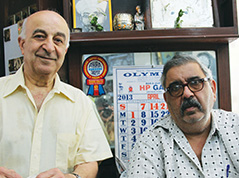
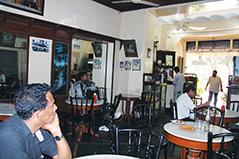
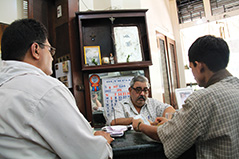
1st row: Adi Yazdabadi and Meheraban Kola, original bentwood chairs and marble-topped tables;
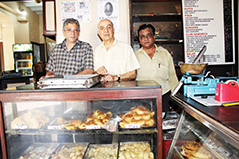
2nd row: Shahrukh Sanjana and Yazdabadi in the bakery section with old employee Ali Mohamad, Kola seated at the counter;
The march of time and the arrival of the ubiquitous Udupis, pizzerias, bars, bistros, fast food joints and coffee chains have all eaten into the share of the Irani restaurants, with just about a handful remaining. "My father used to say: dil thi khavaro (feed people large-heartedly). I love this place. This is my first wife. Our (bakery) oven is never shut. I am a pucco Zarathushti. All this is due to Ahura Mazda,” says Kola who sits at the restaurant for the greater part of the day, Parsi topi on head, faith in the heart, forthright in his views! Assisting him as and when the need arises are his sister Dilnaz and her husband Shahrukh Sanjana. The focus is on food, not frills as far as decor or ambience is concerned. The brun/bun maska costs Rs 15, bread pudding is also Rs 15, omelette Rs 30, kheema Rs 45, etc.
Kola has a son Jahanbax and two daughters Zeenia and Natalia who are abroad with their mother Ruhangeez. "My siblings and I grew up in Bombay. We have been living in Canada for the last 10 years,” says Zeenia who is a real estate agent specializing in the Greater Toronto area. Present in Bombay for the centenary celebration, Zeenia recalls her childhood memories: "Around 1987, apart from cakes, puffs, biscuits and tea, Sassanian had signed up for Dollops Ice-cream but it didn’t do that well and we discontinued. Around the late 1990s, my mother, dad and their business partner Sharookh Irani (Adi Yazdabadi’s late brother, who was known to all as Uncle Sam) decided to revamp the bakery side, giving it the new name of Sassanian Boulangerie. We introduced chicken rolls, Manchurian rolls, salads, cheesecake, etc. There have been ups and downs, as every business has. You need patience, trust and confidence.”
Yazdabadi lives with his English wife Valerie in the UK. They have four sons — Steven, Paul, Nigel and Alan. Steven and wife Havovi are in Abu Dhabi, Nigel and Natasha in Sydney, while Paul and Alan are in UK. "I don’t interfere with Merwan (as Meheraban is often called),” says Adi who was with the Rank Organization earlier. He visits Bombay "as I can’t get away from it (Sassanian)! After a few days I do get fed up of Bombay, yet something always pulls me back!” Another partner, Irandokht Behjat, also resides in Canada, as do her children Banoo, Nergish, Nazir and Kaikhushroo.
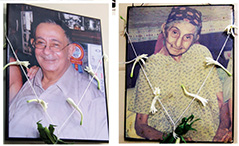
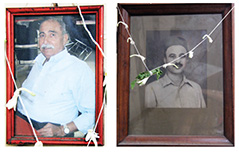
homage to ancestors
Sasanian was started in 1913 by Adi’s grandfather Rustom Yazdabadi. The Kolas became partners later. "I myself was born in Bombay in 1952. My ancestors were from a village called Arestan in Iran,” narrates Meheraban, whose father Khodadad was sent around the year 1920 to Bombay, touted even at that time as the city of gold! After working for a while at the Irani restaurant called Kyani nearby, Khodadad joined Sasanian, becoming a partner later. We ask Meheraban for his assessment as to why so many Irani Zoroastrians arriving in India in the early 1900s took to opening cafes. "Iranis believe in two things – the food business and buying land,” he answers in his straightforward manner. "In the early days, we (Sassanian) used to open at around five in the morning and the fresh bread — brun, laadi pao (block of small soft loaves), etc would fly off the shelves. Irani cafes at that time were also small convenience stores. We would stock soap, toothpaste, Polson butter, newspapers… Trainers and race lovers like K. Irani would drop in early before proceeding to Mahalaxmi Race Course for the training sessions. They would come back at 11 a.m. When Marine Lines station shifted northwards, it was a big blow to our business.”
Be it tea for two, tech talk over the fruity flavors of a Mangola or Raspberry, or just a walk-in and walk-out with Easter eggs, the café has through the decades seen a cross section of society — taxi drivers and office goers, families in simple celebration… "Busybee (late Behram Contractor, the chronicler of the life and times of many an ordinary man) has written about us in his Round and About column. The late Adi Marzban, Jimmy Pocha and several others were my father’s friends and patrons over the years,” Kola recalls.
On the counter stands a framed photo of the late Sharookh (Uncle Sam), popular with patrons for his jokes and sunny temperament. "Dad, Uncle Sam and Shahrukh Uncle have given a lot of dedication to this business. There were times we could not go on holidays or parties, or be at family events together because the shop has to be running. You have to sacrifice personal life at times,” Zeenia declares. With Jahanbux having completed his hotel management course before moving abroad, the father is sanguine he will come back at the right time to run the business. "He has an attachment to the place… If Almighty wishes, he will return and keep the family name going.”
Be it tea for two, tech talk over the fruity flavors of a Mangola or Raspberry, or just a walk-in and walk-out with Easter eggs, the café has through the decades seen a cross section of society — taxi drivers and office goers, families in simple celebration… "Busybee (late Behram Contractor, the chronicler of the life and times of many an ordinary man) has written about us in his Round and About column. The late Adi Marzban, Jimmy Pocha and several others were my father’s friends and patrons over the years,” Kola recalls.
On the counter stands a framed photo of the late Sharookh (Uncle Sam), popular with patrons for his jokes and sunny temperament. "Dad, Uncle Sam and Shahrukh Uncle have given a lot of dedication to this business. There were times we could not go on holidays or parties, or be at family events together because the shop has to be running. You have to sacrifice personal life at times,” Zeenia declares. With Jahanbux having completed his hotel management course before moving abroad, the father is sanguine he will come back at the right time to run the business. "He has an attachment to the place… If Almighty wishes, he will return and keep the family name going.”
Researching the tradition
"Bombay had its own glory in the ’50s and ’60s. I grew up in the territory and have been coming here since I was a child. I remember their lovely cream pastries. Everything was made in house. Sassanian was my rendezvous round the corner!” says old customer, family friend and historian Deepak Rao. The restaurant’s bentwood chairs (introduced in Austria as early as 1859 and so named because they were made using a unique steam-bending technology for wood) imported from Poland and tables with marble tops are all original and still going strong, Rao tells us. "At the time of Independence in 1947, there were 348 Irani restaurants in Bombay. You can read about this on the site (blog) called irani chai mumbai. There is an Australian named Bruce Carter who has done research on this,” states the retired policeman whose knowledge of the history of Bombay is extensive. (irani chai mumbai seeks to document through word and picture the Irani cafes of Bombay. The final aim of the project is to tell the story of the cafes, and through it of the Irani community in India, online and in print as an "illustrated, affordable, popular history book.”)
"Bombay had its own glory in the ’50s and ’60s. I grew up in the territory and have been coming here since I was a child. I remember their lovely cream pastries. Everything was made in house. Sassanian was my rendezvous round the corner!” says old customer, family friend and historian Deepak Rao. The restaurant’s bentwood chairs (introduced in Austria as early as 1859 and so named because they were made using a unique steam-bending technology for wood) imported from Poland and tables with marble tops are all original and still going strong, Rao tells us. "At the time of Independence in 1947, there were 348 Irani restaurants in Bombay. You can read about this on the site (blog) called irani chai mumbai. There is an Australian named Bruce Carter who has done research on this,” states the retired policeman whose knowledge of the history of Bombay is extensive. (irani chai mumbai seeks to document through word and picture the Irani cafes of Bombay. The final aim of the project is to tell the story of the cafes, and through it of the Irani community in India, online and in print as an "illustrated, affordable, popular history book.”)
◆ ◆ ◆
From the archive