
Tribute to a teacher
Though she lost her vision at the age of 13, Zarine Mirza carved a career for herself, teaching Hindustani music
Back in the 1980s, a fair-skinned, petite, sari-clad woman with a white stick would fetch up at the Tardeo bus stop every evening. The bus conductors along that route knew her well and would happily help her. The prestigious music school Bharatiya Vidya Bhavan would draw Zarine Mirza within its hallowed folds as felicitously. For the next three hours, in the first floor room allotted to first and second year vocal classical music students, Zarineben (as she was affectionately called) would diligently etch the basics of raga-sangeet onto the psyche of her young students, many of whom landed in the class straight from school under pressure from parents keen on giving their children music education.
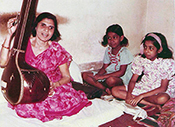 Teaching music, especially abstractions like swaras (notes) as different from songs, to confounded and restless young students is no easy job and calls for oodles of patience. And Zarineben had that in plenty. She would repeat the lessons lovingly, striving to inculcate that most-difficult-to-master sense of sur (roughly translated as melody) in her students. Her second-year students, whom she initiated into the mysteries of khayals — bada and chhota khayals — still remember the meticulousness with which she taught them different variations of the main bandishes (compositions). Playback singer and the 1995 Sa Re Ga Ma contest winner Sanjivani Bhelande, who would careen into Zarineben’s class straight from school, acknowledges, "I learnt my first taal, teen taal from her as also the first khayal, one in Raga Bhopali called Itna joban par maan na kariye… She would teach systematically and make us do paltas (exercises with musical notes) with rigor. She taught me very good variations of the khayal, Na manoongi… which I sang at my first demonstration at Bhavan’s (a fortnightly program held to encourage the students)… ”
Music composer and sitarist Tushar Bhatia, who would be honing his classical music basics in an adjoining class at Bhavan’s in those years (boys and girls learnt separately) recalls being envious of Zarineben’s students. "She was such a devoted teacher and taught variations with such care and they would be set so well that I would feel envious of her students. She had a very sweet, rounded voice and always led the prayers at Bhavan’s. Her memory was sharp. She would remember every raga and every composition.”
Indeed, Pt. Dinkar Kaikini, the then principal of Bharatiya Vidya Bhavan, from whom Zarineben took advanced lessons in music, relied on her for help while composing choruses. As Bhatia reveals, "She served as a ready reckoner to Dinkarji whenever he composed for a chorus; she would remember every bit of his compositions and she’d be mighty pleased when he consulted her during the rehearsals.”
It was again her magnanimity that when Bhatia as a student started curating choruses for Bhavan’s programs, Zarineben gladly participated in them. "I remember a particular chorus in Raga Bhimpalasi which I had composed and taught the group,” says Bhatia. "Zarineben sang the opening alaap and was really happy to do so. You could always depend on her to remember all the detailing. She was like a pillar of Bhavan’s in those years.”
Sometime in the ’90s, I became Zarineben’s student and joined her first-year class along with three or four much younger students. Eager to grasp the basics of music I had imbibed through my home environment but did not know analytically, I would dash to her class every evening after work, trying not to be late. She expected us to do our homework and would be upset if anyone came unprepared. But she never lost her cool and it was the sweetness of her personality as much as the pull of classical music that drew me to her class. Sometimes, after class, I would drop her to her Tardeo home. It was during these visits to her place that I slowly got to know her two other siblings, Vispi and Perviz Mirza, and soon began to frequent their Parsi colony residence and take lessons from the exemplary life of austerity, beauty and dignity that these three souls with zero eyesight led therein. (Their two other siblings, a brother and sister who were blessed with perfect eyesight, supported them in their own ways — brother Cyrus from his perch in the States and the married Villy who lived initially in Navsari and later in Bombay.)
I learnt that Zarineben, Perviz and Vispi had been born with low vision and the curse of retinitis pigmentosa, an irreversible progressive eye disease that lowers a black curtain over the retina gradually and finally shuts out the world. Zarineben told me how she would love to paint as a child and had pursued her passion even as her eyesight steadily dimmed. Finally, one morning at the age of 13 in her school classroom in Udvada, she could suddenly see nothing, not even a spark. The lights went out of her world forever.
As proof of the invincible power of the human soul to transcend adversity, Zarineben and her two siblings (who also lost their eyesight in their teens) developed new skills, fashioned out professions, and committed themselves to contribute to society. Vispi, the first visually impaired student of St Xavier’s college, moved to Bombay from Udvada and then brought his sisters along. While Vispi devised gadgets for the visually impaired and taught at the Victoria Memorial School for the Blind, Perviz became a telephone operator and won the President’s Award in 1986 for best services by a physically handicapped person. Zarineben, the eldest of the five Mirza children and the artist in the family, explored the world of music and reveled in learning and disseminating the legacy of Hindustani classical music.
A picture of tidiness, Zarineben would come to Bhavan’s every evening dressed immaculately in saris, mostly of light pastel colors, with her pallu pinned neatly with a brooch. Sanjivani fondly recalls Zarineben’s penchant for perfumes and her keen interest in clothes. "Sometimes students gifted her saris. And she would inquire about their color in great detail — Green? Oh, is it dark green, light green, which shade of green, and the design on the sari, what’s the design? She always wanted to be presentable.”
And so she was till one day in January 1995 when she suffered a stroke. I remember rushing to the B. D. Petit Parsee General Hospital that morning. She was in the ICU, unconscious; I could discern the struggle to resurface on her countenance. A great warrior, she would not give up. She survived but was partially paralysed, cruelly robbed of that beautiful routine she had carved for herself. But again, true to her nature, she fought her condition tooth and nail, regaining her speech quickly. After a long stay in the hospital and intensive physiotherapy, she was able to renew her music activities and teach students from home. Her siblings’ unremitting support and her own will-power ensured that she could also walk with some help towards the end. She opted to live out her last years in her tranquil Udvada home, teaching music to the very end of her 77-year-old life on May 31, 2012, an epitome of a good teacher, an invaluable asset for any society.
One day, while returning from class, Zarineben had turned towards me saying, "Munmun, sometimes, I feel I can see some spark of light. You think, my eyesight may come back some day?” Today, I want to believe there is rebirth and that Zarineben will enjoy all the colors of paradisiac nature to the fullest in her next birth, and sing out of sheer elation at the beauty of this world.
Reprinted from the magazine Mind and Body, October 2012.