
In Memoriam
The true Zartoshty
My brother and I do our duty towards the community in all countries.” This characteristic understatement made by Mobed Mehraban Zartoshty 22 years ago played down the many benefactions that had earned the Zartoshty Brothers global recognition. The grateful community never forgot their largesse as attested by the tributes that poured in from every corner of the Zarathushti world following the demise of 95-year-old there was uncertainty regarding his date of birth Mehraban Jamshid Zartoshty in San Diego on July 6, 2012. Driven by passion and compassion, Mehraban and his elder brother Faridoon who predeceased him by 15 years, would unstintingly support educational, medical, residential and religious causes.
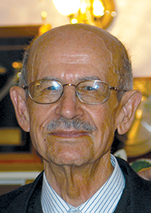
Mehraban’s "selfless service knew no boundaries or borders when it came to helping any one in our Zarathushti community. The Federation of the Zoroastrian Associations of North America (FEZANA) and many of our member associations have been the recipient of his generosity and support for endowments and to build darbe mehrs in various parts of North America,” noted a condolence message from then FEZANA president Bomi Patel.
"We at the North American Mobeds Council (NAMC) are keenly conscious of the legacy of immense philanthropy that Arbab Mehraban Zartoshty has left for our North American and global Zarathushti community. His work embodied love and compassion for his faith without any expectation in return,” acknowledged president Ervad Kobad Zarolia. Having played different roles in life, Mehraban had conveyed during an interview with Parsiana (see "Once youth gets educated…” March 1990) that he was particularly "proud to say I’m a mobed” who after semi-retirement has performed religious ceremonies in Canada, Los Angeles and Australia.
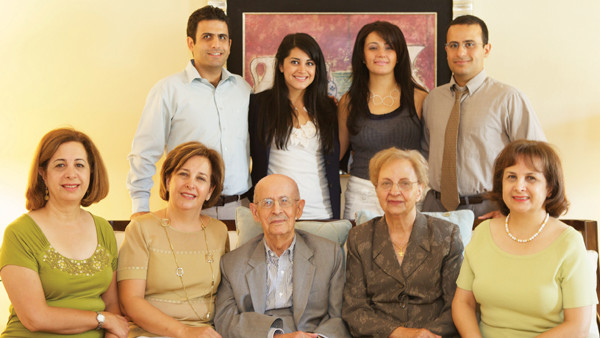
Mehraban and Paridokht Zartoshty (center) with daughters (seated, from left) Homa, Vida and Mehrbanou, and grandchildren Viraf, Shireen, Anahita and Vishtasp
"The Zoroastrian Trust Funds of Europe (ZTFE) would not be where it is today without his generosity, support and inspiration. In addition to the Zartoshty Brothers Hall and the prestigious School of Oriental and African Studies in London, he leaves behind a proud legacy comprising the many institutions he supported,” noted a tribute from Malcolm Deboo, president of ZTFE that had organized uthamna and chaharum prayers in his honor.
Born in Iran and having spent their formative years there, the Zartoshty Brothers "contributed profoundly towards the establishment, maintenance and expansion of almost all the existing religious facilities like fire temples and other pilgrimage sites in Iran,” mentioned Mobed Mehraban Firouzgary listing the outstanding institutions that bear the brothers’ names or those of their relatives: Zartoshty Brothers Community Hall and other facilities of the Shiraz Baghe Vaghf (Donated Garden) complexes, The Isfahan Khaneye Zartoshtian (Home for the Zarathushtis) complexes, The Karaj Kanaye Dowlat, plus many others. The Atash Behram in Yazd has been under the management of the Zartoshty Brothers for several decades and even houses a library and bookshop where thousands of visitors come for knowledge of Zoroastrianism. The books are sold at a nominal price because Mehraban believed that "anything, if given free, is not valued.”
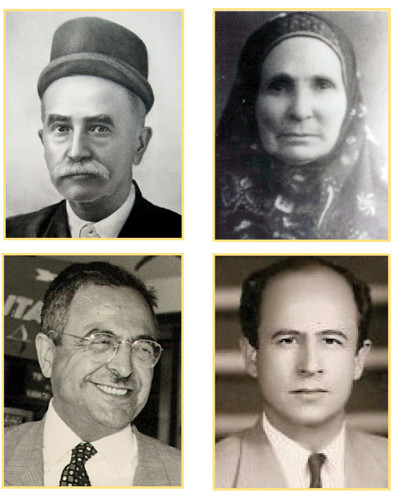
Clockwise from top left: Jamsheed, Ostad Farangis, Mehraban and Faridoon Zartoshty
Mehraban was "a founder member, our grand patron and a past vice president of the World Zoroastrian Organisation (WZO). His foresight and support in our early days…was a source of great strength to the officials of that time and helped in making WZO a truly global body of Zoroastrians,” recalled Darayus Motivala, chairman of WZO. "Humility, industriousness and philanthropy coursed through his veins…The Zoroastrian community can consider itself to be singularly fortunate to have had (him) in its midst,” commented Dinshaw Tamboly, chairman of the WZO Trust. "The focus of his charities has largely been to enrich and preserve the Zoroastrian religion and ethos, promoting education and well-being of youth, and providing medical facilities to individuals and hospitals…He also established the Council of Iranian Mobeds of North America, Kankash-e-Mobedan to propagate the teachings of Zarathushtra and served as its president for 10 years,” noted a tribute by Aban Rustomji in the WZO quarterly Hamazor, Issue 3, 2012.
"Humble,” "modest” and "simple” were the adjectives most used to describe Mehraban at the condolence meeting convened by the Bombay Parsi Punchayet (BPP) at the Homi Taleyarkhan Memorial Hall on July 27, 2012. Referring to his "proud legacy of philanthropy unparalleled anywhere,” BPP chairman Dinshaw Mehta termed Zartoshty "the greatest Zoroastrian of recent times.” He was "a staunch Zoroastrian to the core.”
Homa Petit, president of the B. D. Petit Parsee General Hospital (PGH) that was a recipient of Zartoshty’s largesse, spoke of the "humble demeanor” of a man who was "universally liked… He was the foremost philanthropist and entrepreneur of our times.” The funds made available to renovate the 85-year-old ‘A’ wing of the Hospital and the ground floor would remain a testament "for future generations of Zoroastrians who come to the Hospital for treatment.”
Petit who was in "personal contact” with Zartoshty regarding the Hospital said the philanthropist was "forthright and astute… never rough or rude… totally dedicated to help the poor and needy.” Zartoshty could never forget the debt that Iranian Zoroastrians owed Maneckji Hataria who worked for the betterment of his coreligionists in Iran, said Petit. "He was the emissary of Sir Dinshaw Petit” to Iran. This proved to be "the link between the Zartoshty Brothers, Hataria and the Petit families.”
BPP trustee Khojeste Mistree who had stayed with the Zartoshty family in 1960 when he visited Tehran mentioned that their home there was an "open house” and referred to Mehraban as a generous host. They wore sudreh kusti unlike many well-to-do Iranian Zoroastrians. In business they "always had a Muslim partner.” They were strict disciplinarians. Both brothers had three daughters each and no sons. Their daughters could not fraternize with non-Zoroastrians, observed Mistree.
"It was the Zartoshty brothers who sowed the seed in my mind of switching studies” from accountancy to Zoroastrian studies. When Mistree was hesitant on account of the fees, Zartoshty reassured him "Don’t worry about funds.” Mistree’s travels to Yazd and "the contact with the rural Zoroastrians sparked my interest in Zoroastrian practices,” acknowledged the trustee. Whenever Mehraban visited Bombay he made it a point to visit the fire temples and "go for falooda to Badshah” near Crawford Market. He used to consider Iran his first home and India his second one, having spent 15 years of his life there. According to Mistree, Mehraban was an "institution builder” who believed in the "pleasure of giving rather than (just) giving... He took the art of giving to a new level.”
Former BPP chairman Minoo Shroff said the community "recognized Zartoshty as one of the noblest... He was the epitome of self-effacement and humility. He did good by stealth.”
Homai Modi who organized the condolence meeting, as stated by the evening’s compere BPP public relations officer Godrej Dotivala, looked upon Zartoshty as an "adviser, guardian and friend.” Modi "forged ties” with the philanthropist in 1998 when he requested her to fix an appointment with the trustees of the PGH and later gave two cheques, one for the corpus of the Hospital and one for the building. He was a "pucca (thorough) businessman” who kept a watch on how his charities were disbursed. He invited Modi to be his guest at the 2005 World Zoroastrian Congress in London.
Pervez Irani, trustee of the Iranian Zoroastrian Anjuman (IZA) revealed that the IZA was a recipient of his largesse. "He was a torch bearer of charity,” noted Irani. Condolence messages from Dorab Mistry and Rusi Dalal, former presidents of ZTFE were read out by Dotivala.
"His knowledge, guidance and selfless devotion will be greatly missed,” noted Byram Avari, chairman of the Karachi Parsi Anjuman Trust Funds, who described the donor as "an exceptional human being, globally known for his selfless service, priestly dignity and deep sense of religiosity. Neville Shroff, president of the Zoroastrian Charity Funds of Hong Kong, Canton and Macau referred to "the noble soul (as) a pillar of strength to the whole community.”
The president of the Australian Zoroastrian Association of New South Wales Fariborz Jamshidi termed him "a shining stalwart” and appreciated his donation to the construction of their Darbe Mehr in Sydney. "As a token of appreciation we have established a wonderful library in his name to honor his priceless legacy.”
"We in Vancouver were lucky to have been able to interact on a daily basis with Mobed Mehraban,” commented Fariborz Rahnamoon, president of the Zoroastrian Society of British Columbia, adding, "He led a simple life which money had not been able to sophisticate. Sitting in his favorite corner in his living room with a blanket on his leg, he had stories to tell… He was open-minded even on religious matters and believed in progress… but was careful not to hurt anyone’s feelings by imposing his thoughts on others.”
As conveyed by Mehraban during his interview with Parsiana he didn’t believe in conversion "because we’re not going to gain much.” Even though he did not seek to encourage intercommunity marriages he was of the opinion, "We have to accept the children and spouses (of mixed marriages). If we don’t accept, we’ll lose them. It is the mother who is always taking care of the children.”
The youngest of three children, Mehraban is known to have been deeply influenced by his mother, Ostad Farangis and Faridoon who was 11 years older than him. His father Mobed Jamsheed, who owned a business in Bombay exporting spices, milk powder, biscuits, textiles, saris and other products to Iran, had died when Mehraban was only 16 after impressing on his young children the need to distribute five percent of their income to the deserving. The Dinyari Primary School in Yazd and the Keikhosravi Higher School were the institutions where Mehraban received his initial education in Iran before he enrolled at the Bharda New High School from where he completed his matriculation. After studying biology at Elphinstone College he was hoping to pursue medical studies but was advised to join his brother in the family business that was thriving even during World War II.
A year after the War ended he married Paridokht Mawandad, having loved her from the time he was a teenager. The couple spent some time in Bombay but restrictions on free movement of foreigners in independent India disillusioned Mehraban and when his friend requested him to handle his motor car business in New York for a few months, the couple took up a new base. He would have liked to establish a second business in the USA but his brother convinced him to return to their motherland where the economy was booming. They set up factories to supply leather and plastic to Iran’s emerging automobile industry and soon had three companies listed on the Tehran Stock Exchange.
Following the revolution in Iran both brothers retired from business and focused on their charity work. Whilst Faridoon chose to stay on in Tehran, Mehraban shifted to London where the family spent 20 months and subsequently took up residence in Vancouver until the 1990s when the entire family migrated to the warmer shores of California. A keen gardener, Mehraban was most relaxed amidst flora and derived inspiration from nature. Personal insights and photos were provided by his eldest daughter Homa and grandson Viraf Soroushian.
The self effacing donor is survived by his wife Paridokht, and daughters Homa, Vida and Mehrbanou.
Parinaz M. Gandhi
◆ ◆ ◆
From the archive