
Readers' Forum
“Parsi protestors”
While browsing through your magazine I was fascinated by the account of the Rustomjees, both father and son, in the article by Dr Enuga Reddy ("Parsi protestors,” Parsiana, August 7, 2012).
Incidentally, when my father Sam B. Nariman went from Rangoon at the time of my birth (1929) to South Africa to establish branches of the New India Assurance Company he had met the younger Rustomjee, the man who passed away in Durban in February 1960. My father had traveled, as he was then entitled to, on a British passport and was therefore permitted to stay at one of the fine hotels in Cape Town. He received a telephone call from Sorabji Rustomjee and invited the latter over to the hotel. However, Rustomjee was not permitted to enter the hotel premises and had to remain on the footpath outside; my father had to go down to meet and chat with him! And this was long before Gen Jan Smuts and apartheid!
The review of Rati Forbes’s book on her father Cooverji Bhabha was excellent ("Cooverji’s contribution,” Parsiana, August 7, 2012). The author was kind enough to send us a copy of the well illustrated book and it is in our drawing room, browsed through by visitors! The photographs of old are exquisite, particularly that of Amy Bhabha cutting their wedding cake (see pg 8). I recognize Mr Dubash with Dinbai standing next to Cooverji and the latter’s sister Maki standing next to Amy, but I cannot place who the lady in the white dress with gloves on is.
FALI NARIMAN
Delhi
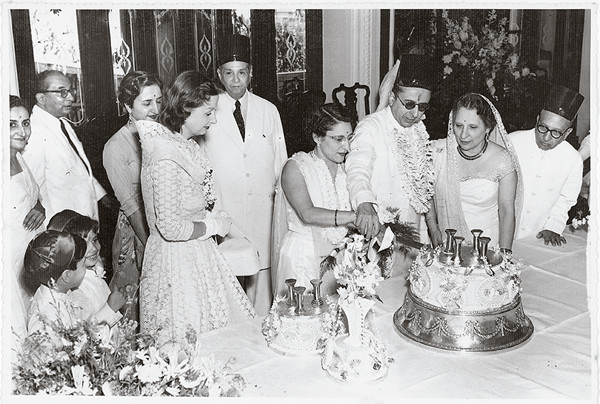
Photo reprinted with permission from Remembering My Father: Cooverji H. Bhabha
Dr Enuga Reddy replies:
I am glad that you liked my article on Parsi resisters in South Africa during the satyagraha led by Mohandas Karamchand Gandhi (1907-13).
It is a pity that there is no biography of Parsee Rustomjee, a great Indian and South African and a close friend of Gandhi. Even his date of birth is not known. I wish a fellowship could be provided to an Indian scholar, even a graduate student, to work on the biography.
It is amazing that a community of perhaps 50 families contributed so much to the struggle for freedom in South Africa. It is important to stress that all communities contributed to the liberation of the country and to build the "rainbow nation.”
It would be best if the research could encompass the history of the Parsis and their contribution to the development in South Africa, and place Parsee Rustomjee in context. The Parsis also contributed in later stages of the struggle, though not as much as during the satyagraha. Frene Ginwala, the former speaker of Parliament, and Pheroshaw Camay, a trade union leader, are two of my friends. Also Khurshid Rustomjee (Ginwala).
The descendants of Parsee Rustomjee are now dispersed. He did not leave much money to his children. Sorabjee’s main occupation, I believe, was as agent of the New India Assurance Company.
Your story about Sorabjee and the hotel in Cape Town is an example of the craziness and contradictions of apartheid. Such stories would be funny if they were not tragic for the victims.
I saw the film by Richard Attenborough on Gandhi many years ago and do not recall Rustomjee in it, nor could I find any reference to him in the script. If you mean the Rustomjee whom Gandhi knew, the following may help. Sorabjee was only about 16 years old in 1913. The most famous incident is his bravery in holding the horse of the General and persuading him to refrain from shooting striking workers. By then his father Parsee Rustomjee was quite old and rather stout. Sorabjee kept in touch with Gandhi and met him on the day he was assassinated or the day before.
I think people in India do not appreciate the contribution of Parsis to the freedom struggle in India. Even Parsi writers are on the defensive because not many rich and prominent Parsis went to jail.
I was working with Divya Gandhi, daughter of Gopalkrishna Gandhi, many years ago on a book on Gandhi and the Parsis. But she had to abandon the project after some research because she could find no funding. I hope there will be some serious discussion on the role of Parsis in the struggle and their contribution to free India.
(Rati Forbes has identified the lady in the white dress with gloves on as being Anna Horsborough. While putting the book together she had been unable to find out the person’s identity and hence the person remained nameless in the book’s caption — the editors)
◆ ◆ ◆
From the archive