
Books
Cooverji’s contribution
Handling important ministerial portfolios in the Interim Government in the early years of Independence, Cooverji Bhabha was also a member of India’s Constituent Assembly
"I am desired to convey to you the official approval of His Majesty the King to your appointment as member of the Interim Government (IG), and to request that you may attend at the Viceroy’s house at 11 a.m. at September 2 for the swearing-in.” So wrote George E. B. Abell, personal secretary to Lord Wavell, the penultimate Viceroy of India, to Cooverji Hormasji Bhabha on August 30, 1946.
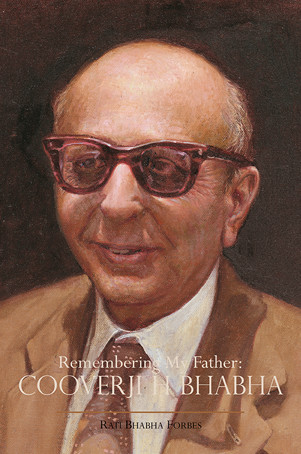
"Since Dad was not a member of the Congress Party or of any other political party even later, for him it was a surprise to be called to join the IG,” writes Bhabha’s daughter Rati Forbes in her endearing memoir Remembering My Father: Cooverji H. Bhabha published by her in 2010 for her family and friends.
"Dad was close to Sardar Patel and in fact had agreed to go to Delhi only because of his regard for him,” writes Forbes.
The background
The British Cabinet Mission (CM) under Sir Stafford Cripps visited India in 1946 to negotiate with Indian political leaders on their demands for independence. The CM recommended that an IG be formed that would oversee the setting up of a constituent assembly for the formation of a new state.
The IG was to consist of 14 members including six members to be nominated by the Congress of which one was to be from the scheduled caste, five members to be nominated by the Muslim League and three representatives of minorities to be nominated by the Viceroy.
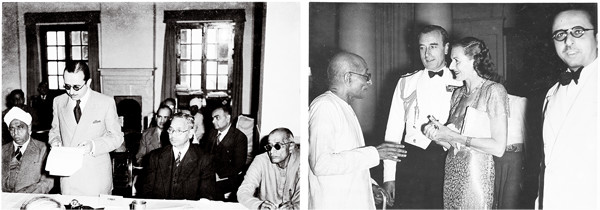
C. H. Bhabha addressing the irrigation board (with B. K. Birla and C. Rajagopalachari seated); (Right): Bhabha with Lord and Lady Mountbatten and Rajagopalachari
"It was this IG that dad was invited to join as a representative of the Parsi community,” writes Forbes. Bhabha used to teach at St Xavier’s and Sydenham Colleges as a guest lecturer and contributed articles to Commerce magazine. He was also well known in Bombay’s business circles.
Forbes relates her father’s "probity in public life” where he declared his shareholdings in 63 companies as also narrates how he resigned from directorships of about 10 companies, as the two portfolios — government and personal — would have been in conflict. Bhabha was sworn in as member of the Interim Government on September 2, 1946 and he declared his resignation from these directorships within five days.
The appointment was not without controversies, as Forbes notes. Maulana Azad who was often at odds with Patel commented on Bhabha’s appointment in his book India Wins Freedom.
"At the time of the Shimla Conference, I had pressed strongly for the inclusion of a Parsi in the Cabinet. Now that the Congress was forming the Government, I again pressed for the acceptance of my view. After some discussions, my colleagues agreed. Since the Parsi community was concentrated in Bombay, we thought that Sardar Patel would be in a better position to advise us on the choice of the Parsi representative. We accordingly left the choice to him and after some time he suggested the name of C. H. Bhabha. We later found out that Bhabha was a friend of Sardar Patel’s son and could not by any means be regarded as a leader or even a true representative of the Parsi community. Our selection proved wrong and after some time, he dropped out of the Government.”
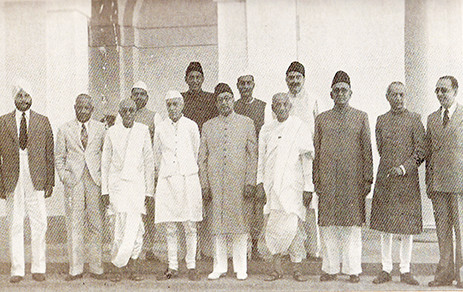
Bhabha (far right) with members of the Interim Government including Jawaharlal Nehru, Liaquat Ali Khan, Vallabhbhai Patel, Jagjivan Ram and Dr Rajendra Prasad
Counters Forbes: "It is hardly likely that Sardar Patel would chose someone for such an important position only because of his closeness to Pashabhai or Dahyabhai (Sardar’s son). The fact was that Sardar Patel had ‘checked out dad’s credentials’ with many whose judgment he trusted; one of them being C. Rajagopalachari.”
Aside from Patel, Bhabha also received "strong support” from Jawaharlal Nehru and Gandhi "without which dad would not have got the portfolio of Works, Mines and Power (WMP),” notes Forbes. The Indian Muslim League was not in favor of Bhabha being assigned this critical business portfolio. As Lord Wavell wrote on October 25, 1946: "After another day of excursions and alarms, we have settled the difficult portfolio business. Nehru as usual opened the bowling with a fast one. He wrote that Matthai was taking the Industries and Shipping portfolio from Rajagopalachari who would take Education; but that Bhabha would go to WMP. Now I told him last night that I was prepared to allot WMP to Matthai if he wanted to but that otherwise I was committed to giving it to the League. So I sent George (Abell) down to see Nehru and tell him that Bhabha should take Posts and Air or Health. No result…”
Forbes writes: "The IG had quite a tumultuous time until it was reconstituted with the members from the Muslim League that M. A. Jinnah had wanted.” Despite the differences between the Muslim League and the Congress, Bhabha "made path-breaking contributions like working on a mining policy for India; setting up the Fuel Research Institute; and initiating work on the planning of what would be major irrigation dam and river valley projects for the country,” states Forbes.
"I regret I cannot agree”
Forbes highlights her father’s "insistence on correctness” when the young Bhabha, aged 36 years, dashed off a letter to Lord Wavell objecting to the way the minutes of the cabinet meeting were worded. It may seem a petty matter in this day but it certainly mattered to Bhabha that he should put his signature on a document that he could not agree with. The Viceroy had circulated minutes to be signed, stating the budget was accepted and taken as accepted "which the cabinet passed.” Bhabha differed from this and wrote "Your Excellency, as president, at no stage sought the opinion of your colleagues on these proposals as is customary on all matters, nor did you at the termination of the meeting, sum up the discussion, as there was none. Under the circumstances, I regret I cannot agree to the last few words in the minutes to the effect: ‘which the cabinet approved.’
Protests seem to have been forthcoming from Nehru, Patel and Bhabha. In his diary Wavell refers to the dissent "from the record of the cabinet meeting at which Liaquat explained his taxation proposals. The record says the proposals were ‘approved.’ Poltroons (cowards), especially Nehru! They now find that the budget is not popular with their big business supporters and are trying to rat or hedge.”
Forbes then quotes from another letter on the same issue that Bhabha wrote to Wavell, a much decorated officer with several honors/medals to his name: "I am sorry, I have to dissent to the minutes as drafted, as I strongly feel that the budget proposals will put back economic progress in the country, and I for one cannot be a party to the same, unless these are substantially altered.”
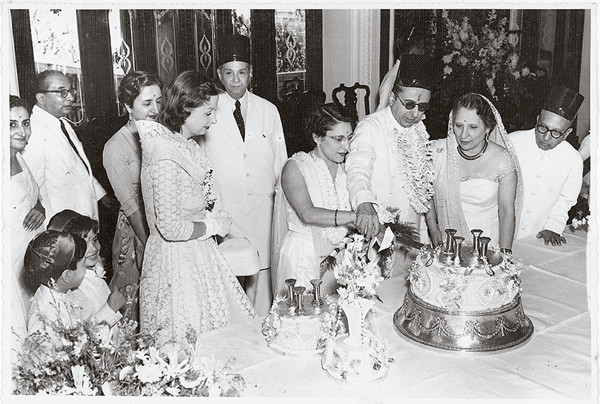
Cooverji Bhabha and his bride Amy cut their wedding cake
The voice of developing countries
Bhabha was sent to Havana, Cuba leading the Indian delegation of the Government of India. Being elected vice president of the conference, he not only represented the voice of India but of many developing countries. After the Second World War, trade was severely impacted and he represented the voice of less privileged nations for preferential tariffs and development along with international trade. He realized the reason for the failure of the League of Nations and was prompt in asking for representation of poorer countries. He was also aware that nations like China, Korea, Japan and Ireland were emulating India in the use of boycott.
"The UNO has now taken the place of the League of Nations. But even this UNO will not be able to establish a reign of peace… if this primeval instinct of man for economic exploitation of his neighbors is not curbed and throttled in time,” wrote Bhabha in a letter. Similar protests were made by Mexico. Ramon Beteta claimed that lower tariffs for highly developed and undeveloped countries is treating "unequals with equality,” echoing Bhabha’s demands.
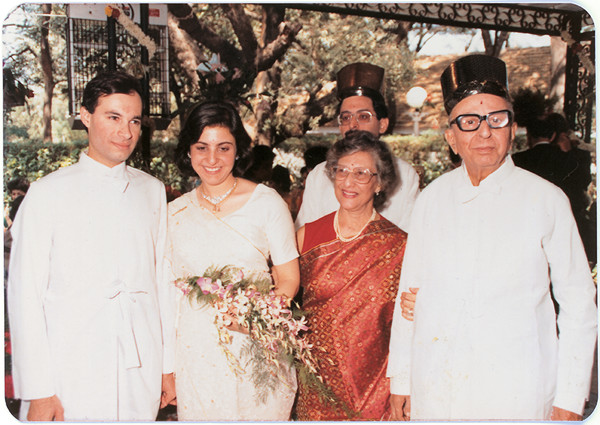
Farhad Forbes marries Rati Bhabha; Bhabha's parents Amy and Cooverji to her left
Bhabha also believed in economic diplomacy — the ability to influence trade through networking and building bridges with industries, industrialists/traders and bureaucrats. He was amazed to find how little the Indian embassy was in touch with influential, potential trading partners in the USA as also the Indian embassy’s lack of influence and social networking. He made a special point of it to Nehru.
As one more enthusiast in nation building of those years, Bhabha "handled the extremely delicate task of negotiating with the princely states on their accession to the Indian union. It was another example of his helpful nature.”
"Difficult tasks”
On August 1, 1947 Nehru wrote to Bhabha inviting him to join the new cabinet. "I know that you are anxious to go back to your old occupation; but we cannot possibly spare you, and I am sure that you will not deny us your cooperation. We have very difficult tasks to face and these will require all our energy and ability. Even this will not be enough. We have to work as a team sharing completely each other’s burdens.
"The portfolios will be formally allotted later on. This is a matter which need not be referred to the governor-general. Many of the existing portfolios will continue as they are. But some changes have to be made because Rajaji is going. I understand from Rajaji that as between Commerce and Industries you would prefer the latter which is the heavier charge.”
On August 4, 1947 Bhabha wrote to Nehru:
"My dear Panditji
"Thanks for your letter of the 1st instant.
"I am grateful to you for the appreciation and sentiments expressed in your letter. When I was selected as one of your colleagues in the IG, it was a surprise of my life and I knew that I was dragged much against my will into public life by Sardar Patel. I have not been a politician and I have my own failings, but it has been a matter of great satisfaction to me that I have been able to secure your confidence. I have explained my difficulties to be able to continue in office to Sardar Patel, but as both of you are unwilling to release me I have agreed to shoulder the burden for some time longer. It is needless for me to say that I shall do my best to be of help to you and to render such service to the country as is possible for me.
"As regards portfolios, Rajaji had made some suggestions to me, but I think there has been some misunderstanding because it is he who pressed me to take his portfolio. I have, however, placed my services unreservedly at your disposal and it is for you to decide what portfolio should be entrusted to me.
"Thank you again for having placed your confidence in me and for your generous appreciation of my services.”
On August 14, 1946, Rajagopalachari, or Rajaji as he was popularly called, wrote to Patel, "I had a talk with (R. K.) Sidhwa (a Congressman from Sind and a member of the Provinces Legislative Assembly) on the plane. He is also of the opinion that Jamshed Mehta (a member of the Municipal Committee of Karachi) is not good. He would prefer Bhabha. All reports tend to this opinion.”
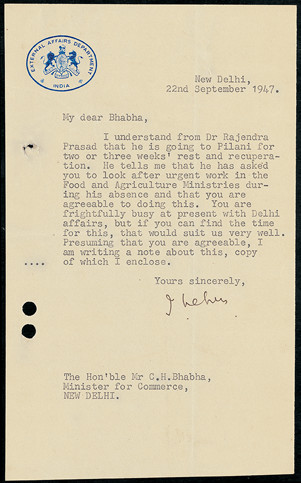
A fascimile of a letter from Jawaharlal Nehru to Bhabha
On August 19, 1946 Patel wrote to Mahatma Gandhi in Gujarati (translated here), "The names of five Muslim members to be submitted to the Viceroy are still undecided… From the Parsis, Bhabha’s name has been selected; Matthai’s too has been finalized. From the Sikhs, Baldev Singh’s name has already been included. Then there will be six out of us including Jagjivan Ram. That includes Rajendra Babu’s name also. Only names of five Mulsim members have yet to be finalized…”
As per procedure all ministers had to resign so that Mountbatten could make new appointments. Forbes mentions that her father "had a very cordial relationship with Lord Mountbatten and worked with him especially closely for relief and resettlement of the victims of the mayhem that followed the partition of the country. A day prior to India’s independence Mountbatten wrote a letter of thanks to all the members of the executive council:
"I cannot leave my active participation in cabinet work without writing a line to express my sincere appreciation of the loyal support you have given me as a member of the IG during my short period of viceroyalty. No one could pretend that the coalition ministry was an easy partnership, particularly with partition looming so large in the background; but you and your colleagues made my task easy and thus proved yourselves true statesmen of whom your country can well be proud.
"Your extremely efficient approach to the business of government should continue to prove a great help and fine example to your colleagues.
"With this letter I am sending you a small informal photograph of myself in the hope that you will accept it as a souvenir of the historic time that we were colleagues together in the cabinet.
"All best wishes to you and the dominion of India.”
Bhabha replied on August 19, 1947: "It is awfully nice of you to have expressed the sentiments about me and my work in the cabinet. On my part, I need hardly assure you that it was indeed a very great pleasure to work under you, and I shall always cherish the happiest memories of the rapidity and absolute businesslike manner in which meetings were conducted under your presidency.
"I am very thankful to you for the present of the photograph of yourself which I shall always keep as a souvenir of the very historic time during which we were associated.
"Once again thanking you and with my best wishes both to Lady Mountbatten and your good self for your happiness and prosperity.”
Map Room
Bhabha spent two years in Delhi (1946 to 1948) first as a commerce minister of cabinet rank and then appointed chairman of the Delhi Emergency Committee (DEC). In 1947 at a public jashan to mark India’s independence Sir Shapoorji Bomanji Billimoria, chairman of the Bombay Parsi Punchayet (BPP) stated, "Although we are such a small community, the Congress government shows a caring attitude towards us. In the Central Cabinet in Delhi, the trade and industry portfolio is held with great skill and admiration from his colleagues by Honorable Cooverji Bhabha.” The DEC was set up specifically to handle the refugee problem during those troublesome times of 1947-48 in India with an ever changing scenario. The partition of India had just happened and Pakistan was carved out, leading to mass murders on both sides of the border. The ever deteriorating law and order position needed swift, decisive and impartial handling. Both Nehru and Vallabhbhai Patel recommended Bhabha for this position.
"A special feature (of the DEC) was the institution of a Map Room, the purpose of which was to provide factual and up-to-date information to all concerned with regard to the place and number of disturbances and the location and the movement of refugees. Every day, before their meeting the members of the committee were taken to the Map Room so that they could make themselves acquainted with the up-to-date position…” quotes Forbes from V. P. Menon’s book The Transfer of Power in India.
Forbes continues her quote from the same book: "The committee had to act here with special speed, for there were over a hundred thousand persons to be cared for and the numbers were increasing. Arrangements for food, filtered water, sanitary and medical facilities were quickly improvised…”
When Rajendra Prasad who later became the first President of the Indian Republic and held the agriculture ministry fell ill, Bhabha was requested to look after the department. Nehru wrote to him on September 22, 1947. "I understand from Dr Rajendra Prasad that he is going to Pilani for two or three weeks’ rest and recuperation. He tells me that he has asked you to look after urgent work in the food and agriculture ministries during his absence and that you are agreeable to doing this. You are frightfully busy at present with Delhi affairs, but if you find the time for this, that would suit us very well.”
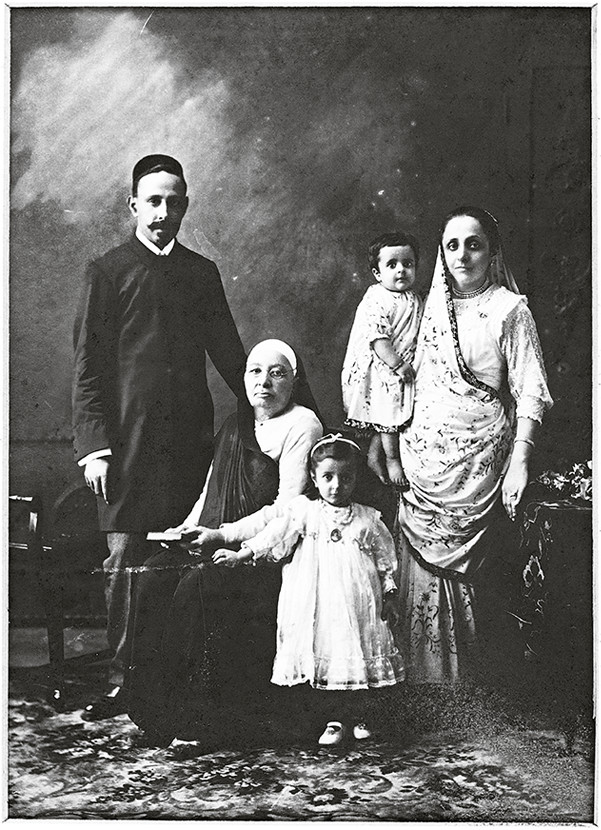
Left to right: Father Hormasji Bhabha, grandmother Jaiji-bai, sister Maki, Cooverji in mother Ratanbai’s arms
Constituent Assembly member
Bhabha became a member of the Constituent Assembly, the body that was assigned the task of drafting the Indian Constitution. "To be a member of the Constituent Assembly you have to be elected,” noted Forbes. So Bhabha was elected by the Bihar Legislative Assembly.
Bhabha participated in the Assembly deliberations for over a year after he resigned from the ministerial position in 1948. His mother Ratanbai’s health was deteriorating and "he was keen to get back to Bombay and spend as much time with her as possible,” notes Forbes. So he spoke to Patel about resigning. "On the question of your membership of the Constituent Assembly, I shall let you know later on my return to Delhi,” wrote Patel. "I do not know, however, if you would like to continue as member with a view to assisting government on various matters in which your experience and knowledge of the commerce ministry would be of value and in which you may be interested from the general commercial point of view...”
Bhabha resigned in mid-February 1949.
Intimate portrayal
Forbes’ book is professionally brought out — with several pictures, both official and personal. Pride of place is given to letters from Nehru, Mountbatten (one such handwritten to Bhabha and quoted above), Wavell, Patel, Rajagopalachari and others.
The 164-page book runs into 10 chapters which are a personal account of the man, his mission, his persona, his business acumen and philanthropic bent. The ninth chapter on his years in banking, highlights his contribution to rural banking, to attract household savings and deposit, insurance for small investors from losing their earnings in case of bank failures as also safeguards for banks from going under. As a board member of the Central Bank of India he had huge authority but worked gratis as a labor of love.
The book was jointly written by Forbes and Nita Mukherjee who did the research and penned the historical parts. Forbes’ account of her days growing up in her parental home is personal, touching and intimate. She has dedicated this book to her two children — Riah and Darius and her two nieces — Aliya and Ayesha.
Forbes ends: "But more than anything else, I learned so much more about the qualities of this fine and caring human being who I am so proud to call my father; who always functioned from a space of integrity and clear principles, who was never fearful of speaking his mind, who never missed an opportunity to help others, who was the most loving and devoted Dad imaginable.
"I believe that both my brother Homi and I try to follow the example he set — albeit in a small way and pass on the values and beliefs we learned from Mum and him to the next generation.”
◆ ◆ ◆
From the archive