
History
“God’s own medicine”
An outline of the history and commerce of opium, its therapeutic use and misuse in the form of addictive recreational drugs
After publishing Dr Farok Contractor’s article "When tea was not a party and opium was a trade,” (Parsiana, March 21, 2012) we are now carrying extracts from The Origin, History and Commerce of the Opium Poppy (Papaver somniferum) in Asia and the United States by Ardeshir Damania (2011).
The Arab traders sailing off the coasts of India and Ceylon (Sri Lanka) reached China in the 13th century and introduced opium eating to China. In the 1500s, Portuguese seafarers, while trading along the East China Sea, initiated the smoking of opium. The effects on the Chinese population were instantaneous, but it was a practice the Chinese themselves considered barbaric and subversive at first. Even in Europe most people considered opium-taking purely for pleasure a peculiarly eastern custom. The Portuguese, having failed to establish a base in Hong Kong, were instead given a trading post in 1557 on the western shore of the Pearl River which was called Macau. They exported Malwa opium to China from their possession at Panjim (Panaji), Goa in India. This opium was grown in the Maratha states of central and western India. Then, as rapidly as it had arrived, opium disappeared for 200 years from Europe as it had become a taboo object for those in circles of learning and power during the Holy (Roman Catholic) Inquisition. In the eyes of the Inquisition, anything from the east was linked to the devil. But in China it was a different story.
In the 1600s the peoples of Persia and India began using opium as a recreational drug on a large scale. First the Portuguese and then Indian (mostly Parsi) merchants began carrying huge cargoes of Afghan and Indian opium to China. Opium was now all the rage in Europe and Asia — captains of ships chartered by Queen Elizabeth I (who reigned 1558-1603) were instructed to purchase the finest Indian opium and transport it back to England. In 1680 the English apothecary (pharmacist) Thomas Sydenham introduced "Sydenham’s Laudanum,” a compound of opium, sherry wine, and herbs to English society. His pills, along with others of the time, became popular remedies for numerous ailments. In 1700 the Dutch, operating from Amsterdam, also got into the business of exporting shipments to China and to their colonies in south east Asia. During this period Dutch ships often called at the port of Bombay. It was the Dutch who introduced the Chinese to smoking opium in a long pipe called "chillum.” However, the Chinese emperor, Yung Cheng, issued an edict in 1729 prohibiting the smoking of opium and its domestic sale was banned, except under license for use as medicine. But it was too late; the Chinese populace had become hopelessly addicted.
The Hungarian photographer Brassai (Gyula Halász) captured images of an opium-smoking session in his famous photographic study of Parisian nightlife (including the photo on the cover of Parsiana, March 21, 2012).
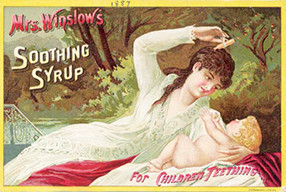
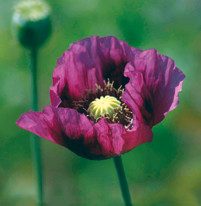
An advertisement for an opium based syrup for children; the opium poppy (top)
Despite occasional police crackdowns, the opium trade was never seriously menaced by law enforcement in California. San Francisco’s Chinatown itself was hardly ever visited by police, and the opium dens there were almost completely ignored. Opium addiction was considered something of a ‘Chinese problem.’ The Chinese migrant laborers, working on road-building and railway projects in California were far from home, spoke little English, and did most of the hard work. There was very little else they could do but to turn to opium smoking, notes Martin Booth in his book Opium — A History. In 1821 in England, Thomas De Quincey published his autobiographical account of opium addiction, Confessions of an English Opium-eater. In it he harped a great deal on the pleasures of using opium and not too much about its dark side and the ravages of addiction. He was criticized for this and hence wrote a revision in 1856 which was twice the length and published by James Hogg of Edinburgh, Scotland.
Sir William Osler, the noted Canadian physician called opium ‘God’s own medicine’ because it was a naturally occurring substance which could perform miracles in the field of pain management. Many writers and poets, among them Mark Twain, Samuel Taylor Coleridge, Rudyard Kipling, John Keats and Elizabeth Browning, the wife of Robert Browning were all enticed into experimenting with opium and got addicted to it, writes Booth. But their literary talents did not diminish as a result. On the other hand, in Barbara Hodgson’s book, Opium: A Portrait of the Heavenly Demon, she states opium smoking in Britain was confined to higher levels of society and that it had little to do with the ordinary man. She suggests that the literary circle of the time, which included authors like Charles Dickens and Arthur Conan Doyle, portrayed the East End of London’s Chinatown called Lime House as the most mysterious place on earth; a place that was constantly shrouded in fog and opium smoke. All the same, it was Coleridge himself, on his death bed, who asked that his addiction and the effect that opium had on his later life and subsequent death be made public so that others may know the danger of addiction, notes Horatio Day, in his book, The Opium Habit.
In 1803 Dr Friedrich Sertuerner of Paderborn, Germany discovered the active ingredient in opium by dissolving it in acid then neutralizing it with ammonia. The result was "morphine.” The beneficial uses of opium were welcomed the world over because of its reliability as a painkiller with long lasting effect and safety of administration. The exude of the opium poppy contains alkaloids such as codeine, thebaine, narcotine, and papavarine, which have analgesic, anti-tussive and anti-spasmodic properties.
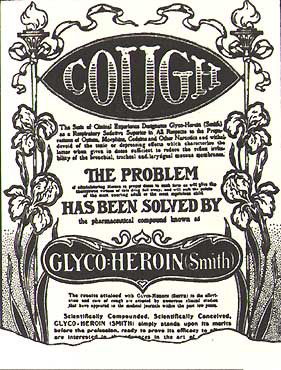
Little work was done to commercialize diacetylmorphine until 1898, when a German chemist, Heinrich Dresser (who had also discovered aspirin only a year before), working at Bayer Laboratories found a way to mass produce the drug as a very powerful painkiller. Dresser carried out drug trials on laboratory rabbits and frogs as well as his own dog. He also gave the drug to his laboratory assistants who loved it, as it made them feel "heroisch” or capable of performing heroic deeds. Dresser then came up with its commercial name "heroin,” after the German word "heroisch.” It made a great deal of money for Bayer. Dresser claimed, quite wrongly of course, that heroin was nonaddictive and tried the drug on himself. He claimed that "it suppresses pain, produces sleep and is definitely not dangerous.” By 1899 reports that the drug was habit-forming began to emerge and in 1913 Bayer itself stopped production and sale of heroin. In 1924 the US banned heroin altogether. This was because there was an explosion of heroin-related admissions in hospitals in New York and Philadelphia where recreational heroin users were reported to have supported their habit by gathering and selling scrap metal and other discarded junk. Hence they were called "junkies.”
Dresser, it was rumored in the meantime, had himself become addicted to heroin and due to his failing health had moved to Switzerland. He died of a stroke on December 21, 1924. It is just conceivable, had anyone known about it at that time, that he could have averted this fate by simply taking an aspirin a day. The irony is doubled by the fact that Dresser, incorrigible in his misjudgment, had spent his twilight years taking a daily dose of the wrong one of the two wonder drugs, both of his own creation!
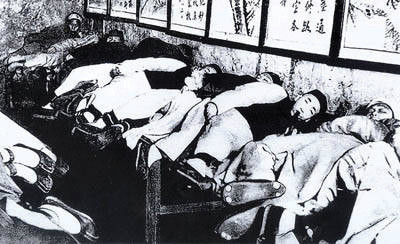
Above: Inside a Chinese opium den
Only way of balancing trade
In 1750 the British East India Company (BEIC) assumed control of the traditionally opium-growing regions of India. In those days opium was grown in Bengal. The opium trade from India to China was initiated by Warren Hastings (the first Governor General of British India) in 1780. At that time there were lots of items, like silk and porcelain, coming out of China, but hardly anything from Europe was bought by the Chinese traders. Hastings came up with an idea that the only way of balancing trade was to export opium to China. An addicted China was good for the British Raj. Therefore, in the 1780s he sent the first small shipment of opium to China. Initially the Chinese did not take to it and most of it had to be thrown away due to lack of demand. But gradually within the next 10 years, demand for opium increased 100-fold! British shipping dominated the opium trade out of Calcutta to China.
After the British defeated Mughal King Shah Alam II at the Battle of Buxar in 1764, the monarch was forced to grant dewani (governing) rights of Bengal, Behar (Bihar) and Orissa (all major opium-growing regions) to the BEIC at Benares. An English dining table covered with embroidered cloth and surmounted by a chair in Robert Clive’s tent served as a backdrop under which such humiliating terms were signed. The whole deed, affecting the lives of millions of Indians was over in less than five minutes. By this deed the BEIC became the real sovereign rulers of 30 million people, yielding a revenue of four million pounds sterling at that time. But Clive paid a heavy price for he became addicted to opium and when publicly criticized for having obtained wealth by dubious means he committed suicide in 1774.
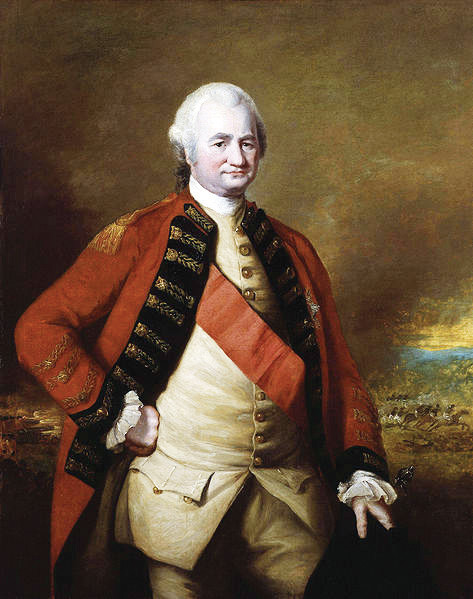
Lord Clive in military uniform.
The Battle of Plassey is shown behind him. Portrait by Nathaniel Dance
By 1767, the year Clive left India, BEIC was exporting 2,000 chests of opium per year to China from the port of Calcutta alone. By 1793 BEIC had set up a monopoly on the opium trade whereby all poppy growers in India were forbidden to sell opium to any other party. In order to control smuggling the British marked their opium packets with a seal with the word "monopoly” stamped on it. It is said that for an appreciable amount of time the British Raj was funded by profits from the opium trade. It was vital for the Empire. During the early 19th century the trade in opium (especially Malwa opium) played a pivotal role in integrating Malwa (western Madhya Pradesh) and the west coast of India with China and thus with the international capitalist economy. This was also the time when Bombay became the main commercial, financial and maritime center of western India. Historians of the city say that the export of opium to China was a critical factor in the rise of Bombay to preeminence as well as in the emergence of the Indian capitalist class centered on the port.
Nonetheless, public opinion against the narcotic use of opium was gaining ground in Britain. Exports to China had declined to such an extent by the 1880s that in some years more opium was consumed by the locals than was sent to China. This was due to two reasons: the Chinese had improved and expanded their own production and Indians themselves were becoming addicted in large numbers. It was impossible to prevent addiction in the country of manufacture where factory workers had started to pilfer from opium godowns in Patna and Benares. In 1881 the state government of Bombay prevented the Government of India from promoting poppy cultivation in its domain. The cited reason was the happenings in Gujarat where crime and corruption had soared in the region where there were poppy farms.
Next to land revenue in India, the most productive source of income to the British was from opium. The public was appalled that 20 percent of the gross national product of the Indian subcontinent was entirely due to the addiction and demoralization of the Chinese people! The debate over opium spilled over in the newspapers with articles in favor of the opium trade being five times than those against. Finally, due to the efforts of the Anglo-Oriental Society for the Suppression of the Opium Trade and an act of the British Parliament in 1906 the Indo-China opium trade gradually came to a stop. A target date of 1917 was set by China by which time smoking opium would be prohibited and the hundreds of thousands of opium dens shut down. In India, between 1906 and 1910, acreage of opium fields was drastically reduced although there was considerable opposition from the farmers. The reduced production led to skyrocketing of opium prices but with the aid of a training program farmers began to grow other cash crops. During World War I from 1914 to 1918 there was an extraordinary demand for morphine and Indian farmers had to be actually given incentives to revert back to opium growing for four to five years.
During the American Civil War (1861-1865) the opium poppy was cultivated in Virginia, Tennessee, South Carolina and Georgia among other states in USA. The opium produced was used to treat dysentery among soldiers of the armies on both sides. Morphine was used widely as a painkiller for wounded soldiers and during surgeries. At the end of the Civil War veterans came home with the ‘army disease’ or opium addiction, mentions Day in his book. In 1890, the US Congress, in its earliest law-enforcement legislation on narcotics, imposed a tax on opium and morphine. Tabloid newspapers owned by William Randolph Hearst published stories of white women being seduced by Chinese men with opium and invoked fear of the ‘Yellow Peril.’
From 1948 until 1972 Corsican gangsters dominated the US heroin market through their connection with drug distributors in Italy. After refining the raw Turkish opium in laboratories located in Marseille, heroin was made easily available for purchase by ‘junkies’ on the streets of New York. This smuggling provided the background for the popular film The French Connection. Also, the US involvement in Vietnam from 1965 to 1970 has been often blamed for the new found popularity of heroin among young soldiers on their return to the US. Wherever those soldiers settled the addict rate increased.

Associate research geneticist at the University of California, Dr Ardeshir B. Damania’s area of interest includes biodiversity conservation issues, early agriculture, crop domestication and plants of economic and medicinal values. His early career was with the Food and Agriculture Organization of the United Nations and he subsequently worked with the International Center for Agricultural Research in the Dry Areas.
◆ ◆ ◆
From the archive