
History
The Patell of Bombay
For raising a militia, leading them against the Seeddee invaders and eventually driving them off the island of Bombay in 1692, Rustom Dorab was honored by the British government
Extract reprinted from The Parsee Patells of Bombay, Their Services to the British Government by Bomanjee Byramjee Patell, published in 1876.
In the year 1692 Bombay was hard beset by the Seeddees of Junjeera, and had it not been for the loyal devotion and courage of Rustom Dorab, the island would have in all probability fallen into the hands of the desperate invaders, at least for a time. At that critical moment the Parsi official boldly came forward to uphold the British flag, and, assisted by his personal influence among the natives, raised a militia and with great tact led them against the enemy, and succeeded in driving them away. Not only did he thus save the island, but owing to the absence of the head of the English factory, he conducted the entire administration of the place for three clear days. The following extract from the Deccan Herald of March 11, 1863, will give an adequate conception of the interesting facts relating to this event:
"He (Rustom Dorab) was the right-hand man of the Government in every department in those days connected with the jurisdiction of the island. The Seeddee (the chiefs governing the island of Junjeera in the neighborhood of Bombay, were called the ‘Seeddees of Junjeera.’ At the time above alluded to, this island was under the dominion of Aurangzebe, the Mogul Emperor and Yakut Khan was its chief) who was at that time a powerful and independent neighbor, came with a large force and took possession of the island, together with Dungerry Fort (now called Fort George). He landed an army of 25,000 men at Sewree without opposition, and in a few hours the Crescent waved from the summit of almost every eminence on the island. Although the Governor of Bombay had several vessels belonging to the Marine in the harbor which, in conjunction with the land forces of the company, might have successfully opposed the disembarkation of the Sciddee’s army at Sewree, yet no orders were issued to them, and they had the mortification of being made passive spectators of their own defeat and humiliation. Redoubt after redoubt was captured, and fort after fort was taken, almost without the exchange of a shot, the European soldiers either falling back with precipitation, or joining the ranks of the conquering Moguls.
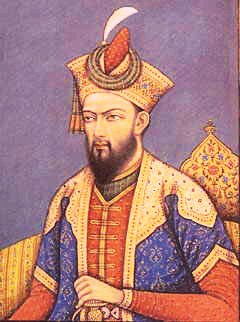
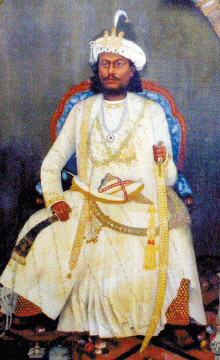
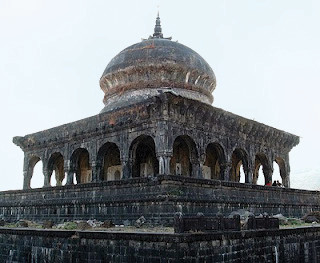
l - r: Emperor Aurangzeb; Sachin Ibrahim Yakut II, a descendant of Yakut Khan; The tomb of Sidi Kasim (Yakut Khan);
"The Sciddee marched into the village of Mazagaon where he established his headquarters. In this village we had a fort mounting 14 guns, which, to our shame be it spoken, was abandoned with such a degree of unseemly haste that its so-called defenders not only left behind them eight or 10 chests of treasure, but their arms and ammunition. All the chief forts of the island, including those of Worlee, Mahim and Sion, fell into the hands of the Sciddee without opposition; and, with the exception of the Castle, at present used as the grand arsenal of the Western Presidency, the whole of the Portuguese dowry was in the possession of the Chief of Junjeera. Captain Pean, with two companies of the Bombay Fusiliers, now Her Majesty’s 103rd Royal Regiment of Foot, was then ordered out to drive back an army of 25,000 men in position! The attempt was heroically made; but soldiers cannot perform impossibilities; and Captain Pean, with his gallant band, had, in consequence, to seek the protection of the Castle batteries.
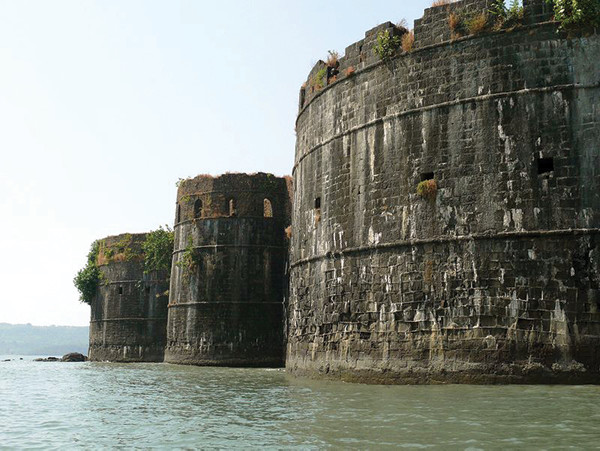
Janjira Fort
"Yakut Khan, the Sciddee, was a man of great bravery, and fully justified the confidence which his master Aurangzebe had reposed in him. Having secured all the strongholds of the island, he erected batteries on Doongaree Hill, within 200 yards of the Fort walls. He was thus able to keep the garrison not only under his eyes, but under his guns, and was, moreover, in a position at any time to annoy them either with shot or shell… The army of the Sciddee had been strongly reinforced, upwards of 40,000 of Aurangzebe’s best-equipped soldiers having established themselves before the Fort walls. The Jesuits of Bandora kept the Sciddee well supplied with provisions, and, as he had free communication with the mainland, he was never at a loss for stores of any description.
"The Governor, who had placed the English in such a critical position, finding, when too late, that he lay almost at the mercy of the Sciddee, tried to bribe his officers; but the mean attempt proved abortive, and he had to undergo the humiliation of seeing his base offers spurned with the contempt which they so richly merited. He then sent envoys to Delhi to sue for peace; but, after being subjected to every indignity, they managed only to procure a new firman. The terms of the negotiation were also most degrading to the English character — so much so, indeed, that, even at this distance of time, the blush of shame must suffuse the cheek of every high-minded Briton when he reads them. Sir John Child (Governor of Bombay, from 1680 to 1690) was ordered to leave India immediately; a full recompense was to be made for every loss that had been sustained by the Mogul Government; the officers of the Company, instead of being regarded as subjects, were for the future to be treated as slaves.
"The new arrangement was entered into in April 1690, but the Sciddee did not evacuate the island until the following June. Before quitting Bombay, he fired the fort of Mazagaon, and his troops left behind them a pestilence which in a few months destroyed a greater number of men than had perished by the sword. This was the Company’s first essay in the art of war, and the experiment, in addition to the humiliation and disgrace to which their servants were subjected, is said to have cost them nearly half a million of pounds sterling. The terrible lesson which had been taught them was not, however, thrown away; and from this period they resolved to strengthen the positions which belonged to them before attempting any further extension of their sovereignty.
"The fortifications of Bombay were therefore repaired, and the defenses of the island generally greatly strengthened. Rustom Dorab was called to aid the Government with his counsel; and, in 1692, when the plague broke out in the city, and when every European and all the garrison were more or less prostrate, he rose with the emergencies, took upon himself the charge of the government, and mustered and called out the militia, which was chiefly composed of the fishermen-class of Bombay. He fought with the Seeddee and his men, who had again invaded the place without orders from Delhi, drove them out of the island and retook the Dungerry Fort, dispatched messengers to Surat to the chief of the English factory there with the news, and, on his arrival in Bombay, delivered into his hand the reins of government. For that service Rustom Dorab was honored with the hereditary title of Patell of Bombay, which means chief or lord, with a privilege that the whole of the fishermen of the island, who so bravely fought under him, were to be placed under his immediate control. He was to collect their taxes for the Government, and also decide all civil and religious disputes amongst them.”
Submitted by Simin Patel
◆ ◆ ◆
From the archive