
Business
Gem of a business
The fourth generation of the K. Wadia family continues to focus on diamonds and designs
Most important to me is the legacy of K. Wadia. It is a huge responsibility on my shoulders,” says Viola Wadia, great-granddaughter of Kaikushru Wadia whose 110-year-old shop K. Wadia is popular among patrons seeking "the finest quality diamonds.” To the young scion who values integrity and loyalty, "money is low down on my list of priorities.”
Whilst 50 percent of their customers are Parsis, the balance comprise Bohris, Marwaris and Catholics. She is happiest when customers remain with them over generations and cites the recent case of a Catholic man who came to them to reset his great-grandfather’s wedding ring designed by K. Wadia in the early 1900s. "A lot of our Parsi clients have been doing that for years,” mentions Viola who designs jewelry and interacts with the clients whilst her brother Kaizad monitors the creation and quality control aspect of the business.
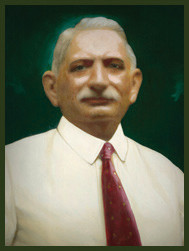
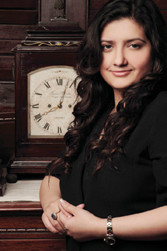
(Left) founder Kaikushru Wadia; (Alongside) Viola Wadia;
"My brother is a perfectionist,” says Viola. He is so particular about quality that to him every piece created by them has scope for improvement. "It would probably never reach the customer if he had his way!” she jests, removing the stunning earring she is wearing to demonstrate how her brother would study a piece of jewelry minutely, praise it and then observe that maybe the repositioning of one of the smaller stones would enhance its appeal. The woman in Viola can well empathize with the impatience of customers who are keen to take possession of their new asset.
The delay is not only from Kaizad’s side. She too contributes to it when she insists that every piece bought from their shop be certified by the internationally recognized Gemological Institute of India (GII) or the International Gemological Institute (IGI) both of which have extremely well reputed laboratories. "A wait of seven working days and a couple of thousand rupees spent on the certification are worth the piece of paper.” Besides the customer knowing the value of his/her new jewelry the written document would serve as a good reference even for future generations who would inherit it, she points out.
This practice has been introduced ever since Viola faced an irate customer who insisted that K. Wadia had deceived her by using substandard diamonds. When the lady refused to listen to reason, Viola urged her to get her set evaluated by the IGI and only then was she convinced of the quality of the diamonds used. Relatively new to the business then, Viola felt she was put through "such hell, I must have lost one week of my life in one day.” She could however sympathize with the lady realizing that "When one has invested hard earned money in a jewelry set no one wants to lose that.”
Value for money is what she believes in giving her customers. In fact she maintains that she offers "extremely competitive rates” and is "partial towards her Parsi clients.” She is surprised therefore when some Parsi customers feel reluctant to approach her believing their modest budgets would not permit them to visit K. Wadia. Dismissing the misapprehension that K. Wadia only likes to deal with upmarket clients, Viola asserts, "Maybe in my dad’s time it was true because he was alone and didn’t want too many customers. But this no longer applies to the younger generation. If you were to do research you would realize how competitive our rates are as compared to others’.”
She has only been involved in the business since the last decade when she returned to India, her dad Sarosh being critically ill that time and passing away soon thereafter. In USA, she was studying International Business Management at the Pepperdine University after her schooling from Bombay’s Bai Avabai Petit and graduation from St Xavier’s College. On joining the business she started taking an interest in designing when she realized "it was in the blood.” Prior to that if anyone used the phrase "it’s in the blood” she would retort, "It smacks of nepotism.” But once she started dealing with jewelry she realized how effortlessly it came to her having been exposed to it since her early days when she whiled away her time at the shop, interacting with designers and leafing through sketches. Whilst the vine and the wreath designs are their perennial favorites, creations of over a century are preserved in the stacks of files that have designs of earrings, necklaces, rings, sets… If a customer is not happy with the variety therein he/she is asked to take a look at her laptop where too are stored design images.
As per the family tradition, it is one of the Wadias who comes and opens the shop at Grant Road each day, the shutters kept partially down to "keep a low profile.” Entry to the premises is permitted only once the nature of visit is known. At their store, the showcases are bereft of jewelry. This has been the practice since Sarosh took the decision in the mid 1980s not to have too many readymade sets. Sarosh had inherited the business from his father Homi, son of founder Kaikushru who at the age of 45 decided to venture into the diamond business after he was confident that he had received sufficient training in the trade. Successive generations were all inducted into the business from a young age. Viola recalls that Kaizad had to compulsorily spend every Saturday at the shop since the time he was in the sixth grade.
In the last century "Grant Road was the happening place,” relates Viola. After opening their shop at Taj Mahal Hotel in 1906 they continued there for the next seven years but tired of sitting and waiting for business to pick up, they shifted to Grant Road where they would be visited by "the who’s who and smartly dressed customers.” Having spent nearly 100 years on these premises Viola says, "The building belongs to us. I can’t imagine being anywhere else.”
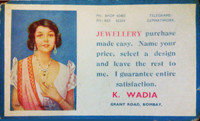
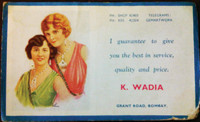

Vintage cards advertising
K. Wadia service
During her father’s time the shop would be open from 8 in the morning to 5 in the evening. But in those days women were mainly homemakers, could afford to visit the shop during the day, leisurely make the choice of design, occasionally get it approved by their husbands, and then place the order. "But now both the husband and wife want to be involved in the selection process and with both of them working, they want to visit K. Wadia in the evening,” says Viola. So instead of working from 8 in the morning to 8 at night, they decided that the owners and the craftsmen would start at 12. By the time she leaves the shop it is invariably 9.30 or 10 p.m.
Besides their Bombay customers, K. Wadia’s clientele includes "a lot of Indian royalty although unfortunately they sell more than they buy.” The royal families in the Middle East too have been their loyal customers for years and she is happy to visit them periodically and secure business unless they are interested in large precious stones when they are invited to come over to India and take a personal look.
"The credit for (securing) the cream of my clients goes to my ancestors,” she accepts. "They keep me in the luxury that I am,” acknowledges Viola who resides in "a beautiful, big bungalow on Pali Hill” where she hosts many parties and increases her customer base. Presently among their patrons are many Bollywood actors and actresses, contacts developed by Viola.
Sourcing their precious stones from Belgium, Antwerp, Israel as and when the need arises, Viola mentions how the relationship between the suppliers and K. Wadia has endured over generations. Instantly drawing up a color/clarity chart she suggests Parsiana carry that to educate the readers. As explained on the K. Wadia website, diamonds are generally evaluated on ‘4 Cs’: cut, color, clarity and carat size. When a diamond is cut to perfection, neither too deep, nor too shallow, light will reflect from inside the stone. Further, white diamonds are graded on a color scale from D to Z based on the degree to which a diamond approaches colorlessness. The D, E, and F variety that are considered colorless are most rare and valuable. Actually even diamonds that appear transparent display tints of color barely perceptible to the untrained eye. Unlike white diamonds, fancy colored diamonds are much sought after particularly in yellow, pink and blue with the more intense the color, the greater its value.
Clarity of diamonds is gauged from inclusions that appear like clouds or crystals or feathers. Those that have no inclusions are categorized as flawless or internally flawless (IF); slightly included are graded as VS; those very very slightly included as VVS. "At K. Wadia we gua-rantee IF and VVS clarity stones only,” declares the website.
Potential customers are also informed that larger diamonds are special because they are found less frequently in nature. Size is measured in carat weight. Diamonds of equal carat weight may differ in price depending on their brilliance, symmetry and cut. Whilst the upper limits may vary, the tiniest diamond at K. Wadia costs Rs 550 and a simple, elegant ring is priced around Rs 5,000, says Viola.

K. Wadia: diversified from jewelry to watches
New entrants seeking to enter the jewelry business now dominated by Gujaratis and Jains "should keep their eyes wide open,” she recommends. "I know people who have tried to enter and lost out.” She would advise those interested in this line to be properly educated, get a degree in gemology followed by five-six years of experience working with someone in the trade before setting up their own business. "It is a huge liability. A client comes to you with their hard earned money... with complete trust. You better know what you are doing. A jeweler may be doing 10 wedding sets in a month but for the customer it may be only once or twice in his lifetime.” In a business where trust is paramount, Viola reveals how "the first person who cheated us after dad’s death was someone who was dealing with him for 30 years.”
The youth in the community "are getting everything on a platter. Nobody wants to work for it anymore,” observes the jeweler. Seniors, though, should "encourage youngsters to start a business,” she recommends referring to one salaried Parsi youth who easily could offer good competition to the GII and IGI were he to branch out on his own.
Welcoming people to visit their website Viola refers to K. Wadia’s plans to introduce a range of readymades and have a second store in Bandra. Whilst they continue "to get a lot of new customers, they are not Parsis,” she regrets.
Looking for a marriage partner, Viola, 32, believes, "It is important to get a Parsi. Till I can push it, I will try. I am very proud of who I am. I’d want my children to experience the same pride.” Even before Parsiana could seek her views on accepting children of interfaith marriages Viola is keen to share her thoughts on the importance of treating women on an equal footing with men. "I think it is very unfair. We are the ones influencing the children. A mother’s influence is the most important. Everything is done through the mother. It is the mother who teaches religion.”
She may not wear the sudreh kusti at all times but Viola does feel the need to go to the agiary once a fortnight, either to the Tata Agiary in Bandra which she considers "so peaceful and lovely” or the Soonaiji Agiary at Gowalia Tank where she feels more at home having frequented it since her childhood when her grandmother used to live in Jer Mansion.
Although her dad chose dakhmenashini Viola says, "I am on the fence. I believe a religion should move with the times and be made a little more practical. A religion has grown out of sociological reasons. We are not in the desert area of Iran, we are in Bombay,” she reminds the community. "Be the change you want to see.”
◆ ◆ ◆
From the archive