
Life-Style
Budgeting for a bash
Parsiana compares the escalating costs of organizing a wedding or a navjote reception now as against six years earlier
While the number of marriages and navjote ceremonies continue to decline and the guest lists are curtailed, the only element that’s growing are the bills for the joyous functions.
As compared to the cost of organizing a wedding/navjote function six years ago (see "Budgeting for a bash,” Parsiana, December 2003) the rates have almost doubled on items like food, jewelry, trousseau, photography and videography, and have shown a five fold increase for music and floral decorations. If planning a celebration in the near future, families should therefore be ready to spend around two lakh rupees, even if the guest list is restricted to 100 individuals. Many of the service providers are already booked for 2010 with some claiming that they are in demand even in 2011.
The cost of booking a venue too has shown a jump. In some cases it is double and in others triple. Surprisingly the Dadysett Atash Behram at Fanaswadi is the only venue in Bombay that has maintained its booking rate of Rs 1,000, the same as in 2003.
The largest item of expenditure, invariably is jewelry but where six years ago a wedding set comprising necklace, earrings, ring with an optional bracelet would have cost Rs 40,000, today no gold set is available for less than Rs 80,000. The senior members of the community place a premium on jewelry set in 22 carat gold unlike "the youngsters who are open to setting their jewelry in 18 or 12 karat gold and want to use more of 18 carat white gold,” mentions Khurshid Vakil of Framji Rustamji Choksey, among the oldest shops in the business. "Gold is gold, it will give us good returns any time,” believe most customers despite the prevalent rate being Rs 16,000 (for 10 g) and expected to further escalate. "Most Parsis want value for their money,” and are not willing to compromise their standards. Investing in guineas and gold bricks they think is a safe investment which would fetch instant cash in times of sickness or emergency. While Framji Rustamji Choksey are willing to execute orders as per the catalog designs to those who ask for the rodium finish, they advise that such pieces be well looked after so that it is not confused with silver by future generations.
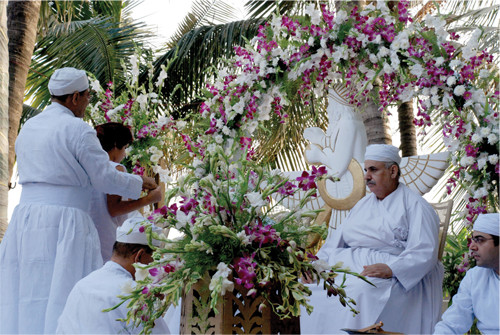
Celebration of a navjote or wedding is a costly affair
Jewelers need to stock a little of everything – little contemporary, little Parsi. People want to see and if you don’t have choices (even if it be in catalogs) they are willing to go elsewhere. "We are not Marwaris. We do not have so much disposable income so if customers like some set which is not within their budget we tell them to buy the earrings, necklace and ring now and purchase the bangle when they have saved a little more,” adds Vakil. They are even permitted to purchase different units from different sets if it appeals to them. When quoting a rate for a particular piece, Parsi jewelers feel obliged to give the breakup of the gold that has been used, the price of the jewels, the making charges, to keep the customer better informed. Vakil also observes that 95 percent of their customers are Zoroastrians, a large percentage of them being Iranis and remembers the time in the 1970s when contingents from Iran would invariably make a halt at their shop.
The practice of "wearing plain gold sets is almost gone,” mentions Yasmin Divecha of Pestonji and Company who finds that most of her customers want "more stones. The youngsters like the American style which is loud and chunkier with more semi-precious stones. Those older prefer the streamlined, sophisticated European style.” Often they are "remaking what they have and don’t wear, or adding something to what they already have.” Comparing the attitude earlier when "janas (jewelry) was considered most important,” Divecha notes that currently "if it is impressive” it is good enough for the hosts. They would rather spend more on the overall effects to add glitz and glamor to their function.
Newly navjoted girls may be still presented a pendant by their grandparents or earrings by their parents but the cuff links and buttons that were earlier presented to boys are now definitely out. When Divecha’s advice is sought on alternate gift ideas, she recommends an asho farohar with a diamond that can come in the range of Rs 9,000 to 30,000.
The most eagerly awaited highlight of a Parsi function is clearly the food for most guests. The basic menu therefore is expected to include meat, fish and chicken and the rate for a basic paatraa starts at Rs 400 as against Rs 210 six years earlier. If the host chooses paatraa ni machhi instead of saas ni machhi, the cost increases. Complimentary vegetarian and non-vegetarian starters are popular with the guests as also the caterer. Vegetarians are almost considered persona non grata.
"As compared to two years earlier, the numbers have definitely diminished,” comments Tanaz Godiwalla comparing the prior trend of hosting at least two functions when celebrating an event with the single function norm this year and that too with a substantial reduction in the guest list and cutting down of frills. Not only are the invites issued fewer, even the invitees think twice before accepting an invitation for they would have to bring out the choicest clothes and jewery, arrange for their conveyance besides presenting handsome gifts in cash or kind. "It is a difficult time for everyone,” she sums up.
Although the crowds may be smaller the hosts are still "very conscious of quality,” observes Farrokh Khambata of Catering and Allied who believes in constantly innovating and researching. Whilst reintroducing dishes like bhaji dana nu gosht which had been almost relegated to the back burner, he improvises with certain tastes by offering khatti-meethi sea bass or paatraani kolmi. His banquet rooms above his Joss restaurant at Kala Ghoda, with a combined capacity to entertain 600 guests, Khambata finds are popular with expatriates who are happy to pay his per head rate of Rs 950 that includes all facilities barring flowers and photography.
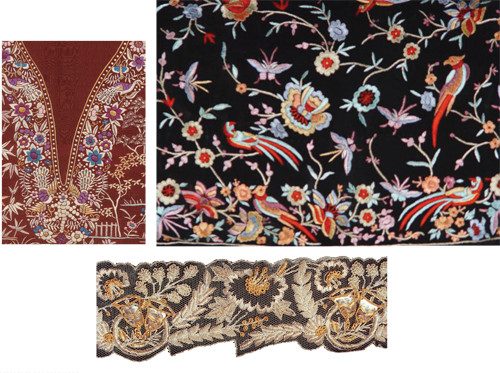
Gara embroidery created by Armayesh (far left), My Beautiful Embroideries (left) and Revival (below);
Likewise Cheron Caterers too offers the facility of booking their service with the open ground that is part of St Joseph Primary Section at Bandra in which case they charge Rs 525-625, depending on the number of guests catered to, a higher number bringing down the costs per head, states Viraf Ghaswalla. Their rates are inclusive of food, lights, music, seating and flowers, with photography remaining the only head on which the host has to bear an additional cost.
For functions at baugs, if alcoholic drinks are to be served, the hosts have necessarily to procure a permit that costs Rs 8,000, mentions Ketayun Bomi Khambata of Khambata Caterers. If Colaba’s Jeejeebhoy Dadabhoy Agiary (popularly known as Colaba Agiary) or Jogeshwari’s Malcolm Baug is the venue selected by the hosts, caterers invariably quote higher rates because of the distance involved. Within the community guests like to ensure that the péramni (cash gift) they offer the hosts covers the cost of the meal. For all practical purposes the gift amounts to paying the host for the food eaten rather than a gesture of love or friendship.
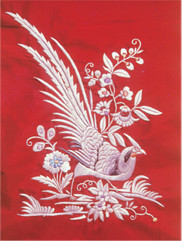
Naju Daver;
A wedding trousseau for a bride which earlier included four saris is no longer considered a necessity and in fact even those in the business advise their clients to go in for two saris with two additional outfits like an exclusive top that can be worn with jeans or as a sari blouse. While the simplest of sari on lace, can cost Rs 10,000, garas would cost around Rs 40,000, saris with reshamni kor around Rs 15,000 and those with real zari kor borders over Rs 60,000. "It is better to spend on saris than to go overboard on decorations,” reiterates Zenobia Davar. "A sari will remain for a lifetime or even longer” but the decorations last only for the length of the function. "Each of my bridal saris is one of a kind, exclusive. I never repeat a design,” maintains Davar. For those who come to her with a lower budget, the design would expectedly be simpler, but she would "never compromise on quality,” she explains. Only after obtaining the client’s approval on a sample of the work, would she proceed with the entire sari.
"While my Parsi clients still prefer ordering saris in the traditional gara colors of red, maroon, black and purple, the modern clients prefer colors such as pink, golden yellow, peach, mint green, cobalt blue, etc,” conveys Perveez Aggarwal of My Beautiful Embroideries, adding, "Hand embroidery done on fabrics such as silk georgette and chiffon looks translucent” adding to its aesthetics. Adopting designs from old garas, to lend an unusual touch she intersperses some embroidery with gold and silver thread. "These look particularly grand when old Parsi borders are affixed like they were in our parents’ time,” she declares. For the saris that she offers the cost may vary from Rs 25,000 for one with a nine yard, 12 inch border and one meter pallav to Rs 55,000 for one that is covered with embroidery. As she candidly declares, gara saris having been in vogue continuously for the last 200 years. "My advice to clients is to go in for the best sari they can afford…I assure them that silk georgette and silk chiffon wear well and will replace them free if the sari fabric gives way.”
"The embroidery from both surfaces looks the same in my garas. That is my speciality,” says Rayomand Maneckshaw of Revival. With his garas costing upwards of Rs 40,000 he tries to offer the authentic designs on crepes or georgettes knowing that these are heirlooms to be treasured. For those seeking something new he embellishes the embroidery with Swarovski crystals. As an engagement sari usually red, burgundy or maroon are the colors preferred but tastes may differ and he has also known a mother of a navjote child choose a black gara for her function.
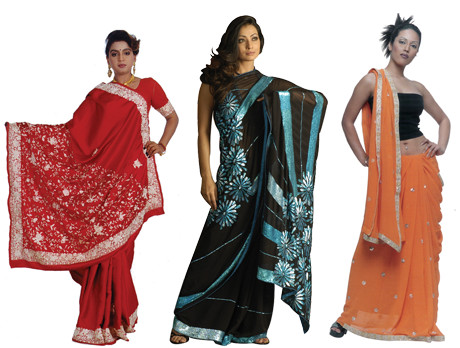
Creations by (from left) Mahavir’s Embroidery, Queens Emporium and Zenobia Davar
As compared to hand embroidered garas that may cost Rs 6,000 to Rs 40,000 depending on the nature of embroidery, machine embroidered garas come in the region of Rs 3,000 to Rs 10,000 at Mahavir’s Embroidery. Saris with jari and zardosi work come in the same range too. In fact the alteration work that they undertake, salvaging the embroidery from old saris and transferring them onto new fabrics works out to be more expensive, the cost ranging from Rs 10,000 to 25,000 depending on the labor involved. They cater to a cross-section of customers, mentions owner Naresh Shah. And to their Parsi customers they feel obliged to offer a matching petticoat as also a sudreh as a complimentary gesture. Besides their saris, their kurtis bearing Parsi embroidery too are popular, particularly with their overseas clients.
"For weddings it is usually white, off-white or pink that are in demand and the fabric could be lace, georgette…” reports Gulshan Kolah who gained fame making pugrees and then expanded the business by accepting orders for wedding saris and navjote dresses. Whether the sari is embellished with sequins or diamantés are used depends on the buyer’s budget.
Life is made simpler for grooms due to the website www.dshamjidagli.com, states Bhupendra Gohil. Since the site specifies how a groom should take his measurements, prospective customers need no longer come to their shop D. Shamji and Company when booking their daglis. This initiative has earned them many customers from abroad and in fact in the last two years, nearly 25 percent of their dagli business is from overseas, mentions Gohil. The demand for daglis has declined by five to 10 percent over the last few years, he regrets, citing two factors: interfaith marriages when there is no demand for daglis; and family elders wearing their old daglis instead of having new ones stitched on the rationale that it will only be worn for one evening. Although they are willing to accept orders for only a dagli (Rs 1,650 for an adult and Rs 1,300 for a child), they offer a package of dagli and shirt stitched in Swiss cotton with pant in Grasim material for Rs 3,500. If instead of Swiss cotton a client prefers the imported Twill material then the cost would rise by Rs 1,000. For a navjote boy the cost for the three-piece set would be Rs 3,000 and 4,000 respectively. During season (September to February) an order has to be placed up to two months in advance and during off-season when they are busy stitching sudrehs and lehengas they may execute an order even within two days!
A new pugree for a groom available from around Rs 5,000 upwards is considered a must as men would not like to wear someone else’s headgear. A pheta would cost less.
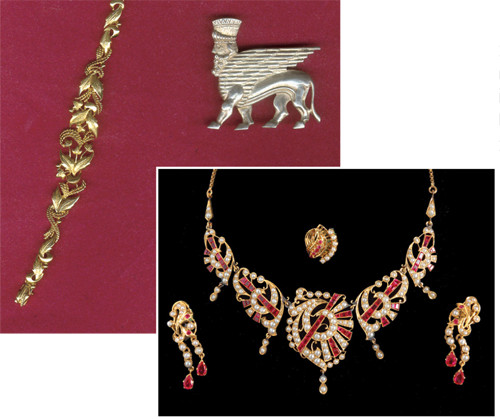
Jewelry designed by Pestonji and Company (left) and B. Jamshedji Jivanji
A navjote dress for a girl would start at Rs 5,000 if it is made of lace and could rise to Rs 15,000 if there is embroidery work on the dress. Whilst earlier white and off- white were the preferred colors, the present trend is any light color.
"Today photography is more of a craft than an art,” believes Homyar Mistry of Homz Prints referring to the freely available digital cameras that are user friendly and do not require to be handled by any professionals. "In fact today we are facing competition from four and five-year-olds who are able to capture moments on their home cameras,” corroborates Sarosh Daruwalla of Mazda Audio Video Lab. Professionals may come with equipment whose value would be upwards of Rs 50,000 so unless a family is particular about perfect results they would not engage a photographer’s service for the divo-adarni and madavsaro functions that precede the wedding. With cameras available for as little as Rs 5,000, they might as well make that investment instead of hiring a professional who would generally charge Rs 5,000 for a photography assignment and Rs 10,000 for videography. "While commercial photographers may sublet their services, professional photographers ensure that they are present in person to capture the event and are therefore booked in advance,” notes Mistry referring to the advances in technology which enables a photographer to offer special effects by using the Photoshop software, digital albums, etc.
Despite the "cut-throat competition,” the husband-and-wife team of Armaity and Rashid Bamanbehram ensure that they do not accept more than two assignments on one day believing that they would not be able to do justice to a function if they are not there in person. As compared to earlier times, "utsa-umang thandu chhè (enthusiasm is low),” he comments. Noticing the "increase in spending power,” Shazad B. Patel of Superstar Video Labs feels the need to offer "innovative services with improved technology – a little extra to customers who want fresher products.” Their banner offers not only photography and videography services but also recorded music for a combined rate of Rs 25,000.
While expenditure on flowers and food would give transient satisfaction only for an evening, money spent on photography is necessary to preserve memories of this "once in a lifetime occasion,” Daruwalla reminds his customers. With 50-60 percent of his income being used to constantly upgrade and update his equipment, he takes pride in reporting that "there has not been a single day when my system has conked off. Everyone’s function is important.” Most customers are content to receive two sets of DVD with one camera cassette on which editing, dubbing, mixing is possible. There are some though who now insist on HD (high definition) video on extra payment. Undertaking photography/videography assignments himself, Daruwalla is happy that his son Aarish looks after the second division of their business that offers recorded music. He repeatedly stresses though that in a free market there should not be "a monopoly of any service provider who may misguide clients by saying ‘package sastu parsé (a comprehensive package of food, flowers, music, photography will work out cheaper).’”
Band masters seem to be giving way to DJs (disc jockeys) who have an eclectic collection of western and Bollywood music. Among the few to offer a choice of both, Zubin Mehta and his Melody Boys provide live band music for Rs 20,000 if the host wants a mix of both western and Indian music. If it is exclusively English or Hindi music the rate comes down to Rs 15,000. For his DJ assignments he charges Rs 10,500. For the live band "sometimes there are three or four bookings in a month and sometimes none,” mentions Zubin Mehta as compared to Marazban Mehta of Darling Orchestra who notes that his band is available for Rs 6,500 but bookings are down.
For floral decorations the expenditure incurred "would depend on the design, customer preference, venue, stage, choice of flowers,” sums up Havovi Readymoney of Afreen Florists. "I am an artist so people come to me in the hope of getting new designs,” says Sarosh Dumasia of Khushnuma Florist who either shows prospective clients his drawing books or if they come to him with descriptions of what they had seen at pavilions or open grounds, adapts those designs to suit the baug parameters.
As elaborated Soona Patel of Baimai Flowers, Colaba Agiary works out expensive because there are so many arches to be decorated. And so too is the case at Allbless Baug which not only has arches but also requires two torans – one for the entrance and the other for the stage. Usually floral decorations at Cama Baug cost upwards of Rs 15,000, for Allbless Baug around Rs 20,000 and for Colaba Agiary, Rs 30,000. Although Patel may have bookings up to 2010 she conveys her experiences with some clients who at the last minute tell her that they do not require her services since no advance payment is demanded by the florists at the time of booking. Just as some clients may feel she is exorbitant, there are others who, if she underquotes a rate, wonder whether she will be able to deliver satisfactory services at that rate!
The size and weight and texture of invitation cards too differ from season to season. The current preference is to have a "single card with wooly paper or tissue paper affixed on it bearing an asho farohar logo or emblem or bow,” points out Kainaz R. Chinoy of Union Press. The simplest card with a plain red ‘kangri’ border would be available for six rupees a piece. If there is a little design, the cost would increase to Rs 9-10. A three-fold card works out to Rs 13-14 and the handmade varieties are available for Rs 25 and above. These rates are inclusive of the reply card in red ink. If a customer wants gold or silver ink for the reply card, the cost would increase by one or two rupees. Likewise embossed printing, whether in red or gold or silver works out more expensive as compared to the plain printing. To save on postage for a reply card in a postcard format which requires a six-rupee stamp, most prefer to insert the card in an envelope where the stamp to be affixed is of four rupees.
Not all service providers reap huge profit margins when working with the community. But as Homyar Mistry explained, "We would rather charge less and stay with the community. We are more comfortable working with like-minded people.”
Rates for venues
Baugs and gymkhana premises are the venues preferred by most members of the community for their wedding and navjote celebrations despite a couple of them being available at nearly Rs 1,00,000, an escalation of three times the rate prevalent six years ago. Parsiana lists the prices quoted by the staff at the different venues but readers should verify the same before proceeding with their booking.
Allbless Baug can be booked for Rs 20,700. Standard lights for the full baug cost Rs 10,700 plus service tax; for a jashan booking, illumination is available for Rs 5,350 plus service tax.
Athornan Boarding Madressa (Dadar) has different rates applicable depending on the duration of the booking, and whether the passage and air conditioning is required. Thus for the full day (8.30 a.m.- 8.30 p.m.) – non-A/c with passage the rate is Rs 8,169; without passage, the rate is Rs 6,066 (both rates include Rs 1,000 as refundable deposit). For half day (8.30 a.m.-2.30 p.m. or 2.30 p.m.-8.30 p.m.) – non A/c with passage the cost works out to Rs 4,963; without passage Rs 3,860 (both rates include Rs 1,000 as refundable deposit). For a full day with A/c and with passage the rate is Rs 13,236 + Rs 1,000 as refundable deposit; for half day A/c with passage Rs 8,051 + Rs 1,000 as refundable deposit. The cost of booking the hall upstairs with A/c works out to Rs 6,948 + Rs 1,000 as refundable deposit.
Banaji Atash Behram hall can be booked for half day (7 a.m.-2.30 p.m.) for Rs 4,412 without A/c or for Rs 8,824 with A/c. For the second half day (5 p.m.-10.30 p.m.) the rates increase to Rs 6,618 without A/c and Rs 13,236 with A/c. The cost of booking the hall for a full day (7 a.m. – 10.30 p.m.) is Rs 9,927 without A/c and Rs 18,751 with A/c.
Cama Baug (big otla) is available for Rs 3,758 (inclusive of service tax) of which Rs 1,000 is a refundable deposit. The ground floor premises of the small otla can be had for around Rs 600-700 plus a refundable deposit of Rs 500.
Dadar Gymkhana grounds can be booked for approximately Rs 55,000 by members and Rs 1,10,000 by non-members (booking to be done through members only).
Dadysett Atash Behram charges Rs 1,000 for booking the otla for a full day, the same rate as was prevalent in 2003. The Atash Behram hall is available for an additional Rs 100.
Elphinstone Cricket Club permits booking of its terrace by members for Rs 4,000 and by non-members for Rs 5,000 (bookings to be done through members only).
Jeejeebhoy Dadabhoy Agiary (Colaba Agiary) charges Rs 82,060 (of which Rs 60,000 goes to the Agiary as donation, Rs 22,060 for baug booking + service tax). Full lights for the compound would cost an additional Rs 22,000.
Joss restaurant has banquet facilities on its first and second floors which can be booked for Rs 950 per head (includes food and other facilities but not flowers and photography).
Malcolm Baug grounds are available for Rs 11,030 (inclusive of tax) in season (November-April) and Rs 6,618 in off season (May-October). Recorded music is arranged for Rs 5,000 and lights (includes lighted Asho Farohar, water fountain, welcome sign, decorative lights, two stages, bar with canopy, one video point and parking area) for Rs 36,951 (includes tax). For half the compound, the lights cost Rs 23,715. For their hall they offer a mini package which inclusive of tax costs Rs 6,618 for 100 people (includes 100 chairs, 40 tables, 20 table covers, kitchen facilities and parking space).
Sohrab Palamkote Hall offers its non-A/c ground floor hall facilities either for a full day (7 a.m.-10 p.m.) or half day (9 a.m.-3 p.m. or 4 p.m.-10 p.m.) at Rs 12,730 (includes Rs 1,000 as refundable deposit). The rate includes 200 chairs. Music must stop at 9.30 p.m. The hall upstairs for a full day is available for Rs 21,451 with A/c (includes Rs 2,000 refundable deposit). A/c to be shut off between 3-4 p.m. Half day charges for the same are Rs 14,833 (includes Rs 2,000 refundable deposit).
Saher Agiary charges Rs 26,000 for use of its grounds which goes as donation towards the Agiary.
Sethna Agiary charges Rs 1,200 for use of its hall whether for a full or half day plus Rs 1,800 being the cost of lights and fans. For half day the cost of the lights and fans works out to Rs 900. Their five workers are to be paid an additional Rs 200.
◆ ◆ ◆
From the archive