
Books
Religion, rituals and reality
Zoroastrianism: An Introduction by Jenny Rose. Published in 2011 by I. B. Tauris and Company Limited, 6, Salem Road, London W2 4BU, UK. Pp: xxiv + 303. Price: £ 52.50 (hardback); £ 14.50 (paperback).
As a result of events in the last 10 years, starting with 9/11 in the US, there has been a surge in enrolment at religion studies classes at all universities. The origin and beliefs of various religions are being examined and discussed in various fora, including social gatherings.

Jenny Rose: latest information on the religion
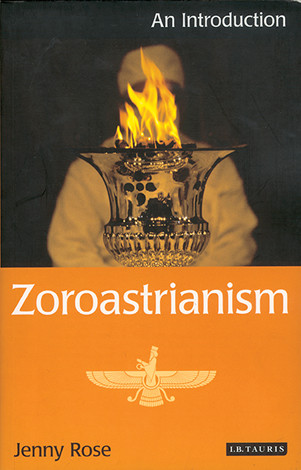
In the West, Zoroastrianism or Zarathushtra are generally well-known but very few have any insights into their teachings. Jennifer (Jenny) Rose, associate professor of Zoroastrian studies in the Department of Religion at Claremont Graduate University, California, and visiting associate professor of religion at Stanford University, Palo Alto, California, has made a bold and convincing effort to educate the world, especially the youth, about the religion through her new book Zoroastrianism: An Introduction.
Rose points out that there are hardly any Parsis in Kerala today, but in the 9th century AD there seems to have been a sizable Parsi presence. This is evident from an inscription on a copper plate regarding a grant made by a local Hindu king to the Christian community; among the signatories as witnesses are several Zoroastrian names written in the Pahlavi script! There are many more such nuggets of information on Parsi history in India in the book that would be of great interest to all Parsis, whether scholars or lay folk. Parsis in India should read Chapter VII, "Parsipanu: Zoroastrianism in India” to understand that the Parsis of India can hold a patent on Parsipanu, but they have no exclusive right over Zoroastrianism which was and will always be an Old World religion, not fettered by the borders of India or confines of Bombay.
In this interesting book Rose also describes the Rivayats or the exchange of letters between the learned Zoroastrian priests of Yazd in Iran and the Parsi Zoroastrian priests of India. The first Rivayat was brought from Iran to India by one Nariman Hoshang of Bharuch in the year 1478. A letter was also given to Hoshang to deliver in India in which it was stated that until that time the Iranian Zoroastrians were not aware that those who had gone by sailboats to seek refuge to India had survived! In the second Rivayat of 1481 the Iranian priests exhort the priests in India to learn Middle-Persian so that they could exchange correspondence in a more convenient manner. The author notes that a great proportion of the Rivayats, including the third one in 1511, dealt with the best way to survive under Muslim oppression. Other concerns expressed in the Rivayats were: the proper way to recite the daily prayers; the tying and untying of the sacred kusti; the consecration and maintenance of an agiary or atash behram fire; the way in which priests should perform various ceremonies; the purity laws, especially when dealing with non-Zoroastrians; and the correct disposal of a Zoroastrian corpse. There was also much general information on what the Iranians believed about Zoroastrian marriage contracts, polygamy, education of children and the life of Zarathushtra.
Rose, who is the grand-daughter of Shereen Khorshid Boga, has read widely on the subject. She has included numerous citations and mentions her sources for this thorough treatment of Zoroastrianism. This book is up-to-date and includes the latest information on the Zoroastrian faith and the diaspora of the Parsis.

The author's grandmother Shereen Khorshid Boga
Rose also discusses Zoroastrianism in Central Asia. For example, the book has a picture of an ancient parchment from Sogdia which has the prayer Ashem Vohu written by hand in the Sogdian language, a Middle Iranian language that was spoken in Sogdiana, located in modern day Uzbekistan and Tajikistan.
It remains to be seen, Rose says, which (if any) of the current manifestations of the Zoroastrian religion (Parsi orthodox, Parsi liberal, Parsi neo-traditionalists, Parsi traditionalists, Iranian Zarathustis, Russian Zoroastrians, or those from the Caucasus) will survive into the next century starting 2100. Current trends indicate that universally applicable resolution is likely to occur in the diaspora that would include all Zoroastrians and not just the orthodox Parsis. While Zoroastrian numbers continue to fall, unity and consensus should be the gateway to survival.
The author has taken on a very tall order to explain and summarize for readers such a polyglot of scriptural and religious tradition as Zoroastrianism. Everyone who wants to know more about Zoroastrians, the Parsis and their religion and history should read the book. I cannot think of any other book in modern times that deals with the subject in such a comprehensive manner. Perhaps, due to several reasons it may not be possible for all to go to Iran and visit the land of our forefathers and places connected with the birth and early years of the Zoroastrian religion, but there should be no excuse not to read this well-written and lucid account of Zoroastrianism.
Dr ARDESHIR B. DAMANIA
◆ ◆ ◆
From the archive