
Cover Story
The Ruttonjee-Shroff saga
Hong Kong’s Rusy and Purviz Shroff continue the family tradition of caring for the dispossessed
He has inherited a tradition of business acumen, wealth and philanthropy. And, like his predecessors, has carried each a step further. Like his predecessors too he has been honored and decorated. And, like them, has experienced personal tragedies. At 88 the doughty Rusy Motabhoy Shroff, MBE (Member of the British Empire) is the face of the 119-year-old Ruttonjee enterprise in Hong Kong.
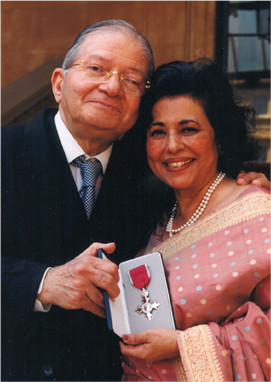
The Shroffs: domestic felicity
The managing director of the Ruttonjee Estates Continuation Limited was most recently in the news for winning the Pravasi Bharatiya Samman Award 2006 which honors non-resident Indians for their contribution in promoting India in their respective adopted countries. Unable to make the trip to Hyderabad — where President of India Dr A. P. J. Abdul Kalam presented the awards to the 16 other recipients — for want of a direct flight from Hong Kong, the octogenarian was conferred the award on the President’s behalf by India’s consul general in Hong Kong Basant Gupta at the Republic Day celebration held at the Holiday Inn Golden Mile.
Commandeur du Confrerie des Chevaliers du Tastevin (a body of epicurean wine tasters), vice president of the Hong Kong Tuberculosis, Chest and Heart Diseases Association (retiring voluntarily after 17 years as chairman) which operates the 614-bed Ruttonjee Hospital and Freni Care and Attention Home, Shroff has enough energy left to personally scrutinize appeals for charity and aid the Community Chest of Hong Kong, enthuse over a string of winning race horses, track cricket and soccer on TV…as note cover articles in BR (Bharat Ratna) International, March 2006 and People of Indian Origin (PIO), April 2006. Nor is this done at the expense of social commitments. As his wife Purviz (née Moogat) told BR, "Sometimes I try to apply brakes also, but he says ‘No, we have to go.’ ...He likes going to the functions and enjoys them.”
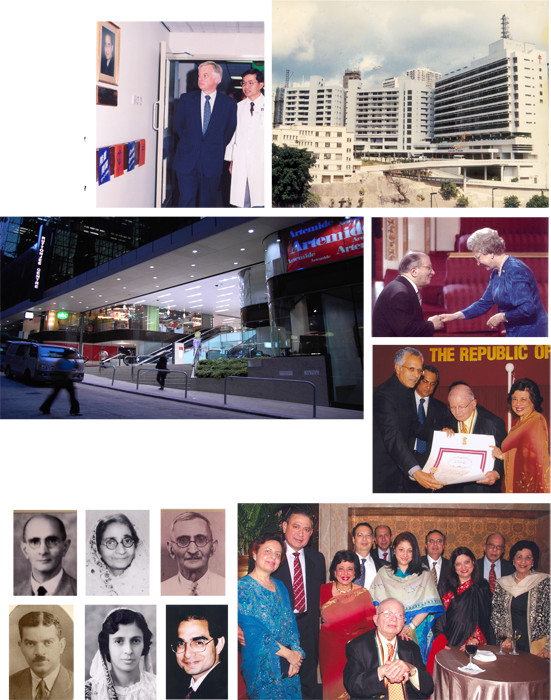
Above: Governor Chris Patten inaugurating the Zarir Shroff ward at the Ruttonjee Hospital (further right). Below: The Ruttonjee Centre at night; CBE from Queen Elizabeth; receiving the citation of the Pravasi Bharatiya Samman; Bottom: L to R: (First row) Jehangir, Banoo and Hormusjee Ruttonjee. (Second row) Motabhoy, Freni and Zarir Shroff; the Shroff family
Giving first priority to his business as "all other activity is dependent on that,” Shroff told BR, "I enjoy going down to my office at 7.30 in the morning. I work until 11.30 and then go up for lunch. We live in the penthouse above the office. At 2 p.m. I’m back in the office where I work until 4.30 p.m.”
Shroff’s love for Hong Kong and concern for its people goes back a long time. Born in Bombay, the son of silk merchant Motabhoy and Tehmi (née Master) had spent the first few years of his life in Shanghai whence the family migrated to Hong Kong to avoid the freezing Chinese winters. In response to a Parsiana query he writes that Hong Kong, which at the end of World War II was home to around 500,000 people, now counts a population of nearly seven million. Though the land reverted to the People’s Republic of China in 1997, as a Special Administrative Region (SAR), "There is no change in lifestyle …except for the change of flags. Hong Kong has a civil service which functions very well. It is one of the top financial centers of the world. The Hong Kong and Shanghai Banking Corporation Limited (HSBC) is one of the largest banks in the world. There are no financial restrictions or controls. Hong Kong has the best public transport system and excellent infrastructure…There are neither electricity cuts nor shortage of water. Hong Kong is a safe, clean and very well maintained city. The Parsis (here) are happy and content. We are a close-knit community.”
Shroff’s other love is more personal. "I consider myself very fortunate to have Purviz as my life-partner…My dear Purviz shares all my endeavors in social, business and charitable work. We are very content and God has blessed us in many ways,” he told PIO describing their first unexpected meeting in 1968 at the Bombay airport where he made a stop-over on returning from a business trip to Europe: "It was love at first sight that resulted in our marriage in 1970.” Alumnus of the Dastoor School in Poona and a graduate in child psychology, the daughter of Dinshaw and Hilla was teaching at Bombay’s Queen Mary School when they met. Settling in Hong Kong she continued her teaching profession, running Kiddyland, a kindergarten play group, for 20 years. Purviz now works four half-days a week at Mother’s Choice, an organization that takes care of babies of unwed mothers and is permanent managing director of Ruttonjee Estates, Shroff informs us.
The taste of tragedy hit Shroff early on when a typhoon carried away father Motabhoy, on his way from Shanghai to Hong Kong, on the eve of his daughter Minnie’s navjote. Rusy, his brother Beji and Minnie were adopted by their uncle Jehangir Ruttonjee and aunt Banoo (née Master). Rusy grew up to be inducted into the Ruttonjee businesses and was married to Jehangir’s daughter Freni. Seven years into the marriage Freni succumbed to cancer leaving behind their young son Zarir. To the sorrow of Rusy and Purviz, the lad who had studied business management and hotel management in Switzerland and lived and worked among the Alps in Leysin, perished in a car crash at the age of 36 in 1991. Every year they visit Zarir’s grave in Leysin, they told BR.
One of the leading wine and spirit merchants of Hong Kong, B. M. Ruttonjee and Company was founded by Hormusjee Ruttonjee in 1887. The cost of a bottle of whiskey in May 1888 was 90 HK cents while a bottle of brandy cost HK $ 1.20, according to an archival invoice with the family. The company’s name was successively changed to H. Ruttonjee and then to H. Ruttonjee and Son. In 1939 it was incorporated as H. Ruttonjee and Son Limited. After World War II the consumption of wines began to grow in Hong Kong, specifically in the late 1950s and ’60s and the Ruttonjees acquired sole selling agencies of vintage wines from all the principal wine producing regions of the world, states PIO. H. Ruttonjee and Son celebrated its centenary in 1987 and was voluntarily wound up by the family in 1988.
In the 1920s Hormusjee’s son and Shroff’s adoptive father Jehangir founded H. K. Brewers and Distillers Limited, the first public company in Hong Kong to be involved in the brewing and production of beer. Though this enterprise floundered, he persisted with The Hong Kong Brewery and Distillery Limited which was eventually sold, in 1948, to San Miguel interests at a price of HK $ 6,000,000, PIO traces the growth of the business.
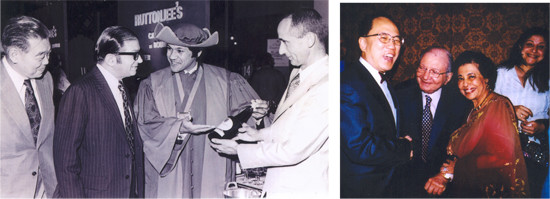
L to R: At Ruttonjee’s Wine exhibition in the late 1960s; with Donald Tsang, chief executive of HK-SAC
In 1925 Jehangir who had entered the real estate business, built the five-storey Rutton Building and, 10 years later, the seven-storey Dina House named after his mother. Ruttonjee Estates Limited was established in 1935. In the 1980s Shroff presided over the conversion of the two properties into 27 and 22-storey towers, collectively called the Ruttonjee Centre.
Jehangir, who had married Banoo in 1902, had a son Dhun and three daughters. The Japanese occupation of Hong Kong was one of the many lows the Ruttonjees encountered. Already well known for his myriad acts of concern for the dispossessed, Jehangir was nonetheless imprisoned together with other members of the family including Shroff. It was during this time that his daughter Tehmi Rustom Desai succumbed to tuberculosis — a disease rampant in the crown colony at the time, compounded by lack of facilities and drugs due to the War.
In a typically Ruttonjeesque response to the tragedy, Jehangir transformed the old Royal Naval Hospital into the Ruttonjee Sanatorium in 1949 and handed its operation to the Hong Kong Anti Tuberculosis Association, now known as the Hong Kong Tuberculosis, Chest and Heart Diseases Association. Staffed by the dedicated and efficient Sisters of the St Columban Mission, it went a long way in the control of the dread disease. It soon became evident that patients discharged after treatment at the Sanatorium returned to their bad living habits and relapsed. The Association decided to build the Freni Memorial Convalescent Home to commemorate Jehangir’s daughter Freni, married to Shroff, who fell victim to cancer in the mid 1950s. In 1995, when Shroff was chairman of the Hong Kong Tuberculosis, Chest and Heart Diseases Association, he succeeded in upgrading the Ruttonjee Sanatorium into a 614-bed general hospital.
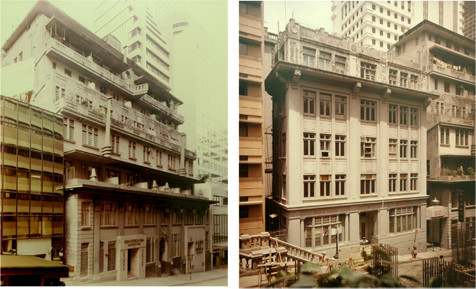
The old Dina House (left) and Rutton Building
Despite these tragedies Jehangir, as president, enhanced the effectiveness of the Society for the Protection of Children and the Family Planning Association. "To him largely, the colony owed the first of the residential blocks at North Pier erected by the Hong Kong Model Housing Society which he chaired,” notes PIO. He also served on the court of the Hong Kong University and the War Memorial Fund committee. The British government honored him with the title of Commander of the British Empire (CBE). In 1952 he and Banoo celebrated their golden anniversary. Jehangir died in 1960 at the age of 80.
Philanthropic like Jehangir, his son Dhun remained aloof from the family’s wine and spirits business and developed his own export/import enterprise. Deeply involved in social work, Dhun was appointed Justice of Peace in 1947, was member of the Legislative Council from 1953 to 1968 and was conferred first the OBE (Order of the British Empire) and then the CBE. In 1972 he was made a Knight Commander of the Order of St Sylvester by the Pope. Chairman of the Hong Kong Anti-Tuberculosis and Thoracic Diseases Association he was active in the management of the Ruttonjee Sanatorium, was senior member of the Board of Education and chairman of the Trade Development Council, PIO traces his many social involvements to the benefit of the city, ere he died in 1974 at the age of 71.
As steward of the Royal Hong Kong Jockey Club Dhun inculcated in the young Shroff a fascination with horse racing. "I was quite young when I started to go to the races with Dhun. It runs in the family,” Shroff told BR. And that is how Shroff’s young wife Purviz also got interested in racing. They currently own two horses in Hong Kong and one in Ireland and are on the verge of importing another from New Zealand. In response to a Parsiana query Shroff writes, "We have been purchasing horses at auctions or on the recommendations of our trainers. To own and keep a racing horse with The Hong Kong Jockey Club is not that simple. First of all you have to apply for a horse import permit. A ballot is held once a year. It all depends on your luck in the draw. If you are successful, an import permit will be issued to you. The permit holder may import the horse from countries like Australia, New Zealand, United Kingdom, Ireland or the USA.”
Shroff had imported Astonish, then six years old, from the Poonawalla Stud Farm in Poona. "He astonished everyone by winning his very first race in Hong Kong” and had won 12 races in India before making the journey, Shroff told BR. Swiss Lad won Shroff the China Olympic Gold Medalist Trophy. "One of our horses, Royal Prince, won many races for us in Hong Kong,” writes Shroff adding that once the horses are past the racing age, they are retired to their country of origin.
Though most of his life has been spent in another environment, Shroff’s attachment to India remains. Happy to see the country’s economic progress post liberalization, the perilous state of its infrastructure, poor living conditions and "heartbreaking” suicides by farmers disturb Shroff. To PIO he spoke of the need for affordable quality education.
At home in Hong Kong he has been a director of The Community Chest, an NGO that collects funds on behalf of member social welfare agencies, acts as donor trustee in the allocation and use of the funds and provides an integrated service to donors wishing to support a wide range of welfare services. And it ensures 100 percent allocation to beneficiaries without any deduction for administrative expenses thanks to an annual grant from The Hong Kong Jockey Club and prudent investment, as notes its website.
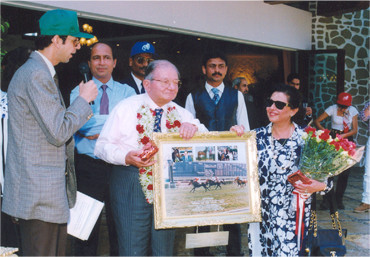
When ‘Astonish’ astonished the Hong Kong racing fraternity
Despite their innumerable commitments to the people of Hong Kong irres-pective of their social status as notes PIO, Rusy and Purviz enjoy a monthly get-together with 38 Shroffians in Hong Kong ranging in age from two to 93 years. The clan includes doctors, teachers and entrepreneurs and they all are doing well. "We are a happy and close-knit family, we Shroffians,” Rusy assured PIO.
On community issues Shroff notes, "I am not orthodox. I am proud to be a Zoroastrian, but are we not all children of one God?” Though he believes there is no conversion in Zoroastrianism, he feels "it would be very nice if Parsi children are allowed to marry persons from other faiths and (their children) are accepted into our faith freely.” As for a world body of Zoroastrians, he notes, "It will be a very good idea for our community if our religious elders can come together and form a world body…It will definitely benefit our future generations.”
◆ ◆ ◆
From the archive