
Cover Story
Accolades for Aga
The Government of India honors former Thermax chairperson Anu Aga with the Padma Shri for social work
Her short silvery hair, crisp cotton or silk saris with bold borders have long been her trademarks. As have been her grit and gumption in business and personal life, her dedication and desire to live in compassion zone despite wealth and privileges, her proven ability to turn intent into affirmative action.
In March this year, the Government of India presented Anu Aga, who is the former chairperson of Thermax Limited, a leading energy and environment solutions company based in Poona, the Padma Shri for social work. At the end of May, another honor came her way. She was appointed a member of the prestigious National Advisory Council (NAC) in New Delhi chaired by Congress president Sonia Gandhi. The 14-member NAC is a group of domain experts and civil society activists who act as a think tank outside of the ministries and the Planning Commission. The NAC advises the UPA (United Progressive Alliance) government on social agenda and policy, particularly with regard to the rights of disadvantaged and vulnerable sections of society. "We have to reach out to the larger community from which we draw all our resources,” Aga believes.
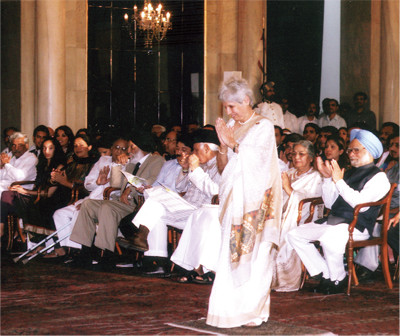
Anu Aga at Rashtrapati Bhavan for award ceremony. Seated at right is Prime Minister Dr Manmohan Singh
With a masters degree in social work from the Tata Institute of Social Sciences in Bombay, strengthening the feeble has long been Aga’s pursuit of happiness. Thermax’s corporate social responsibility (CSR) programs, functional for long, were given a formal structure with the setting up in 2007 of the Thermax Social Initiative Foundation (TSIF) as a registered not-for-profit body, with the primary focus of providing quality education for children from weaker sections. One percent of Thermax’s profit after tax has been earmarked for social causes. "I have been on the board of Akanksha [a nongovernmental organization (NGO) founded by Shaheen Mistri which works for the upliftment of slum and other underprivileged children through education] for over 12 years. Ten years ago we brought Akanksha to Poona. We have 20 centers here where children who go to municipal schools come for two-and-a-half hours for fun-based learning in English, maths, creativity and values. Three years ago, in partnership with Akanksha and the Pune Municipal Corporation, TSIF adopted two English-medium schools in Poona. We hire the principal and staff; Thermax bears the financial cost and Akanksha undertakes the teachers’ training,” Aga relates.
Actively involved in a plethora of programs, Aga gives us some details. "Teach for India” is a nationwide movement of outstanding college graduates and young professionals under the age of 35 who commit two years of their life to teach full time in selected low income schools to help students enhance their level of education. They are put through a tough screening process. "We look for attributes such as passion, critical thinking, ability to make a difference and humility. In the first year we had 2,000 applications and recruited 86 Fellows (as they are known). This year we had 4,000 applications and took in 146. They have to go through five weeks of intense, residential training,” Aga notes. She is also on the board of Give India, a not-for-profit organization. "One of its activities is to encourage employees to give donations to credible NGOs that Give India has screened. It is up to the donor to select the NGO of his/her choice. Last year we decided to start a movement to encourage people to give not just money but themselves, their ideas, their affection and called it ‘Joy of Giving.’ We had a tremendous response from all over India and we want to have this every year,” she states.
Aga is also involved with several other causes — the Commonwealth Human Rights Initiative in New Delhi which works for the practical realization of human rights in the Commonwealth, Mallika Sarabhai’s Darpana Academy of Performing Arts in Ahmedabad, NGOs working for cancer patients and other associations too numerous to name. "What is wonderful is that she is very passionate about the cause,” says her daughter Meher Pudumjee, who is the present chairperson of Thermax. "In some form or another she has always been involved in helping the underprivileged. I remember as kids she suddenly brought home two orphan teenagers who were begging on Main Street. She tried to make them feel at home, as part of the family but they valued their freedom a lot more and left after a few days. She has always seen her contribution to society as her first love.”
Speaking to Parsiana on her return from an NAC meeting in June, Aga graciously accepts our congratulations on the Padma Shri award and moves on to other topics. "India faces many problems but some of the critical ones are neglect of the marginalized people, mismanagement and corruption,” she remarks. "Some weeks ago, the Planning Commission invited a few citizens to give their comments for the 12th Five-Year Plan due to start in 2012. All of us observed that many of the government programs are good on paper but lack effective implementation. We need greater accountability and monitoring mechanism. We tend to neglect issues for years and it is only when the exploited become violent that we wake up and try and reach out.”
You cannot develop a city either without planning for the poor, she believes. "At Napean Sea Road in Bombay, there is a slum and I wanted to construct toilets for them. I was told this would not be allowed due to coastal zone regulations. If no construction is allowed within 500 m of the sea, we should demolish the slum and if we allow it to be there we should provide the most basic amenities. It is very undignified for the slum dwellers to have no toilets and use public spaces.”
Speaking about Poona, Aga says: " I love my city and yet have great concerns. The political/builder nexus has ruined Poona and has led to unplanned growth. The Mula Mutha river which is our lifeline is polluted due to untreated sewage being pumped into it.” The city has frequent power cuts and water shortage. "The public transport system is pathetic, the traffic is chaotic and safety norms are not adhered to.” With Poona having one of the largest number of two-wheelers and helmets not being made compulsory, "the death toll due to road accidents is one of the highest in the world.” As she speaks, we can see flotsam drifting in the river as it flows quietly past the boundary of the bungalow. The monsoon has made the garden greener, the lawn is lush, tall trees enfold the house in their embrace. The sound is of silence, away from the madding crowds.
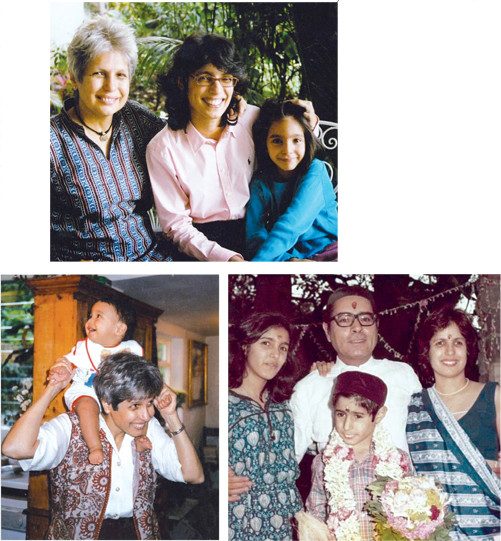
Three generations (above, from left): Anu Aga with Meher and Lea Pudumjee (Alongside): Aga playing with Zahaan and at Kurush’s navjote (l to r) Meher, Rohinton, Kurush and Anu
In the 67 years of her own life, Aga has seen the best and worst of times. "My father Adi Bhathena owned a small business of manufacturing sterilizers and hospital equipment under the name of National Steel. As I grew up, my two brothers were given overt and not so overt messages that they would be expected to join it. Though I was good at studies and in fact academically did better than my brothers, I was never groomed nor invested in to join the family business. Since I had good people skills, it was suggested that I go in for a postgraduate program in social work. This I did,” Aga said in the course of one of her presentations on leadership to an international business audience, notes the website www.thermaxindia.com Her late husband Rohinton, she continued, had joined her father as a senior executive and the two of them began a new venture of making industrial boilers which eventually became Thermax Limited.
The company started as a small-scale industry "with a capital base of Rs 0.3 million, a dedicated team of 40 people and unbridled enthusiasm,” Rohinton himself had related in the course of a lecture celebrating 25 years of the Poona Chapter of the Institute of Cost and Works Accountants in December 1990. When the factory was set up in Chinchwad outside Poona, "basic necessities were miles away; scorpions and snakes were rampant. We were working on a shoestring budget. Every day meant survival or extinction.” After Bhathena retired, Rohinton became Thermax’s chairman and managing director. "He was a charismatic leader who created an enviable work culture and in spite of our small size, was able to build the company into a strong brand,” Anu describes in her writings.
In 1982, Rohinton had a heart attack and underwent a bypass surgery in London, but complications set in, followed by a lengthy period of recovery. Anu joined the organization in the human resource division in 1985. In 1990 Meher, who has a postgraduate degree in chemical engineering from the Imperial College of Science and Technology, London, joined Thermax as a trainee engineer and was managing Thermax’s subsidiary company in the UK along with her husband Pheroz Pudumjee, who has a masters in business administration from Symbiosis in Poona and a diploma in automobile technology from Stanford University in the US. In 1995 Thermax went public and, though the market was depressed at that time, the stock was oversubscribed seven times.
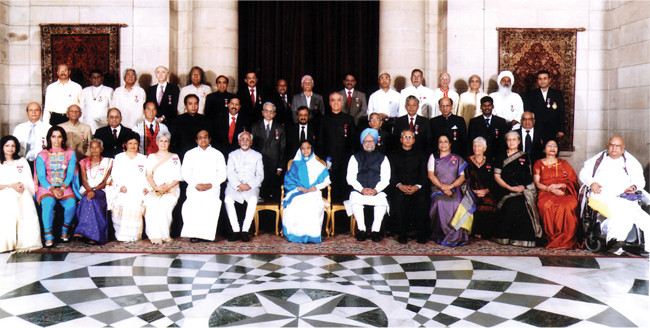
Anu Aga (1st row, fifth from left) with other awardees. To her left are Home Minister P. Chidambaram, Vice President M. Hamid Ansari, President Pratibha Patil and Prime Minister Dr Manmohan Singh
In 1996, disaster struck. "I was in the UK for six months helping Meher look after her first baby. I was returning home and Rohinton came to Bombay to pick me up when he had a massive heart attack and passed away. The Thermax board met within two days and decided to appoint me executive chairperson,” Anu narrates. The company was struggling. The share price, which had soared to over Rs 400, plunged to Rs 37. The trauma was compounded by the death, a little over a year later, of their 25-year-old son Kurush in a car accident and the passing away of Rohinton’s mother Piroja, within the space of a fortnight. "As I struggled with the turmoil, I realized I had a choice — either to feel helpless and wallow in self- pity, allowing my sense of inadequacy to grow, or to pull myself together and take charge of my life.”
An anonymous letter from one of Thermax’s shareholders (regarding the erosion of share value) jolted her out of her stupor. "She pushed herself to understand the business, to utilize her strengths rather than focus on her weakness and when in doubt ask for help, which most people at the top of organizations shy away from. Her composure and the external ease with which she took on the challenge and responsibility was very inspiring,” asserts Meher. When Thermax went through a rough patch in the late 1990s, she brought in a management consultant to help turn around the company. "My mother had no shame in bringing out the fact that our non-operating income was what made us look profitable and that even though the external economy was in a downturn, there were many levers in our hands which we needed to make use of,” Meher candidly explains. "She had to take tough decisions — whether it was a change in the board, closing down or selling off certain businesses or separating ownership from management.”
"Thanks to the hard and dedicated work of our senior team who stayed with me through all those tough years, we turned around. Our company’s turnover when I took over in 1996 had been $ 108 million with a profit of $ 9.7 million. In 2000-01, following the downturn, the turnover declined to $ 104 million and we posted a loss of $ 2.8 million. In 2006-07, we had a turnover of $ 472 million and a record profit of $ 41 million,” Anu had narrated in one of her speeches. "I strongly believe skills can be hired, but wisdom has to be a key attribute of a leader. I also realized that at the top it could be lonely and demanding.”
After eight years at the helm, Anu announced that she was stepping down as chairperson in favor of her daughter. Meher took over as chairperson on October 5, 2004. "Rarely do you find anyone wanting to retire at the peak of their career, but my mother had decided that at 62, she would spend her time and energy on her passion (social work). Anu recalls: "None of us — my father, my husband nor I — who had headed Thermax had an engineering degree. Meher is the first chairperson with an engineering background and has done extremely well. She has a very good grasp of finance. Most importantly, she has imbibed values. She also has very good leadership qualities and people skills. Pheroz, along with Meher, helped to turnaround a small business in the UK and is currently a non-executive director in the company.” Anu explains.
Thermax is one of the few companies in the world that offers integrated, innovative solutions in the areas of heating, cooling, power, water and waste management, air pollution control and chemicals. For the fourth year running, Thermax has featured in Forbes’ list of "Asia’s 200 Best Under a Billion” companies, reports their website. Thermax’s order book stood at a record Rs 5,381 crore as on March 31, 2010, including overseas orders. Its share price was quoted at Rs 744, as on July 2, 2010.
Though she continues to be on Thermax’s board of directors, her main priorities now, says Anu, are her social work, the NAC and her family, including spending quality time with grandson Zahaan and granddaughter Lea, aged 14 and 11 respectively. "My grandchildren and I go for a holiday together every year, in India or abroad. This ritual is extremely dear to me,” she states. Vipassana, which is a Buddhist meditation discipline, has helped her find inner strength. She has attended 10-day residential programs "where you are not allowed to distract yourself by reading, talking or writing… one has to focus on one’s breath and become intensely aware of one’s being. It taught me that unless we tap the personal power which is within each of us, we cannot lead from positional power that comes from our office and title.”
The cause of secularism and the need to sustain plural faiths is also very important, she believes. She was among the very few courageous captains of industry who spoke out openly against the communal riots and killings of 2002 in Gujarat. "I had the good fortune of having been appointed western region chairperson of the Confederation of Indian Industry and Gujarat was one of the states that came under my official charge. I went and saw firsthand the Muslim victims in the makeshift camps. It was a harrowing experience and I decided to speak, bringing it up as a legitimate human issue that should concern business leaders.” She was aware of the possibility of a backlash. "But this is a decision each of us has to make — to stay in our comfort zones and like an ostrich pretend that it is not our business to intervene, or to take an active stand and be prepared to face the consequences… Amartya Sen, economist and Nobel Laureate, warns us that ‘silence is a big enemy of social justice.’” It is not enough for businesses just to generate growth and profits. In a country like India, "where poverty is a compelling reality and the gap between the rich and the poor is widening… it is imperative that the corporate sector with its managerial resources, financial muscle and technical competence reaches out to the needy,” her words are quoted on Thermax’s website.
Anu is also "very unhappy with fundamentalism creeping into the Parsi community.” To her, religion means "compassion, awareness, doing good deeds. It is not about someone else telling me how I should deal with my body after I die, or whom I should marry. These are very personal choices. In the name of religion I do not accept a few self-appointed leaders dictating to and misguiding young minds by saying that this is what our religion preaches. I think this is a total misinterpretation of our religion.” Which faith does not allow its priests to bless the living? she queries. "When Parsis have affairs with non-Parsis, our self-appointed leaders do not comment, but if a Parsi and especially a woman marries a non-Parsi, there is a big hue and cry and the children are called ‘bastards.’ I think it is a disgrace to call any child by that name. If we continue with this narrow interpretation and do not allow mixed marriage children to be Parsis, our numbers will surely decline.” The role of punchayet trustees, she believes, is to make best use of funds and properties, reach out to the needy, support youngsters in their studies and encourage them to be entrepreneurs. It is not their role "to meddle in people’s private lives.”
"When I think of mom’s qualities, ‘genuineness’ comes out loud and clear. She is who she is — (she has) no airs and graces. She feels comfortable amidst youth as well as the elderly; basically very comfortable in her own skin,” Meher summarizes. "I have learnt a tremendous amount from her, whether in my professional or personal life. I am in great awe as to how she has found so much meaning in her life, even after so many adversities. She is willing to learn, to change, to grow as an individual.”
◆ ◆ ◆
From the archive