
ART
Architecture as art
‘Construction’ is the theme of Prof Percy Pithawala’s art exhibition where he uses everyday materials, transforming them to his aesthetic
Unbelievable, unbuildable, unthinkable and the sublime” represent four backlit boxes that constituted one of the art installations at Prof Percy Pithawala’s three-tiered exhibition at the Hutheesing Visual Arts Center, Cept Campus in Ahmedabad. "This is clearly one of those few exhibits which lays more emphasis on the thought process which goes into creating a work of art rather than a finished final product which allows the viewer to participate in the very act of completion of the work according to his/her own take,” notes a press note referring to the works of the architect and urban designer.
The theme of the exhibition being constructions, it was divided into three distinct parts: Construct-I explored varying mix of installations including scrap metal and sketches. Construct-II depicted a set of disparate images including Braille boards, textual references and doodles of a proposed project. Installation art displayed three-dimensional assemblages.
The Ahmedabad exhibition in February 2011 was considered "a compilation of years of meticulous research for his ongoing PhD dissertation which traces the influences of Avant Garde art movement on art and architecture during the early 1920s in Russia,” noted a press release introducing the exhibition and the artist who has been principal of the Arvindbhai Patel Institute of Environmental Design (APIED) for the last six years.
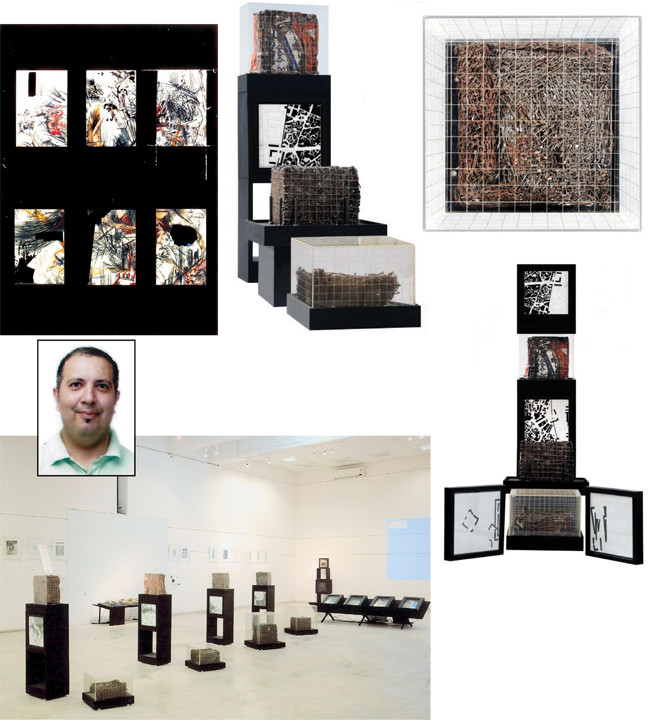
Clockwise from top left: Penumbra —color pencil and transparency; Installation — Assemblage; Installation — Construct; Installation —Assemblage, all three made of scrap metal, wood and acrylic; A view of the exhibition and Percy Pithawala
The professor "strongly believes in an interdisciplinary approach to education and design making which draws inspiration from the related fields of architecture, fine arts, the performing arts, product design, fashion and media,” adds the press release. While the preview of his exhibition at the D. C. Patel School of Architecture, APIED, Vallabhvidyanagar was attended by several academicians from the art world as well as other dignitaries, the exhibition was inaugurated by Prof Pradyumana Vyas (director of the National Institute of Design, Ahmedabad) and eminent architect Gurjitsingh Matharoo.
The architect "has attempted to lessen the technicality of architecture and produced it in a rather interesting way through his sketches,” commented Devika Chaturvedi of the Ahmedabad DNA.
Talking about his journey as an architect, Pithawala states that he has always looked up to art as a constant source of inspiration. "I am aware that somewhere it helped me during my academic years as an architecture student at the Maharaja Sayajirao University” in Baroda where he was a gold medalist and then leapt to the Pratt Institute in New York where he pursued a postgraduate program in urban design. His exposure at the Pratt Institute as also his copious visits to the various museums and galleries of New York, led him to create art in mixed media, tracing overlays, collages, pen and ink, photomontages as well as assemblages. "We should try to look at architecture as an art form,” Pithawala is convinced.
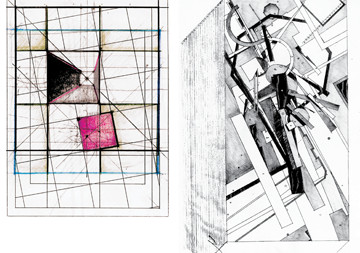
Calibrate — ink and pencil on paper
"My first concrete steps as a serious artist were taken during my six years at Pratt... I was exploring the interface between the Black Square of (Kazimir) Malevich and found objects using a technique of multiple layering with print images and texts.” In fact the article on him in Insite, March 2011, the official publication of the Institute of Indian Interior Designers (forwarded to Parsiana by reader Rashid Khosravi) is titled "The Malevich influence.” Influenced strongly by Malevich’s aesthetic theory, known as Suprematism, as the supremacy of pure feeling or perception in the pictorial arts, Pithawala’s own art took shape under the Russian’s influence. The austere painting of Malevich counts among the most radical paintings of its day, yet it is not impersonal; the trace of the artist’s hand is visible in the texture of the paint and the subtle variations of white.
At the end of his studies in New York, Pithawala was ready to exhibit his works, solo as also in group shows, at Cooper Union, Van Allen and Pratt Galleries. With 11 solo exhibitions to his credit — from Baroda and Bombay to New York — the bachelor wanders where his art takes him. New boundaries are explored on design related issues from his cell "The Red Studio” in Baroda.
Considering himself "privileged to be a Zoroastrian,” Pithawala adds that his "strong values… have guided me in my personal and professional life and helped me in delivering on my responsibilities in a fair and credible manner… I have experienced that my management, faculty, parents and students have immense faith in my integrity of character and sound judgment as a Zoroastrian.” He continues, "I feel encouraged by renewed interest in our religion amongst our youth. I feel they need to build on the goodwill and respect that still exists in abundance for our community and carry on the legacy of our forefathers.”
The staunch Zoroastrian claims to be well ensconced in his Navsari roots, his father Adil being self employed and his mother Daulat being an artist and art teacher who honed his artistic sensibilities from a young age. His own inner urge was to draw spaces with which he was intimate. "I remember as a child living in our ancestral Parsi home in Navsari that I had an inner urge to draw spaces which I felt were intimate with my scale — these included the space under the stairs, niches and protruding balconies offering vantage points. Over time, I developed an intimate relationship with individual antique furniture objects and could almost sense their unique personalities and presence.” Visits to the atash behram next to his home were a regular feature as also to the Dastur MeherjiRana Library where he extended his curiosity from Zoroastrianism to other ecological issues — the use of space in art, as a young artist.
The professor artist has also drawn inspiration from several of his contemporaries. Acknowledging the contribution of professors John Johanson and Bill Menking in shaping his work, Pithawala had conveyed in the Insite interview, "They encouraged me in my search for a meaningful language to effectively represent my thoughts with clarity and emphasized the need to introduce an underlying nonhierarchical structure in my works in the form of reference points, planes, grids and similar devices which I experimented with later.”
Heartened by the feedback he has received to the elective course he has been teaching over the past several years called "Architectural Futures,” Pithawala declares that this study enables students "to unlearn and unravel new directions in their professional careers and future life.”
◆ ◆ ◆
From the archive