
Life-Style
The choice is yours…
Beauty Without Cruelty is a way of life which causes no creature of land, sea or air, terror, torture or death
In 1959 the Right Honorable Muriel, Lady Dowding, with support from her husband, Air Chief Marshall Lord Dowding of the Battle of Britain fame, founded Beauty Without Cruelty (BWC). The unique name denotes that one can look beautiful and have beautiful things without being cruel to animals.
The BWC charity began working for fur bearing animals by promoting simulated furs which were proudly worn sporting a button "Make no mistake, my fur is fake.” BWC was the very first movement that created a worldwide awareness of the intense cruelties inflicted upon animals for the luxury trades — not only for furs and skins, but covering other products like perfumes, cosmetics and toilet preparations.

Red circle around BWC logo (above) signifies the fourth element, fire – a protective shield. The outer circle in green is for the environment as a whole;
Parsi involvement
BWC soon spread to different countries and on September 12, 1974, its branch in India was started by Diana Ratnagar who is, to this day, actively involved in running the organization as managing trustee and chairperson. Her masi (maternal aunt), Pilu Dady, one of the founder trustees, was the organization’s first honorary secretary; her father Dhun, another founder trustee, was the honorary treasurer. Today, I, yet another Parsi, am a trustee and the honorary secretary of BWC. Adarbad T. Hozdar, a Parsi priest who lives by BWC principles, has since the very beginning been auditing BWC’s accounts for a token fee.
BWC — India, registered as an educational charitable trust for animal rights, began by focusing on commercial exploitation of animals for vanity, but over the years expanded its scope of work to cover animals subjected to suffering, torture or death for entertainment, exhibition, research, science, fashion, religion, service, sports, food, or for any other reason. This is in keeping with the organization’s motto and logo: "Beauty Without Cruelty is a way of life which causes no creature of land, sea or air, terror, torture or death.”
No demand, no supply
BWC works on the premise that if there is no demand, the supply diminishes. Investigations into animal cruelty, suffering and killing, are followed by creating public awareness of the facts. We encourage the use of non-animal alternative products and suggest advantageous lifestyle changes. Simultaneously, we approach government to pass laws or take action. BWC has thus been instrumental in helping people lessen animal suffering and death.
BWC puts no restrictions upon its members as to what they eat or use since the organization strongly feels every one needs to decide for themselves how far they would like to go in letting animals live. For example, some numbers have given up nothing, some flesh, some leather, some both and much more.
We are proud to have the highest number of life members among the country’s organizations that work for animals. Our life members reflect our strength which aids us in our achievements. In turn, they receive informative literature including a pictorial wall calendar — and best of all, they have the satisfaction of knowing that they are supporting the rights of animals and are a part of our success.
Over the years, several Parsi vegetarians have worked for BWC — notable among whom was Noshir N. Bhesania who wrote our accounts for 12 years. We feel the animal rights concept can be promoted in a much more effective manner by people who do not eat animals, so the BWC staff is all vegetarian.
Several Parsis have generously remembered BWC in their wills: Silla Adi Marzban, Pilu C. Dady, Rutty C. Dady, Khorshed Karl Kheshwala and Dr Meherwan M. Bhamgara.
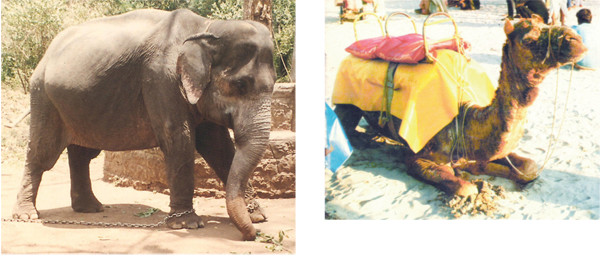
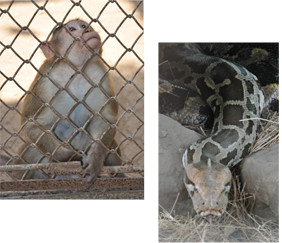
A tethered elephant inside a reserve, (on opposite page) camel on Juhu beach where joyrides are history; a ban on export of monkeys and discouraging the killing of snakes and other animals for their skin
Loving animals but eating them
Most Parsis profess to "love animals” but few are vegetarian. However, nowadays many more youngsters choose not to consume meat. This transition from dog lovers, I feel, has come about because of our community’s inherent feeling of compassion, which is fast extending to all species. Many Parsi kids wonder why their families keep dogs as companions but put sali boti, chicken farcha and patra ni machhi derived through killing goats, chickens and fish, on their dining tables. The feeling of inconsistency is found to be stronger among children who say that the family dog "maaro bhai ché (is my brother).”
Strangely, Parsis throw up their hands and declare that they cannot fathom what to feed their kids who resist eating flesh on compassionate grounds. But, we’ve come a long way since our chairperson, as a teenager, won a battle against her mother who eventually agreed that she could turn vegetarian. I myself know how difficult it was for us siblings when we began resisting non-vegetarian food. Now, I am happy to see my teenaged daughter (and some of her friends) be vegetarian by choice.
Zoroastrians are expected to be vegetarian for the entire month of Bahman, and on every Bahman, Mohor, Gosh and Ram roz. In my opinion, there’s no better time than this month to begin abstaining from flesh, fowl and fish.
Achievements
Donations, without which BWC would not be able to function well, are received from different quarters. Many Parsis, and a couple of Parsi run charities, generously send us contributions every year. But, donations from Parsis do not form the bulk of our income. This is possibly because Parsis perceive BWC as not doing much or anything worthwhile! They are probably unaware of our achievements or that we have been coming out with a quarterly, Compassionate Friend, since 1977. A Parsi gentleman, Savak M. Masani was our editor for the first decade.
During the 37 years that BWC — India has been in existence, many tasks undertaken proved difficult. But years of perseverance have resulted in the remarkable achievements listed below, which may be read about in detail, alongside our other achievements, on our website www.bwcindia.org:
1977: Monkey exports banned
1978: Pegasus Award received for best advertisement
1984: Animal rennet imports banned
1987: Export of frogs’ legs banned
1989: Indian Council of Agricultural Research Karakul lamb project closed; Christian animal sacrifice by humans biting piglets to death abandoned in Goa
1991: Ban on tigers, lions, panthers, bears and monkeys performing in circuses; Amendments suggested by BWC included in the Wildlife Protection Act, 1972
1992: Ban on ivory trade
1996: Joyrides on camels banned in Bombay
1997: Dissection made optional in Gujarat’s schools
1998: Elephant show in Madumalai Sanctuary stopped; Export of deer antlers banned; Udbur village convinced to give up animal sacrifice; All India House Journal Competition Special Award received for Compassionate Friend
2001: Vegetarian/Non-Vegetarian symbols on packaged foods made mandatory; Mini zoos shut down
2002: Meat lobby plans thwarted
2004: Mechanised slaughterhouse at Amravati cancelled
2008: BWC developed a phonetic alphabet for use by animal activists
2009: 50 percent less animals sacrificed at Gadhimai Mela in Nepal
2010: Awareness campaign Hinsa vs Ahinsa resulted in a great number of persons pledging to give up particular animal derived products
BWC hopes it won’t be long before the Government also makes it mandatory for soap and cosmetic manufacturers to affix the vegetarian/non-vegetarian symbols on their products. In fact, some manufacturers have voluntarily begun doing so, thereby making it easy to identify and use cruelty-free items.
Rule of minimum harm to animals
BWC asks people to follow a lifestyle of minimum harm to animals in all aspects, be it food, clothing, entertainment, or anything else:
If you are doing it for enjoyment, do no harm.
If you are doing it for survival, do minimum harm.
If you can do with a less harm-causing alternative, adopt it. If you can’t, question it.
Finally, apply the golden rule to what you are doing: put yourself in the place of the animal-victim of your action. And, listen to your conscience — the voice of truth.
◆ ◆ ◆
From the archive