
Business
Ventilator venture
From repairing medical instruments to designing life support systems, this scientist entrepreneur intends to save many lives
Is this suicide, euthanasia or murder?”
wondered Capt (retd) Rustom Bharucha seeing thousands of breathless patients turned away by hospitals when they were unable to pay the exorbitant ventilator charges of around Rs 10,000 per day. Further, around 50,000 people die of snake-bite every year, the protocol for treatment being ventilator therapy. "This motivated me to help these patients by offering ventilators whose cost ranges from Rs 22,000 to Rs 3,00,000,” says Bharucha who with his aptitude for engineering started his own company called Bharucha Instrumentation and Control in 1970.
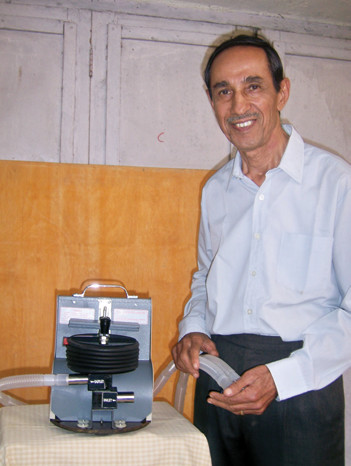
Capt (retd) Rustom Bharucha and the medical equipment he has designed
He commenced operations from his house and a garage that was his workplace, undertaking repair of sophisticated electronic instruments and eventually repair of medical instruments. With his never-say-die attitude he was able to devise his first product, the Pulse Monitor. "Its acceptance and praise encouraged me to develop four more instruments and I received several awards including the National Entrepreneur Award (presented by the Federation of Associations of Small Industries of India, New Delhi) in 1986,” recounts the 77-year-old. It was only a matter of time before he progressed towards designing life support ventilators producing three different types required both during anesthesia and intensive care.
"My portable anesthetic ventilator is used both for anesthesia and ICU (intensive care unit) in rural areas. It can be carried by a visiting anesthesiologist. (The) other anesthetic ventilator is used with the boyles machine to give anesthesia during surgery. The T2BN portable volume ventilator helps during the critical care of a patient who needs ventilator support either in the ICU, at home or during transit,” explains Bharucha.
.jpg)
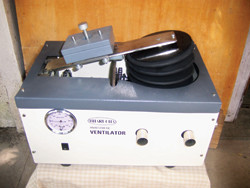
The sophisticated ventilator he has recently introduced has been the outcome of a challenge to repair a similar ventilator of American make. The tedious and costly procedure of testing and certification of the portable Volime Ventilator that he designed is complete and it has an ISO-13485 and a CE mark from Europe, he notes. "One has to satisfy eight International Electro Technical Committee Standards and offer the equipment for rigorous testing to get the CE stamp,” he adds. CE stands for "Confirmité Européenne” and signifies that the product has been tested in a laboratory and meets all health and safety requirements laid down by the European Communities Commission and the International Electrotechnical Committee.
Last year the International Biographical Centre, Great Britain listed him in their publication Professionals of the World in the "Leading Scientists of the World” category. Thereafter he was selected for the International Einstein Award for Scientific Achievement. "Recognition for my work has come from abroad but here people are still hesitant to purchase this ventilator,” regrets Bharucha who is awaiting a boost in sales from a generous purchaser or an NGO (nongovernmental organization) "so that I can help to save many more lives.” When a patient is kept on a ventilator at home, he "can lead a reasonably active life; he can move about on a wheel chair along with the ventilator and can even go to work and to shopping malls,” he explains.
For the over 200 anesthetic ventilators, both portable and standard, that he has sold since 1991 he says he has not received a single complaint or a defect report and in fact has received many appreciative comments. Recognition for his entrepreneurship has come from business bodies like the Maratha Chamber of Commerce in Poona and the Maharashtra Chamber of Commerce in Bombay, the Federation of Associations of Small Industries of India, New Delhi, the Federation of the Parsi Zoroastrian Anjumans of India and the Institution of Electronics and Telecom Engineers, Poona where he is currently the vice chairman.
Rustom, fondly known as Rusi, was born at Nargol in 1934. He obtained a bachelors degree in physics and maths but could not pursue further studies due to financial constraints. Having displayed a strong aptitude for engineering since his younger days, he joined the Territorial Army, Corps of Signals where he was summoned for duty during the Goa operations at Daman. Again for the 1962 Chinese aggression his services were required. "I carried out troop trials of wireless equipment at Ladakh and was later posted as General Staff Officer at Army Headquarters (HQ) in New Delhi where I worked on two major projects namely VHF-isation (very high frequency) of the Army and theater signals stores reserve each worth over 32 crores,” he recounts. Elaborating on his contribution to the Army, the Captain relates that earlier all army communications during peace or war used short/medium waves which could be easily intercepted. After the 1962 Chinese aggression, the Army decided to switch over to VHF communications. This project involved selection of equipment, purchase and induction of the same in a planned manner over 10 years. Further, the reserve of signals (communication) equipment to be used during war or hostilities by the East, West, South and Central commands were completely revised following the Chinese aggression.
After his last posting at the Army HQ Bharucha retired in 1967 and has been involved with his enterprise for the last 40 years. His wife Parven continues to work even after retirement as the Head of the Department of Social Work at the K. E. M. Hospital, daughter Kashmira and son-in-law Rohinton Doctor work at Vapi. Fondly addressed as "Tooti” by his two grandchildren Nekzad and Mihr, the talented entrepreneur can play the flute, harmonium, sitar and mouthorgan. He has contributed to background music during Parsi nataks (plays) organised by the Poona Parsee Dramateurs Association. An active member of the Poona Zarthosti Seva Mandal, Bharucha believes in submitting to the authority of the high priests and not challenging it.
While precision and measurement are his forte, Bharucha derives immeasurable joy from adventure and the outdoors. "I have represented the winning team for the Army HQ pistol shooting competition,” he mentions adding, "and have travelled from Kufri to Kanyakumari solo on my motorcycle.”
Bharucha Instrumentation and Control is located at 202/1/7, Nagar Road, Opposite Aga Khan Palace, Poona; tel: 020 26681798.
◆ ◆ ◆
From the archive