
Medicine/Health
Have a heart
Noted cardiologist Dr Aspi Billimoria receives one more award but does not take it to heart
Dr Aspi Billimoria’s living room is quiet, anchored and aesthetic, like the persona of this septuagenarian bachelor MD (Doctor of Medicine).
He has just received the award "Master Teacher 2010” from the Indian College of Physicians (ICP). He wears this lightly and is not in any fevered frenzy for being acknowledged by the ICP, the academic wing of the Association of Physicians of India (API). Billimoria was the sole recipient the second time it was awarded. What was the honor for? Was it for papers published, teaching, mentoring scores of students? "When I was told, I was surprised.” That is all that is elicited. Our imagination has to work overtime like his heyday practice to decipher the answer.
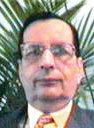
His bio data indicates that he has been affiliated with government hospitals. The explanation is simple — he wanted to teach and practice. No better place for this than these institutions. So he straddled practice and teaching. A student of the Grant Medical College, he was house physician, junior and senior registrar at the Sir J. J. Hospital. He was honorary at the above hospital as well as at St George’s Hospital where he was the head of cardiology for 15 years. In fact his teaching career has spanned more than four decades, of which he taught post graduate students for 30 years. "Teaching involves not only talking but training on the job, bedside manners, teaching of course, lecturing, papers published, talks in conferences, talks on continuing medical education (CME) programs. Both (these) are fulfilling.”
After coaxing a response from him about another award he had also got, it is learnt that he received the Distinguished Member Award from the API, which is the biggest body of physicians in India with about 15,000 members. Billimoria earned this award in 1995, the plaque says.
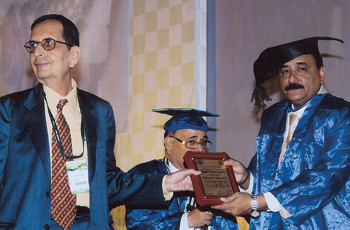
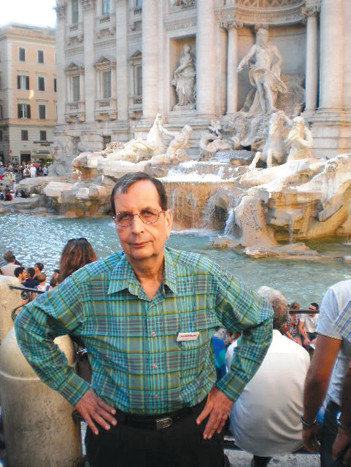
Dr Aspi Billimoria (top and above) receiving the "Master Teacher 2010” award from the vice chancellor of Gujarat University. Alongside: In front of the Trevi Fountain, Rome
The academician has 40 published articles to his credit in medical journals, books and lay publications. He has held top positions — from treasurer to chairman — of the API and of the ICP. He was also the vice president of the Cardiology Society of India, president of the western India chapter of the International Academy of Chest Physicians. However, his chest does not swell at all these achievements. "I was just lucky to get in” is all he says.
Before he had heard the word ‘cardiology,’ he had decided to become a heart specialist as a child. No other ambition was closer to his heart. His high is when "a seriously sick person comes through.” Does he have any regrets? None that he remembers, he says. Casually he adds, "all doctors have successes and failures.” He cannot recall any major regretful moment.
Billimoria has a kind word for politicians who he encountered regularly in his practice at government hospitals. "From bureaucrats to superintendent to ministers, all are polite.” Without skipping a beat, he adds, "but MLAs (members of the legislative assembly) think you are their servant.” The wry smile also says this quiet mannered specialist is no pushover. He recounts that he was pulled out at odd hours of the night about twice a week at one stage of his career, "but the junior doctors took over and the instances became fewer.” He hung up his stethoscope at the government hospitals this January and now only uses it at a charity hospital, Conwest Jain Hospital at Girgaum, where he goes every day as he has been doing so for the past several decades, almost from the onset of his practice.
After the long hours he practiced how does he spend his time now? Billimoria is a firm believer in infusing new blood. Born to teach, he let go when the time was right for him. His evenings are mostly spent in regular visits to the National Centre for the Performing Arts where he hears live concerts in western classical music and watches art and classic films. As he mentions travel, the picture frames from China, Russia, Morocco, jump out at the guests. Some framed photographs have him in them, others simply indicate ‘been there, done that.’ The doctor reminisces about his trip to Uzbekistan, where he seemed happy to see the ancient monuments, Muslim architecture, and specifically two Zoroastrian places of worship. The travel buff is eagerly waiting to go to the Far East next. In fact the cardiologist maintains his equanimity, keeping emotions to the normal limits like in all the medical reports he has studied. No highs, no lows, except when music and travel are referred to. Sport is also a pastime that absorbs him, but his viewing of it is mainly of tennis and football.
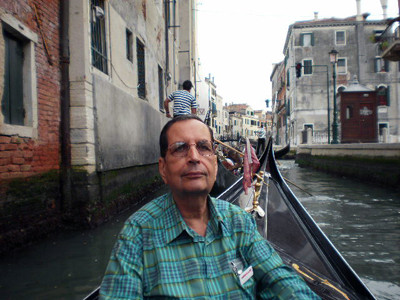
Floating away in a gondola in Venice, Italy
In his research and vast experience does he subscribe to the belief that Parsis are more susceptible to heart ailments? The doctor’s contention is that there is no research which shows that Parsis have a higher percentage of cardiac ailments than other Indians. He believes that because we are such a small community the statistics get highlighted. The cautious cardiologist adds that our diet is not the healthiest and those who eat heartily are bound to be potential victims and acquire an affinity for cardiac dysfunctions.
When asked whether he advocates any preventive measures for heart ailments the doctor mentions: "Healthy diet, exercise, less stress, no smoking, less salt, low fat, (as) free from stress as possible.” He has infused these in his own life — he cooks his own meals with the same restrictions he advises for his patients, walks most days a week and relaxes with music and travel. His heart swells with pride, "I am completely self-sufficient.”
Would he recommend young Zoroastrians become cardiologists? "Today there is lots of competition; I don’t know how clean everything is. In my days if you had the marks, you got in.” He sees neither advantage nor disadvantage in Zoroastrians joining the cardiac stream of medicine, "it depends on them,” he says. According to him being a Zoroastrian has not affected his profession either positively or negatively. His credo is "to have a clean conscience and not harm anyone.” Not a regular practitioner of Zoroastrian rituals, he has imbibed the faith’s ethics and values which he translates into his day-to-day living.
Seldom does he opine on generalities. However, he is sure that we have as good care as the western world in cardiac medicine. He relates how we get the latest machines now, a marked change from when he started his practice. Similarly, he believes that healthcare can go a long way using rural paramedics. "The concept is good so long as basic training is given. It could be a parallel concept such as the barefoot doctors. They have an advantage over me as they speak the same local lingo. They could communicate better. It is not a sine qua non that they are not as successful as I,” mentions the cardiologist.
◆ ◆ ◆
From the archive