
Zoroastrians Abroad
Wiser at the wicket
Playing for Canada in the recently concluded ICC World Cup was a learning experience for cricketer Zubin Surkari
"I owe everything I have to cricket,” declares Canadian batsman Zubin Surkari, the only Zoroastrian who played in the 2011 International Cricket Council (ICC) World Cup series. The opportunity to play before cheering crowds in three countries — India, Sri Lanka, Bangladesh — traveling on 16 flights in one-and-a-half months, staying in the best of hotels are just some of the perks. The truly remarkable experience was observing the strikes and sweeps of the most formidable players in the world and admiring the very opponents who were quashing them.
In the very first match Canada played in this World Cup series against a strong team like Sri Lanka, the North Americans proved that they had a lot to learn from the "professional” players who exhibit a "lot of class.” Surkari referred to the Sri Lankan batsmen like Mahela Jayawardene and captain Kumar Sangakkara "who had me chasing the ball for a long time.” The next two matches against Zimbabwe and Pakistan too saw Canada struggle until the game against Kenya brought them their sole win in the series. Thus it was an upbeat Canadian team that came to Bombay in mid-March to play against the New Zealand team. For Surkari, the Bombay leg of the tour acquired a special significance for the World Zoroastrian Organisation (India) taking pride in his accomplishments had organized a felicitation for him and other outstanding Parsi sportspersons on the lawns of Rustom Baug on March 10, 2011.
International exposure was steadily building up the Canadians’ confidence and although their performance in Bombay could not withstand the New Zealand onslaught, in their last match of the series, against Australia in Bangalore they gave a tough fight. Australia did win the match with a very comfortable margin but they were unnerved when the 19-year-old Canadian opening batsman Hiral Patel scored "a highly entertaining half century… His aggression saw Canada fly to 50 in just 4.4 overs, the fastest in the World Cup,” reported the Hindustan Times of March 17. Surkari who came in to bat at No 3 scored 34, his highest in this World Cup series, and with his captain Ashish Bagai who made 39 runs contributed to a valuable partnership such that the Canadians were comfortably placed at 150 runs with only three wickets lost. When reporting on this game, the sports page of the Bombay dailies carried photos of Surkari crouching in pain by a Shaun Tait high full toss delivery that hit him on his abdomen guard. Unable to give his best thereafter, the next delivery by Tait saw Surkari’s stumps uprooted.
One of only three Canadian born players on the national team (the rest comprising émigrés), in an interview with Parsiana on the morning of March 10, Surkari explained how cricket that once used to be a national sport is now overtaken by baseball and ice hockey. In fact cricket has been played in Canada since 1844 but due to weather conditions they can barely practice for around five months in a year. "International exposure and intensive training is helping us get better,” observes Surkari whose interest in cricket was fanned when as a little lad he accompanied his father Eruch to the Zoroastrian Cricket Club (ZCC) in Canada. Although there is limited amount of play now at the ZCC, the Club is still going strong with 50-60 members.
Qualifying first for the under 15 team in Canada, then for the under 19 team before he found a berth on the national team, Surkari says, "I never thought of it as a career until later on.” The coaching he received from Brian Hale at the Toronto Cricket Academy gave him the necessary impetus and confidence to strike out in style. Just when his cricket performance was peaking he was struck with an autoimmune disease that caused inflammation of his joints and affected his lungs and heart. "I could not even walk that far,” he points to a five-foot distance. With heavy medication and steroids his condition fortunately stabilized and to his immense joy he was able to resume his career. But the pause in the game came soon after he was announced captain of the national team bringing his innings as a captain to an end. Besides ill health, his sports career received a setback due to differences with the then CEO (chief executive officer). "I am fairly vocal,” confesses Surkari. "I had issues in the past with the CEO. Now everything has fallen into place.”
Every morning he spends an hour or more on fitness before he reports to work at DST Output, a firm that handles inventory management, invoicing and other company statements. He appreciates that "Joe Faria, the executive vice president being a big cricket fan is very supportive,” and permits him some leeway.
Accompanying Zubin on his World Cup tour were his supportive parents Eruch and Katayun who had come from Canada to see their son in action. The couple had started their married life in Bombay before taking up base in Canada, mentions Zubin. His education was at the Vaughan Secondary School in Toronto but he had an opportunity to spend a brief time in the city around 14 years ago when he was sent to train at the Elf Vengsarkar Academy at Oval Maidan.
With his parents he frequently participates in the activities organized by both the Zoroastrian Society of Ontario and the Ontario Zoroastrian Community Foundation. "I don’t have allegiance to anybody. We are such a small community. There is no point splitting it,” maintains Zubin.
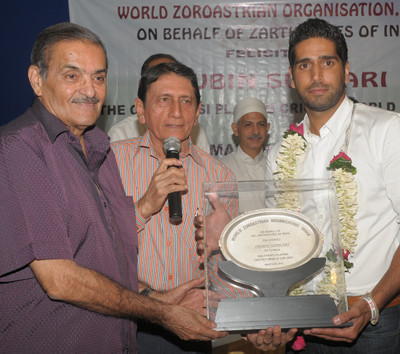
At the felicitation organized by WZO-India (from left) Nari Contractor, Rusi Bhumgara and Zubin Surkari
"My parents are fairly religious,” conveys Zubin. Is he religious? we persist. "I wear the kusti all the time,” he replies, the constant use of the sudreh not being practical with his cricket attire. "I am going to visit agiaries here,” he conveys his plans for his Bombay stay. "I like what the religion stands for, the philosophy behind it,” he continues, happy that he is part of "a good community, good people, very supportive.” His elder brother Xerxes is settled in Canada too. "The community being small in Toronto it is difficult to find somebody,” Zubin accounts for his non-Parsi girlfriend. "If both parents feel the children are going to follow the Zoroastrian faith they should be accepted,” believes Zubin realizing the need to give validity to children of interfaith marriages. He is not in favor though of unbridled conversion to the Zoroastrian faith.
Living with his parents in Toronto, Zubin says cricket being an "amateur sport in Canada, there are budget issues with limited salary and match fees.” Although payments are better than in the past, with him touring frequently it did not make financial sense to maintain a second home.
"Cricket is not going to be my career for much longer,” admits the youthful looking 33-year-old. "I have to think of supporting myself with a full-time job.” Whilst there are seven members of the Canadian team who are full-time sportsmen, Surkari is not among them. But dedicated as he is to the game he spends three evenings a week coaching other aspiring cricketers. "Nobody is as committed as I am,” declares the batsman adding, "Cricket has been a passion and commitment for a long time. There are not many who have made it their life’s ambition.”
◆ ◆ ◆
From the archive