
10WZC
Be a good sport
Sports can be pursued as passion and profession, noted leading sportspersons while debating the decline of Parsi sports
"Parsis have vacated the space that they had in the sports scheme of things. Earlier they were pioneers in sports, performing at the highest level of competition in cricket, squash, table tennis, swimming, cycling, yachting, etc. Today you really are not hearing names of Parsi champions, except perhaps for occasional ones like Rehan Poncha, Kyra Shroff, Jehan Daruvala, Karl Vatcha,” stated Adille Sumariwalla, fleet-footed athlete and Arjuna Award winner who represented India at the Moscow Olympics in 1980. There were 15 Zoroastrians who won the Arjuna Award, India’s second highest sports honor, up to 1993 and then there was a long gap of 17 years till Poncha won it in 2010, he said. We have also had recipients of the Padma Shri like Polly Umrigar and Nari Contractor.
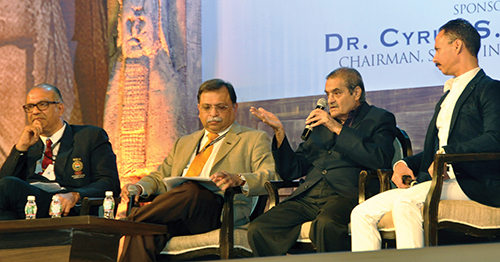
Addressing issues at the World Zoroastrian Congress (from left) Cawas Billimoria,
Adille Sumariwalla, Nari Contractor and Mickey Mehta
Sumariwalla was chairing the session entitled "Sports in the Parsi context or the lack thereof” on December 29, 2013, day three of the 10th World Zoroastrian Congress (10WZC) at the National Sports Club of India. On the stage with Sumariwalla were the panelists — Contractor, former captain of the Indian cricket team, judo champion and Olympian Cawas Billimoria and health and fitness guru Mickey Mehta. For all four, sport and fitness have been passion and profession, pursued through struggle, single-minded determination and self-motivation. "They are legends in their lifetime,” declared master of ceremonies Mahiyar Dastoor. Receiving a big round of applause were two young sportspersons attending the Congress as delegates — tennis player Shroff whose talent and tenacity has taken her to international shores for tournaments including Junior Wimbledon and Delkash Shahriarian who played in the US Women’s Cricket Open Championship in 2010.
"People today sport a beard, a watch or earring but they seldom sport a spirit,” remarked Mehta. Run towards something larger in life, exhorted the man who was the first to start equipment free gyms with his brand Mickey Mehta Health Beyond Fitness. Mehta has launched wellness workout DVDs and owns and runs India’s largest portal on holistic health and lifestyle, as per his website. He has brought out a book and CD for the blind on health and nutrition and has been a trainer of models, Bollywood stars and the rich and famous of the corporate world. Winning, losing, competing — there should be grace in your attitude. "Parents, release the pressure of winning from your kids. Let them enjoy, come alive as kids. How many medals you win is not as important as how well you play.”
Contractor, now 79, expressed his anguish at the decline of Parsi cricket over the decades. "We are now playing in the lowest division of the Kanga League (Dr H. D. Kanga League, the monsoon tournament of clubs in Bombay.) In the early 1960s there were four Zoroastrians in the Indian Test team — Umrigar, Contractor, Farokh Engineer and Rusi Surti. "Our population at that time was around 96,000 and we had four Parsis in the team,” he noted. "If our population had been two lakhs, we could have made a whole team!” Today, unfortunately, there is no Parsi cricketer at any (good) level of tournament, in any age group, in any of the formats.
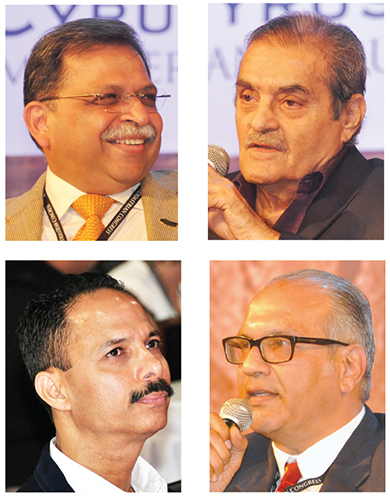
Clockwise from top left: Sumariwalla,
Contractor, Billimoria and Mehta
Speaking from the heart, Contractor told the audience that he had striven very hard to promote cricket among the community. To circumvent the rigors of commuting long distances for training in a metropolitan city like Bombay, nets had been set up at much cost at Rustom Baug, Malcolm Baug and other places and cricket coaching introduced, but there have been few takers. There was some response initially, but the number steadily dwindled and most of the facilities lie unutilized, he noted regretfully. "The Parsi Gymkhana also holds coaching camps,” he mentioned. In contrast, camps conducted by the Board of Control for Cricket in India and the Indian Cricket Academy attract a huge number of boys. This allows for selection of the best ones even from places like Jharkhand (from where India captain Mahendra Singh Dhoni comes).
Contractor’s cricketing career epitomizes endurance and endeavor. A left-hand opening batsman, he made his debut in first-class cricket with 100 runs in each innings, the second man after Arthur Morris to achieve this distinction. His first Test match was in December 1955 versus New Zealand in Bombay. At Lords in 1959, he battled on bravely to score 81 despite the pain of cracked ribs from a blow by fiery fast bowler Brian Statham early in the first innings. His 74 runs at Kanpur later in the same year helped India win its first Test against Australia. He led India to a series victory in 1961-62 against England.
Etched in Parsi and public memory are images of an injured Contractor lying on the ground in Barbados in the West Indies in 1962, felled by a bouncer from Charlie Griffith hitting the back of his skull. Blood transfusions and skilful surgery saved his life, but his promising international career came to an abrupt end. With grit and determination, despite the steel plate in his skull, Contractor took guard once again and played first class cricket for West Zone and Gujarat till the 1970-71 season, involving himself thereafter with the promotion of the sport.
Oft referred to as the "gentleman-cricketer,” Contractor was appointed head in 2012 of the Cricket Improvement Committee (CIC) of the Mumbai Cricket Association (CIC being a committee of ex Test cricketers working on an honorary basis). "Boys from our community have not taken up the sport. I really can’t say why this has happened,” he lamented.
"My size 14 shoes ensured I didn’t become a cricketer,” jested Billimoria, his tall frame towering over his fellow panelists. Most Parsis are healthy ["despite the two eggs and malai (cream)”] and young community members can run, jump, fight as good as any of their peers, he believed. Our girls (and boys) dance and dance requires balance, stamina, chest strength, rhythm, etc. Basic gym equipment and facilities are available at most of the baugs. A good education makes us mentally strong so why is it, Billimoria queried, that we do not excel? It is because we are "totally passionless, we go towards safety,” he asserted. While running the 200 m race, you have to take the bend properly, with correct balance, but then comes the sprint in the straight where greater push and practice is required. "Winning is only 15 percent talent and 85 percent sweat and hard work,” he emphasized.
Narrating personal experiences, Billimoria said he was never particularly good at school sports because of tough competition. Success in judo did not come to him easy despite several years of training. "In 1979 I won the gold and never lost the Bombay championship thereafter.” His first national championship saw him choking in the first round but thereafter he won 10 consecutive national golds! Fortitude and a fighting spirit saw him achieve a bronze medal at the Asian Games in Seoul in 1986, silver at the Commonwealth Championships in Cardiff in 1992 and three South Asian Federation championship medals as well. The Barcelona Olympics, unfortunately, proved to be a forgettable experience. Billimoria also participated in sumo wrestling in Japan, winning a couple of medals. Encouraged and employed by the Tatas for over 15 years, Billimoria expressed appreciation for the "yeoman service” the Tatas have done to sports and acknowledged the Bombay Parsi Punchayet and other trusts which helped him, even with small contributions of Rs 3,000 or Rs 5,000. Since 2003, he has been director of physical education at the prestigious Dhirubhai Ambani International School at the Bandra-Kurla complex.
Putting the question to the panelists, Sumariwalla asked whether it was the diminishing Parsi population, diminishing gene pool, socio-economic reasons or plain disinterest that has led to the decline of sports in the community. Mehta believed that the fundamental problem is that among Parsi parents "very few push and motivate” their children to excel on the playing field. It is true, he said, that sports remains within the domain of the rich who can afford good coaches, club facilities and training, etc. "Perhaps the seniors of the community can come together to create a corpus” which would allow the less affluent to use these facilities. Billimoria observed that today it is children from the villages of Manipur and other north-eastern states or places like Orissa who win maximum laurels for the country. "These guys are hungry, these guys are passionate!” he said.
"The better you are at sports the better you will be at studies. In sports you have to take split second decisions, the mind is so sharp,” remarked Sumariwalla, refuting the popular perception that sports and studies can’t go hand in hand. Currently the president of the Athletics Federation of India (AFI), Sumariwalla was 11 times national champion in the 100 m and has won 40 medals at the national level and 17 medals at the international level. He is the founder and managing director of InterSpace Communications Private Limited and founder and mentor of Professional Sports Services (I) Private Limited, among his other professional accomplishments. "In giving our children everything we make life soft for them and somewhere the competitive streak is lost… (But) parents, don’t hold kids back from what they passionately love,” urged Billimoria. Students can get additional marks for success in sports, he noted, adding that institutional support is also far stronger today through funding by corporates like the Jindals and Bajajs and programs like the Olympic Gold Quest (which identifies and grooms amateur sportspersons).
When a mother in the audience pointed out that today’s youngsters face problems earlier sportspersons may not have encountered, like fudging of ages resulting in boys of 16 or 17 competing in the under-14 age group, or politics at every level of sport, Sumariwalla responded that there is politics in every baug, every profession, at work and in the street! "When I stood for election as AFI president, I was up against one minister, one Member of Parliament and one Member of the Legislative Assembly! Yet I won.” Every single national sports organization is run by politicians and he was the only Olympian heading a national federation, he added. "Prioritize what you want and do your time management. Fight your way through. It is tough, not impossible.”
◆ ◆ ◆
From the archive