
Cover Story
Looking at ourselves
Reflecting the edges between modernity and tradition these postcards of Parsis in Bombay a century ago are a valuable archive of the community
The postcard was the most popular and widely looked at medium in the first 20 years of the last century. Thus images of the community were seen all over the globe during that period. Following "Parsis on Early Postcards (Parsiana October 2001),” other cards retrieved from an old album, beloved of the amateur collectors of the time, give us the opportunity to enjoy another look at ourselves.
A group of three cards brought out c. 1903 is significant. These cards move away from the then clichés, from eyeing us, and others, as ethnographic exotica. Instead, they reflect the on-going social relationships in the city, Bombay, which they are covering. They reflect too, the edges between modernity and tradition in a fast-altering Bombay and India. The three cards are in color, and comprise Parsee Ladies at Seaside, Two Rupees, Sir! and Parsee Priest. The publisher’s name has not been given on the cards, but the artist has signed the paintings.
The scene of Parsee Ladies at Seaside (see front cover) is Chowpatty Beach, Bombay. The figures in the foreground are a lady and her younger companion. The lady faces the artist, and the many thousands who will look at the eventual postcard, with self-assurance. This is evidently the look of a highly sophisticated individual, and mirrors the community’s achievement in female education. The fine sari, the parasol, the shoes, the evening promenade itself, the lack of any male in accompaniment, all speak of changed social attitudes. This representation is different from the subjects usually depicted on the postcards showing India, Africa and the Pacific. Those all too often illustrated social dependency or deprivation as in Bombay Street, Parsee Types, Plague Hospital. This was not coincidental. Such images were justifications of colonialism and the Empire, including the occupation of India, as a moral necessity in the best interests of the colonized themselves. In this card, there is a sharp departure from that norm.
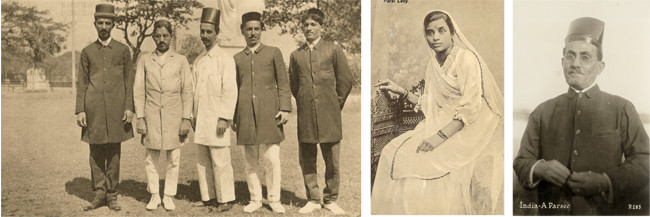
From left: Postcards of the early 20th century titled Parsees, Parsee Lady, India — A Parsee
Two Rupees, Sir! likewise encapsulates different social strata, in a neat combination of the occupational postcard (such as Mochi or Dhobi) and the postcard of social record. Here the contrasts are twofold: firstly, between the two figures in it, the workman and the patron; and secondly, within the Parsi’s own figure, between his traditional pugree on the one hand and his dandyish pin-striped trousers on the other. He is comfortable with both. It is a reflection too of the confidence with which the community was simultaneously managing ancient traditions and the strong cosmopolitan influences that were at play in the country at large and in this city in particular.
Parsee Priest is a pleasant departure from the usual figure attending to rituals. The priest’s footwear, also seen in other cards, is not what has been worn in recent times.
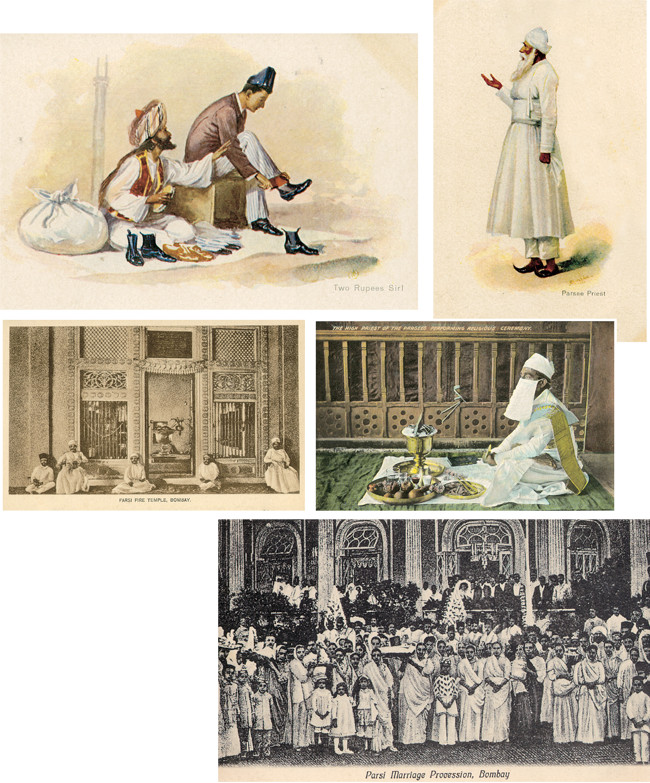
Clockwise from top left: Two Rupees, Sir!, Parsee Priest, The High Priest of the Parsees Performing Religious Ceremony, Parsee Marriage Procession, Bombay and Parsee Fire Temple, Bombay
Another group of cards, some of only a few years later, c. 1908, return to the more usual scenes of priests, agiaries and ceremonies. These are of value in showing the layout, devotional decoration and architecture of that period. They give us visual checklists of ritual rectitude, ceremony and the dresses of priests and laypersons. These cards are Parsee Fire Temple, Bombay, Parsee Marriage Procession, Bombay and The High Priest of the Parsees Performing Religious Ceremony. Parsee Fire Temple, Bombay shows the kebla in which the sacred fire is kept and tended at the Anjuman Atash Behram in Bombay.
Moving into the next decades, we see faces with which we are more familiar. Parsi Lady and Parsees were published c. 1922, respectively by Phototype and Company of Bombay and the well-known Thacker and Company, also of Bombay. In the first, the dress and the studied look repay a careful examination. In the second, the young men stand self-consciously with the stance of those being publicly photographed for the first time, but yet with faces reflecting individuality and diligence.
This typical mix of ability and modesty is reflected also in India — A Parsee, a 1930s card brought out for Canadian Pacific Cruise by Associated Screen News of Montreal. The card is mildly surprising in that cruise passengers were unlikely to have felt that families or friends back home would consider this figure or his headdress sufficiently representative of a visit to fabled India. They were more likely to have expected a postcard of the Taj Mahal or the Himalayas or a Rajah’s palace. But we should be glad to have had this delightful portrait of ourselves passed down.
The Towers of Silence continued to be a popular subject for postcard publishers during all those years, but by then these were no more than copies of old cards, illustrations that had become used and re-used till they had neither instruction nor novelty left in them.
With old photographs, postcards such as these constitute a valuable archive of the community.
◆ ◆ ◆
From the archive