
Cover Story
The texture of text
Banoo Batliboi turns pages to give them a new shape
She gives books a new meaning, not by reinterpreting the words but by giving a new dimension to the pages. "I’m sensitive to the fact that my raw material has a life of its own,” acknowledges Banoo Ratan Batliboi. To give her books an artistic expression she generally uses paperbacks creased with a regimented precision to form sculptures. Each page is folded, tucked, aligned to create the layout form she has conceived. "An object has its own life, its own connotation. I add an intervention to this process. You see the life of the (second hand) book, and I see myself as a part of the process of the book.” This is not a commercial venture, a business. As she puts it, "it is an expression of self. I don’t want external validation,” Batliboi explains her position.
She works with text books containing reading matter and not pictures as "text creates texture.” The evenness of text gives a book a design all its own. Batliboi also has to check that the pages are not so brittle that they will crack or give way while folding. Experience answers doubts here.
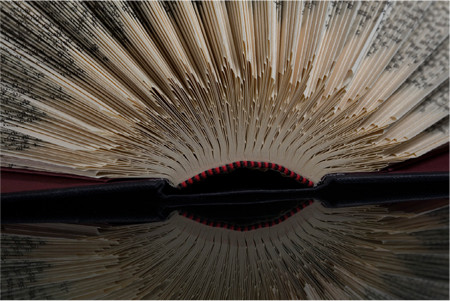
An altered book reflects in the glass
Photo: David de Souza
Batliboi believes "classics are venerated objects — to respect the written word, to revere it,” she notes. Similarly, "I won’t use religious books because I am sensitive to the fact that I am creating a new narrative with the book. It also negates the purpose and gives it a re-use.” For the same reason she "does not touch historically valuable first editions like old leather bound gilt edged books.” So bibliophiles need not spew venom at her hobby. Neither are bibliopegic interventions her scene: Batliboi does not restore books and renew their form. She virtually ‘re-forms’ them.
She studies the binding and familiarises herself with each specimen. Whilst flipping through, she has found letters inside books she has bought. Of course scribblings, jottings are not unusual. She venerates these and folds in such a manner that they are not noticed. She is also fascinated to find at times the precision of name, date and place at which the book has been bought.
Her hands don’t speak as she talks. They rest in assurance at her side in self contained silence. She keeps them for folding the pages. Her hands are her only tools, she says. The hobby started with her habit of folding paper. She starts by thinking through her sculpture, what she terms "cracking the code… I map out the design. There are limitations to what you can and cannot do. You have to create a vocabulary. It is like a logical puzzle.” She varies and combines techniques. Rarely does she cut the spine of a book; only if it does not fold well. Seldom does she undo the pages.
She has given away some 75 books she has sculpted to friends and relatives — the first one being to her brother as she was looking for an unusual gift for him. Since that time seven years ago, she has never looked back. She now makes 20 to 30 sculptures a month but does not retail them; "if you retail you have to get the packaging right,” she asserts. She likes "to sell to those who respond to it. I like a connect with the buyer.” Her book sculptures are available at Rs 3,000 upwards.
Batliboi hunts for her books on the pavements of Bombay, in second hand stores; she even has had some castaways given to her for sculpting. She laments that second hand book stores are a vanishing breed and it is getting tougher to source books. These stores that once abounded are now almost extinct. So she walks down the pavements of Flora Fountain in Bombay where she finds her treasures.
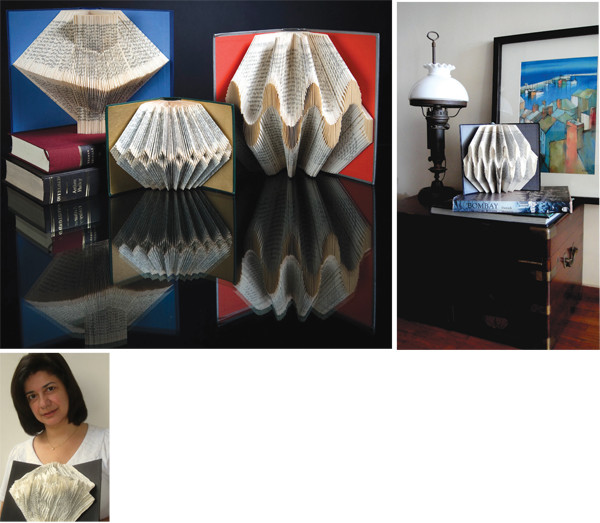
Top: Sculpted Books of Banoo Batliboi Photo: David de Souza; Alongside: A rare hard bound altered book Photo: Banoo Batliboi
Below: Batliboi with her creation Photo: Rehaan Batliboi
Is she in touch with other sculptors doing the same sort of work? Batliboi explains she is by and large a silent spectator to the flurry of words on the internet and does not interact one-on-one with netizens. She belongs to the old school of see-and-talk-across-the-table. She is forthcoming about how she saw her first book sculpture in Bangalore. A friend had bought it from the streets of Milan in Italy. This image stayed with her for some time till she googled it and saw images of folded books on the net. "It engages you. It grabs you.” And thus started her romance with sculpting books.
She still has her first attempt but seems less than pleased with it now, after having perfected the art. "The tried and tested patterns are easy — the new ones take time,” she admits. Only when she is dissatisfied with the colour of the pages does she redo the background of some pages. She is minimalistic in her interventions as each book speaks for itself.
She belongs to the coterie of altered books artists. She experimented. She gave up, at times. Most importantly, she continued… Some of the credit for this goes to her encouraging family. She was a fitness instructor and married an architect. Her youthful figure belies her age. Not surprising, as she was into fitness before the book bug struck her. Her son, Rehaan, 27, manages a website which is an online forum for automobile enthusiasts and daughter, Rhea, 26, works with a bio-tech start up to commercialize a new technology in water purification. Batliboi (née Cama), had a Zoroastrian upbringing. She says her religion is her identity and she is proud of it.
Her altered books come in all sizes and shapes. In the display area one eyes a tiny book of Lilliputian proportions. Somewhere down the room is a sculpture like a diamond consisting of four paperbacks juxtapositioned on a backing. That seems to be the largest in her stable of book sculptures at this point of time.
Batliboi is raring to go and wants to do an altered book depicting Shakespeare’s iambic meter in its design. In fact she says she is itching to lay her hands on musical notations as she has envisaged a poem all its own.
Batliboi considers herself a craftsman. There is an almost spiritual quality to the artist as she talks of "the visual and tactile qualities in these sculptures,” those made and those yet to be made.
So, how long do these books last? Promptly she tells you, "You can’t bequeath them to your grandchildren.” Books acquire the patina of age. Her beauties should last till the pages turn brittle and can no longer maintain the precise fold that Batliboi has breathed into them.
◆ ◆ ◆
From the archive