
Sports
Football in focus
Schoolgirl Kunashni Parikh played for India as part of the U-16 football team
She played for India as vice captain and goalkeeper in the Under-16 (U-16) Women’s football team in the Asian qualifiers for the FIFA U-17 World Cup (scheduled for 2012 in Azerbaijan). Kunashni Parikh of Bombay was the only girl from Maharashtra in the Indian squad for the qualifying matches which were held in Jordan from October 10 to 19, 2010. Her teammates were from places strong in girls’ football like Orissa, Jharkhand, Manipur, Pondicherry, Pun-jab, West Bengal, Uttarakhand, etc.
While emotion, excitement and enterprise were a common denominator, communication was a different ball game, even at the training camps held earlier. "Speaking English was considered to be alien and Hindi was the standard language spoken by only half of the girls,” describes Parikh who studies at the upmarket Cathedral and John Connon School in Bombay. "Whenever I seemed to not be able to communicate with a fellow player, with a simple smile I would gesture towards them asking for a pass or whatever and they would reply in their respective Malayalam, Manipuri, Oriya, Assamese or some random language where another warm smile could be substituted for words!”
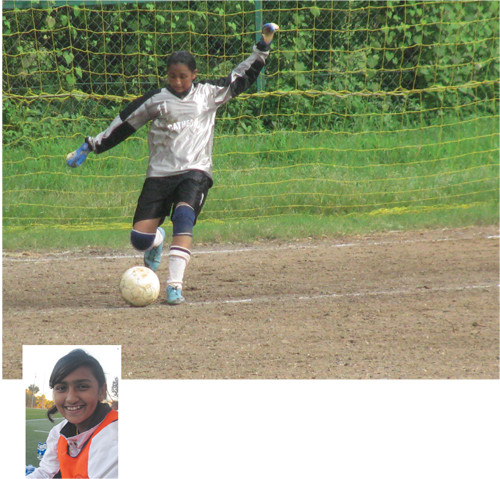
Kunashni Parikh in Jordan (above) and in action in India
The long and arduous training and selection camps prior to the tournament provided cold comfort! "I’m sure you’ve seen the movie Chak de India (about the tribulations and eventual success of the women’s hockey team). The food and rooms were the same, worse actually. I survived sometimes with Lays, biscuits, theplas or just a few chocolates,” the teenager relates. The eve of her 15th birthday was spent on the Ashram Express, with the squad rattling their way from Gandhinagar in Gujarat (the venue of the final training) to Delhi prior to flying out to Jordan. "I never thought I’d be spending that night with ‘cauufee’ and ‘chaaaii’ wallas screeching through the night! But I had with me my friends, our strong family of 23. And the icing on my special birthday cake was one I had not expected — the announcement ‘your vice captain is KP.’ That’s what I was called because no one other than two or three could pronounce my name without making it sound like a Mongolian curry dish!”
Winging their way to the qualifiers, the players checked into their hotel in Amman. "The rooms were heavenly. The food was however quite peculiar and the Pondicherry girls almost fell sick by the lack of ‘chavaal’ (rice) as that’s what they eat in large, really large quantities,” she narrates. "Our first match was preceded by a pep talk in the dressing room (‘yes, we had professional dressing rooms — unbelievable!’) where I remember assisting my captain in encouraging our 11 players by reminding them who they were playing for and what name they carried on their jerseys,” relates Parikh. The on-field thrill of the resonating national anthems of India and Jordan was dampened by the lack of support in the stadium. "I clearly remember the ratio of Jordanian to Indian spectators which was 250:1 and that was the dad of one of our players!”
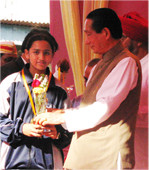
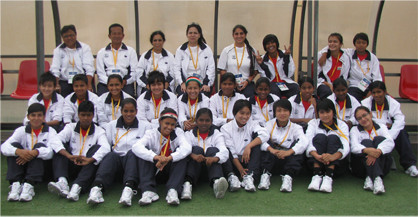
Kunashni Parikh being felicitated by then Maharashtra governor S. C. Jamir in 2009 (above); the Indian team in Jordan
Success eluded India in the matches against the hosts and Iran. "To me, the problem was not lack of talent or team effort but the disorganization and last minute training sessions that we had to go through the day before the match, along with the inadequate facilities throughout all the previous training camps,” Parikh analyzes. Compounding the issue was the by-now-infamous last minute planning and rushing through important decisions that plague Indian sport! "I (have) learnt more than just football… Our country has so much talent with platforms insufficient for the entire lot. There will be hundreds in remote towns and villages dying to take the place I had in the team because football is their life and they could be better than me. I learnt (about) human nature, sometimes selfish, sometimes kind but most of the time silent, and human desire to achieve what initially would seem unconquerable, but would be accomplished later,” she asserts.
Football kicked off for Parikh when she played in the U-12 girls’ team for her school at the district level, progressing to the state level through her PIFA (Premier India Football Academy) training. In October 2009, she tackled her second national tournament. "Maharashtra is not exactly an excellent competitor at national level, especially when it comes to facing annual title winners Orissa and ever aggressive Nagaland,” she states. "While I stood in the goal watching my dazed defenders just allowing our opponents to glide the ball past their lifeless bodies, I knew it was up to me to make a few saves or at least exhibit movement indicating that one player out there was still alive!” Throwing herself at every ball that intruded her area, her index finger soon resembled a mini balloon. Gashes on thighs and arms were her penalties!
What followed was a letter from the All India Football Federation stating that Parikh had been shortlisted with 43 other girls from different parts of the country to attend the selection camp for the U-16 women’s team. Six months later she attended another camp of 42 days, where a shockingly large number of girls — 19 out of 41— were medically declared overage and asked to leave! Exhibiting rare commitment to stick it out despite the difficult conditions, Parikh made it to the final 23. "All the moments I spent at those camps are like another home spent with another family. There was nothing to do other than crowd around one colored screen in the TV room … or read, write poems, play my guitar or listen to my iPod. That was not the atmosphere to study, and my parents Nergis and Gaurav, the two people who I owe my everything to, understood that,” she says. Grandparents Aloo and Baji Kalwachia have also been a great support. "And of course how can I not mention my brother Varun who is simply amazing,” she declares.
Cathedral School, she adds, has granted her leave after leave "without once doubting my chances into the Indian squad.” Currently in Standard X, "the so called study pressure is about to haunt me soon.” This time she has given the nationals a miss. "I would now be in the U-19, with tougher chances of being selected in the team. I cannot afford once again to miss 42 days followed by another five weeks away from school, fighting lizards and mice in the campus rooms or trying to live with them!” she jokes. In April 2009, she had been selected by her school to participate in Duke TIP (Talent Identification Program) — a three-week intensive residential program held on the campus of the Indian Institute of Management, Ahmedabad and conducted by Duke University, Durham, North Carolina, USA. Her travels all over India with focus on football have given her, she believes, the opportunity to see and experience "the real India.”
◆ ◆ ◆
From the archive