
Zoroastrians Abroad
Sacred stairway
"Set the flames of our sublime faith ablaze in this new land which we now call home,” urges Aspi Colah who is playing a pivotal role in the establishment of the "first and only perpetual burning fire temple this side of the western hemisphere.” To be built on a property located on 9000 W. Airport Boulevard in Houston, the traditional dadgah is expected "to fulfill the spiritual void in our community in North America and more so for our young children and future generations so that they can experience the beauty of our sublime faith just like we did back home in India, Pakistan and Iran;” their vision is delineated on their website www.myzdgroup. org.
Spearheading this effort for the creation of a traditional dadgah which will permit entry only to those of at least two generations of Zoroastrian lineage is the MYZD (Mazda Yeshni Zarathusti Dar-e-Meher) Group with Kaemerz Dotiwala as the president. The other key members of the Group are treasurer Barjor Dastur, accountant Kershaw Khumbatta, with Tehemtan Aresh in charge of fund raising, Noshir Challa, Affraz Boomla, Aspi Colah supervising construction, and Colah’s 14-year-old son Zubin being the webmaster. On January 1, 2011 the Group launched its website seeing the "phenomenal response and support for our MYZD booth and display at the 2010 North American Zoroastrian Congress in Houston.”
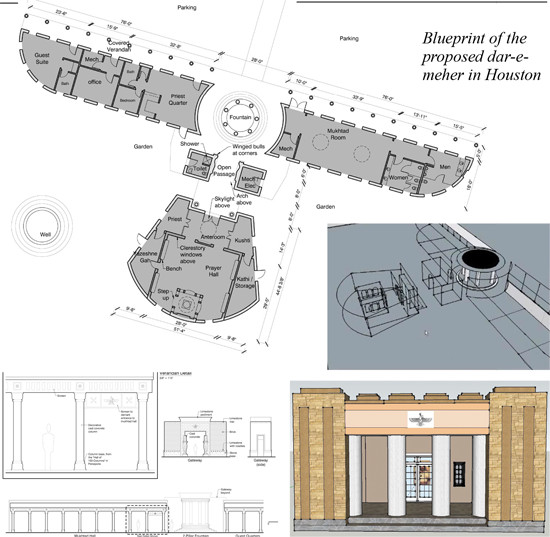
Their plan for the Ahunavar Complex envisages a group of five buildings, each connected with the other, so that when seen as an aerial view it represents a farohar. Architect Cyrus Rivetna of Chicago is in charge of the project which will commence with the construction of the dar-e-meher, the nerve center of the complex, as soon as the finances are arranged. The dar-e-meher was inspired by the ruins of Persepolis, the imposing capital of the Achemenian empire envisioned by Cyrus the Great and built upon by Darius I, Xersis and Artaxersis. "All proper protocol and specifications for creating a proper traditional dadgah as recommended by the high priests in India, religious scholars and other experts in the field in India will be followed,” assures the website. The necessary ground work, axis coordinates, site orientation and spiritual geometry including the digging of a fresh water well will be taken care of. To make the precincts environmentally friendly, emphasis will be given to natural day lighting as also harnessing of wind power for natural cooling and air circulation while the square kebla is designed to dissipate smoke.
The roof of the building is meant to represent the legendary Mount Damavand, "considered by many of the faithful as the portal to the beyond, a transit stop before the soul of the departed enters the realm of Chinvat on the fourth day of judgment. During the yearly muktad ceremonies it is said that the souls of the departed make their way down the same path to reside in the water urns filled with flowers...” Damavand also gains significance in light of poet Ferdowsi using it as a backdrop in Shahnameh for many of the battles between good and evil; where the young Shah Faredoon defeated the evil Zohak and fettered him in chains. Additionally the website declares that the "forerunners for the revival of our sublime faith, Hosedar Mah and Hosedar Bami and the advent of Shah Behram Varjavand, our future savior will be coming forth from this talismanic mountain peak...”
A winged bull arch is meant to create "a grand entryway to the main dadgah” after one circles the seven-column bull-headed fountain. The seven-column structure in the center of the complex denotes the real circle of life with the columns signifying the seven Amesha Spentas or the archangels. The structure will stand tall under a bezel roof with a circular skylight opening at the top. Three steps lead to the center fountain pool inside a circular promenade.
In addition to the dadgah, the complex will have a right wing to house a muktad hall with a full size commercial kitchen area. This section can be used for lagan and navote ceremonies. The left wing will house the priests’ quarters and guest quarters for out-of-town visitors. They plan to have a resident priest who will perform a minimum of three boi ceremonies for the fire each day. "We are very fortunate to have 15 to 16 priests within our community in Houston who have volunteered their services as and when required,” reports the website.
The facilities proposed for the complex are: "a real Sunday School teaching a true curriculum of our Zoroastrian history, culture, traditions, rituals, customs, morals and values... Gujarati and Persian languages;” a religious seminary for the training of navars and paramobeds and hosting of conferences and seminars; a center for preserving Parsi arts and crafts; a dharamshala; and Montessori/daycare.
Entrance to the dar-e-meher "shall be governed by the directives of the high priests of the Zoroastrian faith in India,” stipulates the MYZD Group. Hence they have decided that only Zarathushtis whose both parents as also maternal and paternal grandparents are Zoroastrians will be permitted entry. Marriage outside the community would disqualify a Zarathushti from this fire temple.
Parsiana enquired from Colah if these restrictions would be violative of US laws pertaining to discrimination on the basis of race, marriage, etc. We also enquired about the total cost of the project and whether the site was acquired or to be acquired. Till the time of going to press, no response was received.
"We need your support... We need your help...” the MYZD Group seeks financial aid, offering "different programs to suit every budget, from monthly contributions to pledges big or small... Donate as an individual or as a group or in memory of a loved one. If you are interested in one of our legacy projects or in naming rights for one or more parts of this unique complex please contact us at myzdgroup@yahoo.com or myzd group@hotmail.com or myzdgroup@ gmail.com”
◆ ◆ ◆
From the archive