
Cover Story
New Center in North Texas
Two decades of planning, fund-raising and labor by ZANT went into the building of America’s newest Zoroastrian facility for prayer and community activities
The embers were transferred to the large afarganiu, the maachi was readied, and the mobeds performed the first boi ceremony at the newly inaugurated ZANT (Zoroastrian Association of North Texas) Center. It had been a cloudy day with threats of rain but just as the flames burst forth in the main afarganiu, the clouds parted and the sun burst through the high western windows and streamed right onto the sukhad. It seemed as though Khorshed Yazad had chosen to enter the prayer room and bless the atash!
Before the congregation followed the priests into the prayer room, they sat through a 90-minute inaugural jashan showcasing the best of all the traditions brought to America. The ZANT community consists of approximately 200 families, about a third of whom are originally from Iran and the rest from India and Pakistan. Over 150 Zarathushtis, young and old, filled the ZANT Center to capacity on the evening of April 30, 2011 to witness the jashan and five afringans being prayed by Ervad Soli P. Dastur and the local mobeds, Ervads Poras T. Balsara, Yazdi Dastur, Cyrus Dastur, Hormuzd Karkaria, Zubin Kotwal and 11-year-old navar Burzin P. Balsara. They then partook of the mounds of chasni (consecrated offerings) laid out in the large, antique khumchas (platters).
.jpg)
Top: Members of the Zoroastrian Association of North Texas on the inauguration day outside their new Center
The 5,000 sq ft ZANT Center housing a darbe mehr with an atash dadgah, and a multi-purpose hall is a beautiful facility located in the town of Flower Mound. North America’s newest Zoroastrian Center, representing 20 years of efforts by ZANT, was designed by architect Cyrus Rivetna who incorporated many traditional elements into the design. The building consists of a prayer room with kusti area, a library-cum-office, a large open meeting space, with kitchen and restrooms.
The gumbaz area with the afarganiu is the focal point in the 800 sq ft prayer room. On one side of the gumbaz (sanctum sanctorum) is a six-foot-tall portrait of Zarathushtra. On the other side is a unique glass etching, designed by Poras Balsara, which is illuminated by concealed white LEDs (light emitting diodes). The three main prayers, Ashem Vohu, Yatha Ahu Vairyo and Yenghe Hatam are set as a spiral in the Avesta script, with an atash and a farohar in the center. Under the spiral, the three prayers with their meanings are transcribed in English and arranged as a triangle, to denote the strong foundation they provide the community.
.jpg)
Although the sacred fire is an atash dadgah, the community wanted to enthrone it with appropriate rituals, as far as possible. Towards this end, Poras Balsara, who has served the ZANT community for two decades, gathered advice from many individuals. The first ceremony was a vendidad sadeh, to ritually purify the building. It began shortly after midnight, in Ushahin gah the day prior. All 22 Fargarads were chanted by Ervads Soli Dastur, Poras Balsara and Yazdi Dastur. Completing this ritual was a very personally satisfying experience for all three mobeds, and according to Soli, this was the first vendidad sadeh done in North America.
On the morning of April 30, Soli performed the baj of Sarosh inside a special pavi. Later in the day the symbolic cutting of ribbon by the chairman of the fundraising committee Behram Irani and the chairman of the building committee Jamshed Rivetna was followed by the inaugural jashan. Bringing the evening to a close was a round of thanks by the current ZANT board comprising Zal Parakh, Saghar Behroozi, Khurshid Jamadar, Pearl Balsara, Delnaaz Irani, Boman Godiwalla and Afsaneh Samiya and a traditional meal prepared by dedicated members.
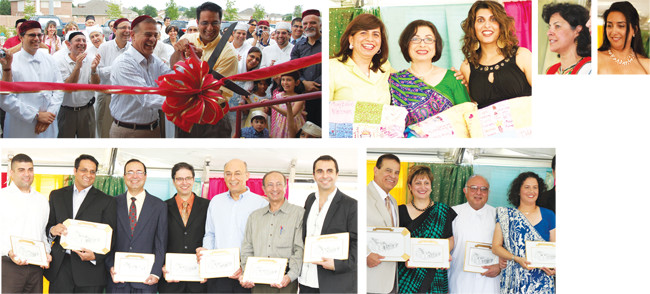
From left (top row): Behram Irani and Jamshed Rivetna cutting the ribbon; religious class teacher Pearl Balsara, Nina Kalianivala and Sherazade Mehta; Saghar Behroozi and Arbez Patel; (second row): building committee Karl Mistry, Jam-shed Rivetna, Spenta Irani, Kali Buhariwalla, Kamran Behroozi, Jamshed Jamadar, Darius Shroff; and fundraising committee Behram Irani, Farieda Irani, Firdosh Mehta, Keshvar Buhariwalla
However the celebration was far from over! An opening ceremony committee chaired by Farieda Irani and Arbez Patel had been working for over a year to plan a program fit for the momentous occasion. On May 7, there was a gala event to recognize and acknowledge everyone who had made this building a reality. A special tent was erected on the grounds to accommodate over 300 guests, and a grand show featuring all aspects of ZANT was planned. The event began at 11 a.m. with a benediction, and a beautiful rendition of the Star Spangled Banner by Zara Patel, accompanied by the Boy Scout Color Guard. The Masters of Ceremony were Behroozi and Keshvar Buhariwalla whose task it was to convey to the audience the extent of time, talent and dollars contributed by so many. Recognized were all the members of the building committee, the fundraising committee, the major donors, and others who contributed to the project. Each person was presented with a white ceramic platter, hand-painted and etched in gold with the front elevation of the ZANT Center, done by Karin Nayar. Although more than 20 individuals were recognized with personalized speeches, Behroozi and Buhariwalla did a fabulous job of keeping the audience engaged and entertained. The religious class teachers, Nina Kalianivala, Pearl Balsara and Sherazade Mehta were presented with quilts decorated with personalized messages from each child.
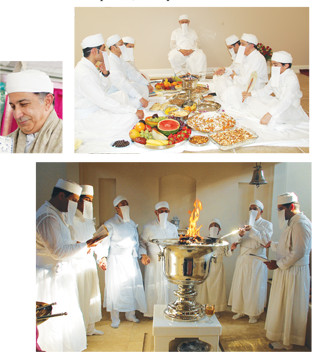
(Above): Ervad Poras Balsara; inaugural jashan and (left) baj in kebla performed by Ervads Hormuzd Karkaria, Zubin Kotwal, Yazdi Dastur, Soli Dastur, Navar Burzin Balsara, Poras Balsara, Cyrus Dastur
The entertainment event, called "ZANT from A to Z” was choreographed and directed by Cyra Shroff assisted by Mehta. It featured ZANT’s connection to each letter of the alphabet, with a song, dance or rhyme. They started with the letter A that stood for Ahura Mazda, with a tableau featuring a fravahar, B was for the building committee who danced with shovels, E for ervads, F for founding members, S for seniors, etc. Celebrations like gahanbars, mehergan, tirgan, yalda and the Olympics took care of some letters while concepts like the ZANT Center being the "key” to the future, with unity and Xshatra Vairya allowed a wide range of ideas and talents to be showcased. Of course it ended with Z for ZANT, and altogether over 90 people came on stage to sing, dance and entertain. After a catered lunch, a time capsule with ZANT memorabilia was lowered underground, to be opened after 25 years. The attention to detail and sense of style from the opening ceremony committee made this a truly memorable day, marking a monumental milestone for ZANT.
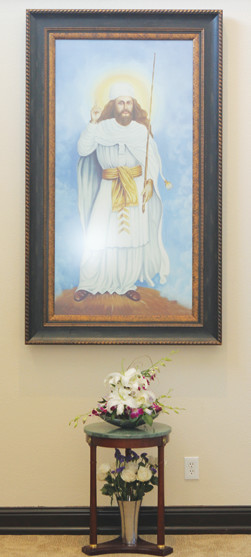
Prophet’s portrait in prayer room
Strong foundation
The entire project has been a labor of love for the building committee chaired by Rivetna, and members Kamran Behroozi, Kali Buhariwalla, Spenta Irani, Jamshed Jamadar, Karl Mistry and Darius Shroff. This group persevered through five years of construction details and made the community’s dream into a viable vision and finally a reality.
Like most diaspora communities, the Zarathushtis in North Texas felt the need to lay down roots and formed an association in 1989. Soon after, in 1991, Roda and Aspy Mistry planted seeds to acquire a building, and the ZANT Building Fund was established in 1995. While the community endeavored to raise funds through monthly donations and selling food like falooda at local fairs, Behram Irani, one of the founder members and first president, took the lead in 2002 to initiate a successful Capital Campaign to raise funds from within the ZANT community. Recognizing that "people give to people” Irani trained volunteers who convinced many members to make pledges towards the project. The fundraising committee members were Pearl Balsara, Kamran Behroozi, Kali and Keshvar Buhariwalla, Behram and Farieda Irani, Firdosh Mehta, Feroze and Anahita Sidhwa. Community fund-raisers continued which included raffles, silent auctions, garage sales, a recipe book, a Gujarati natak and a "Creation” book authored by the children.
By 2006 ZANT had purchased a 2.5 acre property, and a substantial donation from the Zoroastrian Charity Funds of Hong Kong, Canton and Macao also gave the project a boost. To date, $ 1.2 million have been raised from over 275 families, and 70 percent of the total funds have come from the local Zoroastrian community. To economize, the building committee also acted as the general contractor, which took a tremendous amount of personal time and effort. After a ground-breaking ceremony on February 8, 2009, the structure finally began to take shape.
The Bharuch Parsi Panchayat donated a large afarganiu, circa 1910, thanks to the efforts of Firdosh Mehta and Dinshaw Tamboly. Ervad Nariman Dalal assisted with storing the afarganiu and acquiring many prayer room and kebla items.
Future plans consist of a large hall for about 300 people. Will the enthusiasm be sustained? The children’s religious class the day after the celebrations (May 8) gave a glimpse with nearly 100 kids and adults attending eagerly. ZANT has begun a new era with the Center being used almost every week. The prayer room is a peaceful sanctuary and the open hall lends itself to fun and fellowship. Construction for Phase 2 should begin soon, and with Ahura Mazda’s blessings the community is optimistic about spreading humata, hukhta and huvarshta in and around their new home.
Written by Anahita Sidhwa with contributions from Ervad Poras T. Balsara, Ervad Soli P. Dastur, Behram Irani and Arbez Patel. Photos: Kali Buhariwalla, Farook Raghani and Vispy Sarkari
◆ ◆ ◆
From the archive