
Books
The complete man
Homi J. Bhabha: A Life by Bakhtiar K. Dadabhoy. Published in 2023 by Rupa Publications India Pvt Ltd, 7/16 Ansari Road, Daryaganj, New Delhi 110002. Pp: xix + 723. Price: Rs 995.
The recent success of India’s space mission, symbolized by the landing of the Chandrayaan lunar vehicle on the south pole of the moon in September 2023 has given a huge fillip to the nation’s self-confidence in projecting its scientific prowess onto the rest of the world. The spree of self-congratulation which followed the event (including, inevitably, some preening by Prime Minister Narendra Modi), unusually, shone a spotlight on India’s scientists and the strides they have made during the past 70-odd years. The foundation for those strides was laid by a small number of highly dedicated and talented men (and they were all men) whose life stories deserve to be told, not least as an inspiration to the current generation of Indian youth who have been growing up in circumstances far removed from those of their parents and grandparents.
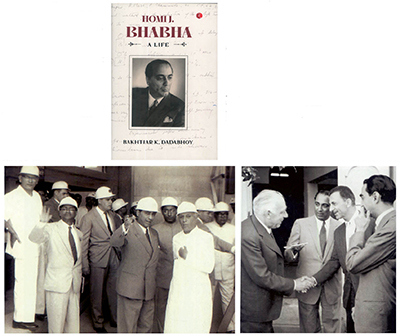
Above l: Dr Homi Bhabha and Jawaharlal Nehru (5th and 7th from l) at Trombay;
above r : Niels Bohr (l) being introduced to J. R. D. Tata while Homi (center) and Jamshed Bhabha look on
The subject of this weighty tome, Homi J. Bhabha, is one about whom much has already been written. But what stands out about this work, in addition to its size, is its comprehensiveness and attention to detail, both of which make it engrossing reading — provided, of course, that the reader has the patience to go through its 700-odd pages! Author Bakhtiar Dadabhoy is meticulous with his research and referencing (there are over 60 pages of notes and a 12-page bibliography). No less impressive is a well-constructed back index which deserves special mention given that this feature is often the Achilles heel of books published in India.
What, then, has Dadabhoy set out to do? He eschews any claim to scholarship (the book is, he asserts, intended to be "a popular account”) and sets out his stall thus: "I have chosen to write for a general readership, and it is hoped that this book will appeal to a larger audience. For those interested in both Bhabha the man and his contribution to fundamental research and the nuclear energy program, this book will definitely be of interest. For those exploring atomic energy as it is now, an understanding of the people who made it what it is today will certainly enhance their experience. It will also appeal to all those who simply like a good story.”
And the story that he tells is as instructive as it is interesting for the most part. The tone is equable, with no attempts at hagiography or hyperbole. Bhabha comes through as a fairly complex and multi-faceted man, a product of his generation in terms of attitudes and impulses. In today’s jargon, he would probably be called an alpha male. There was certainly no self-doubt, even in his younger days, either about his innate abilities or about the contributions he could make to India in terms of "institution-building on a grand scale” — probably because, speculates the author, Bhabha was "secure in family wealth and an international reputation.” Those attributes did not, however, seem to protect Bhabha from experiencing racial prejudice at the hands of the British because, notes Dadabhoy, when Bhabha offered to help in the war effort in 1939, he was rebuffed. "Despite his wealth and western outlook, when it came to the crunch, his racial origins barred the way,” is Dadabhoy’s verdict on the incident. A few other examples are cited elsewhere in the book to reinforce this point about the racial prejudice which apparently dogged Bhabha and a few other talented Indian scientists, particularly in Cambridge.
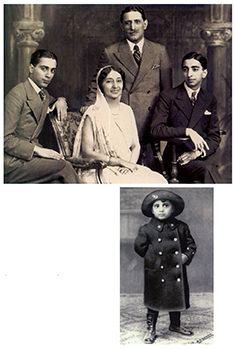
Top , from l: Homi Bhabha with parents
Meherbai, Jehangir and brother Jamshed;
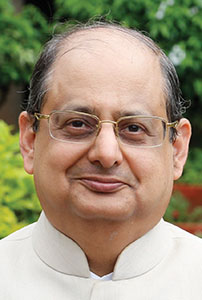
above: Homi as a child; below: Bakhtiar Dadabhoy
An important turning point in Bhabha’s life came when he decided, despite indications to the contrary, to forsake England for India after completing his education in Cambridge. That decision also became consequential for India because, soon thereafter, Bhabha, with financial assistance from the House of Tatas (to which his family was connected by marriage), went on to set up the Tata Institute of Fundamental Research (TIFR), an entity which was pivotal to India’s scientific progress in subsequent decades. The story of the TIFR’s founding and growth coupled with the establishment of a number of sister institutions focusing on atomic science — which eventually led to India’s successful detonation of a "nuclear bomb” — is both compelling and illustrative of the many challenges that institution-building, especially in a poor country, involves. A notable example of such challenges was the creation of the Atomic Energy Commission (AEC) where Bhabha received much needed support from the then Prime Minister, Jawaharlal Nehru (who himself introduced the necessary legislation in parliament), even as he was facing strong opposition from one of his senior colleagues, Meghnad Saha. The twists and turns in the AEC saga are covered elaborately in the book.
 Nuclear physics was by no means Bhabha’s only professional interest. He was, points out Dadabhoy, visionary enough to realize that India could not afford to ignore the importance of electronics and computers. With that in mind, he set up an electronics group at TIFR which began paying rich dividends soon, including by aiding cosmic ray and other experiments as well as providing indigenous equipment for nuclear reactor control systems. Computers also captured his imagination early on; he realized "the important role they would play in fields ranging from pure research to industry. He felt that the use of computers would become inevitable in railways and communications, missile guidance and meteorology and even in such a complex field as national planning. Bhabha observed that computers were giving rise to a new world view and a new scientific culture in society.”
Outside science, Bhabha enjoyed more than a modest reputation as a connoisseur of the arts. The book refers to his "considerable artistic skills” and to his involvement in a plethora of activities which encompassed painting, sketching, designing the sets for plays and operas, and even conducting the Cambridge University Orchestra (as for his tastes in music, he is said to have admired Wolfgang Amadeus Mozart and detested Wilhelm Richard Wagner). For all his passion for the arts, he refused to contemplate it as a career option. "Science,” he is quoted as saying to a friend, "shall be my wife, Art my mistress.”
Anyone looking for salaciousness in this book will be disappointed. The closest Dadabhoy comes to discussing Bhabha’s personal life is in a short section where he describes the live-in relationship that he had with a married woman, Pipsy Wadia; they were, says Dadabhoy, "an item” and Bhabha appeared freely with Wadia in public although it occasioned embarrassment with certain hosts. More tantalizingly, Dadabhoy refers to an interview that Homi’s brother Jamshed gave in which he noted that there was one failure of Bhabha’s which was of "such an intimate nature that he could not talk about it. It involved Bhabha’s failure in his relationship with a lady.” It is, declares Dadabhoy matter of factly, "impossible to know who Jamshed was referring to.”
All in all, this is a highly readable book. Such blemishes as remain are minor (among other things, the editing could have been tighter in places; there is occasionally avoidable repetition, e.g. of passages from Homi’s letters to one of his friends, Homi Seervai; and there is a careless reference to Homi’s parental home, Mehrangir, as a "bungalow” despite it being correctly described elsewhere in the book as a three-storeyed building). None of these should, however, take away from the painstaking effort that has gone into the preparation of the volume.
VENKAT IYER
Iyer is a UK-based barrister and legal academic.
◆ ◆ ◆
From the archive