
In Memoriam
The mighty Mini
In mid 1973 when we were going to take over Parsiana from Dr Pesi Warden, an architect friend introduced us to Mini Boatwala stating she was a person who could as- sist us with the designing of the magazine. Mini was at that time the art director for the Life Insurance Corpora- tion of India (LIC). An ex- tremely competent and self taught designer she readily offered her expertise without charging a pie. Not only with designing but guiding us to one of the leading presses in Bombay at the time G. Claridge and Company where the LIC magazine Yogakshema was being printed. On Mini’s account they accepted the job and extended us the much needed credit (as did a reputed paper dealer and block maker known to her) we required in the initial stages. So began a professional and personal relationship that spanned 37 years.
Through Mini we were able to access for Parsiana and the other publications we brought out for a number of years some of the best photographic talent in the country. Due to the high regard they had for her abilities and integrity they worked for much less than their normal professional charges. Through her eyes we began to see typefaces and the layout of printed pages from a different perspective. The texture of paper, the col- ors of ink, the boldness of an alphabet, the intricacies of the printing process all came into sharper focus.
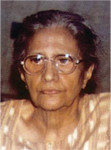
Mini Boatwala: creative critic
As freelance writer and reviewer Geeta Doctor who often wrote for Parsi- ana and the company’s other erstwhile publications notes, "She was exacting in her choice of images and in the care she took to make the page look both clean and elegant. Of course not many people will recall that in those days everything had to be done by hand and checked again and again to make sure that every page turned out as crisp and fresh as a slice of buttered toast. She pored over the printed pages with a small eye-glass that she placed close to her eye when she was working so it was like watching a jew-eler polishing a rare gem. In fact that was the kind of dedication that she brought to her job and that she expected from those working with her, like Manjula Padmanabhan, then resident illustrator of the Parsiana group.”
"I met her at a time when I knew very little about printing technology and magazine design,” recalls Padmanabhan. "From the very outset, she was always patient and unfailingly kind. I must have seemed to her just like a frantic puppy, always desperate to rush ahead with fanciful ideas and drawings inappropri- ate for the magazine’s size and budget! She was a wonderful example of what it means to be professional: to put the quality of the finished product ahead of all other considerations, to be punctual,to be responsible and dependable.”
As travel writer, former managing editor of Signature and Voyage maga- zine and a contributing editor to Parsiana
Jeroo Irani recalls, "When I joined Parsiana as an editorial trainee way back in 1974, Mini was already a legend in the office. The minuscule editorial depart- ment was in awe of her finely honed sense of aesthetics and graphic design, and her business-like approach to life.
Over the years, I discovered that beneath that no-nonsense exterior was a soft, almost maternal person with a lively sense of humor and an inimitable twinkle in her eye.”
States Parsiana’s executive editor Parinaz Gandhi, "Frank and formidable, she did not stand on formality, and de- spite her seniority and age would insist that even the juniormost colleague ad-dress her simply as ‘Mini.’ An artist to the core, her creativity flowed with in- spiration and deliberation. Only after understanding the gist of an article would she undertake a page layout which was never a random exercise. She detested working under pressure of deadlines. With her command over Gujarati she would often come to the rescue of the editorial department when they were at a loss for an appropriate English transla- tion.”
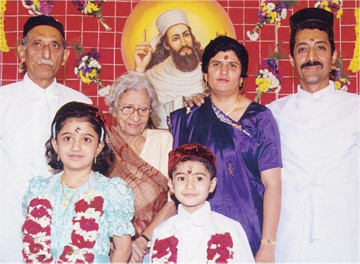
Mini (center) in maroon sari with members of the Amroliwalla family (from left) Hosie, Nilufer, Marzban, Rashna and Khushroo
Having worked in the erstwhile Tata Press when its factory was initially in the Fort area and later Prabhadevi, Mini knew the intricacies of letterpress, offset and silk screen printing better than most other printers and designers. No press- man dare give a flimsy excuse for spoil- ing a job. The person would be delivered a no-holds barred tongue lashing that left most dreading having to face her. Errant block makers were not spared ei- ther. On account of her sin- cerity and honesty few har- bored resentment towards her. Only the dishonest and incompetent may have borne her a grudge.
Athough a harsh judge of quality, she was at the same time a patient and understanding teacher. Gustasp Irani, noted freelance travel writer and photographer who worked for Parsiana in the 1980s recalls, "As a fledgling photographer, Mini’s honest feedback on my photographs was ini- tially hard to take. Her comments were to the point but they changed the way I looked through the viewfinder. Even today when I take a photograph, I think of the pointers about composition and photography that she gave me — they were wonderfully simple but very valid. The first time she gave my photographs a big splash was when she used them to illustrate my story on Nepal in Signature magazine that was then being published by Parsiana Publications. When I hap- pened to stop by the office, she said: ‘Tu havé bahu hoshiyar thai gayo! (You’ve become very clever now).’ At that point, I felt that I had arrived.”
Eyesight permitting, she would read through an article and offer her cryptic comments. Even captions would not es- cape her critical eye. Often she would question the wording, asking if it was essential to mention a fact that was obvi- ous from the photograph.
A restless person who felt the con- straints of a bureaucratic post restricted her creative potential, Mini left a secure job at LIC to venture into independent designing. She operated from the Parsi- ana office and received a nominal sti- pend. But she did not have a business- person’s temperament. She was happier designing without the headache of court- ing clients, educating them to the nu- ances of sound designing based on ty- pography, balance and color (a difficult if not an impossible task given the gen- eral level of ignorance prevalent). Screen and rules were discouraged if they were used to create a facade of design. The design had to speak for itself. When we struggled with mediocre pictures or lack of any visual material we could count on her to come up with an idea, artwork or design that saved the day.
Disenchanted with the hustle and bustle of city life she bought some land in the Gujarat seaside resort of Tithal and built a cottage next to the one of her friend, noted photographer Ashvin Mehta. A coconut grove was planted behind. She shuttled between her Rustom Baug resi- dence and Tithal till a fractured hip fol- lowing a fall restricted her mobility.
Mini sold her Tithal property on the understanding that the new owner would not develop the land by building addi- tional structures on it so as not to disturb the tranquility of Mehta and his family. She thereby got a lower price for the land but did not grudge the loss. Money was never the central focus of her existence. The Tithal sale bolstered her finances somewhat causing her to jest that while she lived poor she would die rich. But her additional income barely kept pace with rising costs.
"She was as independent as the wind, the waves and the stars shining down on the spare bare beauty that Mini brought to her life and her world,” remarks Doc- tor, reminiscing of her "real fondness for Indian textiles, wearing beautiful khadi blouses in an old fashioned manner with long sleeves and a cut that went down to the waist with matching cotton printed saris that were often in the yet to be made fashionable vegetable dyes and dark beaded necklaces that made a contrast to her silver hair neatly pinned into a bun at the back. With her bright shining eyes and inquisitive enquiring look, Mini had an interest in people and in the world that made her a most interesting and fasci- nating companion.”
Adds Padmanabhan, "What I remem- ber most vividly of Mini are her lumi- nous, amber-brown eyes — and the way that she would unfailingly wear one or two pieces of jewelry that perfectly complimented the light in her eyes. There would be the peridot earrings, for in- stance, or the pale golden topaz set in a dainty little pendant — never anything flashy or expensive, but always exquis- itely tasteful, well made and perfectly matched to the muted colors of her cot- ton saris.
"This is just another way of saying that she was a designer with every par- ticle of her being. From the way she dressed, to the close attention she paid to every small detail of typeface and layout in Parsiana’s early days, to the care and skill she lavished upon her commissioned oil-paintings.”
She had spent a lifetime looking after her three younger siblings as her father Maneck died when she was young. Ac- cording to her cousin Capt Pestonji Bhujwala, Mini’s grandfather Hormusji "was a very strict man and a tough jailor. They said he used to carry a rhino skin whip in Bhuj.” Maneck moved to Porbunder where he was appointed Con- troller of the Royal Household, largely looking to the welfare of the palace guests, silversmith Shamji "Bachubhai” Gajjar informed Bhujwala. The royal family took to Mini and hence along with Lilaba Saheb and two or three oth- ers she was educated at the palace by private tutors. The family later moved to Hyderabad where her father started a hotel, one of his several ill conceived business ventures. Upon his death her mother, Tehmina, and her progeny all relocated to Bombay and stayed in a dharamshala in Bandra after which they were allotted a flat in Rustom Baug.
With no formal education in art, the young woman from Porbunder was as eager a student as she was a teacher. Through observation, reading, a friends circle of civic minded, creative individu- als and an artistic bent she inquired into the how and why of things, taking noth- ing for granted. She lost vision in the center of one eye when in childhood a ball struck the vital organ. After her cataracts were removed she found her vision fur- ther impaired and would often say in jest when looking at photographs that she was doing so half blind. Yet she could still see the flaws and strengths of the visuals that were not visible to others.
Unmarried, she took keen interest in the well-being of her sister Najoo Amroliwalla’s two grandchildren refer- ring to them as her own grandchildren. A textile designer, Najoo assisted Mini at Parsiana and even worked at Diners Club when it was owned by the Aggarwal family for some years before retiring on account of ill health. Of her four sib- lings, three brothers and one sister, she was closest to Najoo.
Till the June 21, 2010 issue we would send our potential cover photographs to her residence for her to look at, study, praise (rarely), criticize (often) and sug- gest which one to use, the color of the Parsiana logo, the size of the lettering, what colors were to be toned down or strengthened, the background to be cropped or kept… When the publication came out she knew exactly which in- structions the office or the printer had followed. Although of modest financial means, she steadfastly refused any pay- ment for this consultancy. Over the course of time we imbued much of her sense of judgment but could never equal her sense of color, balance and style. That was something inborn in her. She died on October 25, 2010, a day before her 87th roj birthday at the B. D. Petit Parsee General Hospital. No one could have asked for a better teacher or a dearer friend.
Every issue of Parsiana bore and will continue to bear in varying mea- sures her innate sense of style and content.
◆ ◆ ◆
From the archive