
Politics and Policy
“They cut their own noses”
Maneck Davar lists the shortcomings of the present Bombay Parsi Punchayet trustees while presenting his plan of action
"You are very fortunate not to reside in a Bombay Parsi Punchayet (BPP) colony,” said BPP trusteeship candidate Maneck Davar while addressing residents of the Tata Blocks and others in Bandra on September 27. Davar noted how well maintained the colony was with the buildings smartly painted and the greenery well tended.
"We are blessed because of the contribution of our forefathers,” stated the self-made prosperous businessman. He was introduced to the gathering by Prof Khurshed Sheriar "as a person who has proved he can deliver.”
The publisher/printer and former journalist noted in some BPP managed colonies open drains and uncut grass resulted in the spread of dengue. In Panthaky Baug the pavilion/club house is a tin shed. When a donor offered to construct a proper structure, the BPP trustees reportedly replied, "give us the money we will build,” a condition not acceptable to the patron.
Davar claimed that the BPP had a deficit of Rs 8.5 crores (US$ 1,282,549) while earlier they had a surplus as they received Rs 11 crores in donations (this came from flat transfers). All that money was spent. "The BPP is almost bankrupt,” he observed.
"I am doing charitable work for children, and outside the Parsi community where I am a trustee, the trusts are financially strong. If even a thousand rupee cash donation was received, the full amount was deposited in the bank. You can’t have Rs 22,00,000 locked up in cupboards,” he commented, referring to the monies found in the BPP office following the demise of the chief executive officer (CEO) Mehli Colah.
"We are blessed because of the contribution of our forefathers,” stated the self-made prosperous businessman. He was introduced to the gathering by Prof Khurshed Sheriar "as a person who has proved he can deliver.”
The publisher/printer and former journalist noted in some BPP managed colonies open drains and uncut grass resulted in the spread of dengue. In Panthaky Baug the pavilion/club house is a tin shed. When a donor offered to construct a proper structure, the BPP trustees reportedly replied, "give us the money we will build,” a condition not acceptable to the patron.
Davar claimed that the BPP had a deficit of Rs 8.5 crores (US$ 1,282,549) while earlier they had a surplus as they received Rs 11 crores in donations (this came from flat transfers). All that money was spent. "The BPP is almost bankrupt,” he observed.
"I am doing charitable work for children, and outside the Parsi community where I am a trustee, the trusts are financially strong. If even a thousand rupee cash donation was received, the full amount was deposited in the bank. You can’t have Rs 22,00,000 locked up in cupboards,” he commented, referring to the monies found in the BPP office following the demise of the chief executive officer (CEO) Mehli Colah.
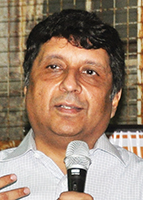
Maneck Davar
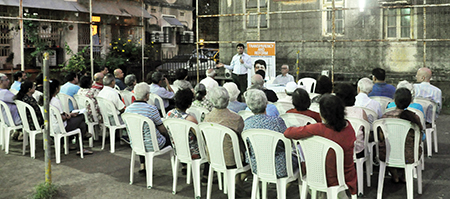
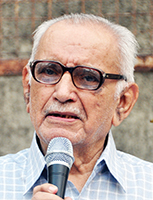
A view of the audience at Tata Blocks with Prof Khurshed Sheriar (right)
Davar alleged all the trustees knew about the Rs 22 lakhs, but when filing criminal charges they never gave a thought about the ramifications if the news went public. "They cut their own noses,” he remarked. "If three of the four trustees can’t think,” things go awry. "What happens in the boardrooms should never come out. For the greater good they should not publicly show dissension. The credibility level of the trustees is low.”
The most successful program of the BPP is the Holiday Programme for Youth "because the trustees don’t interfere,” he surmised.
Though he has never been a BPP trustee nor stood for election earlier, he stated, "I have always been aware of what is happening in the community and the BPP.” Davar’s company Spenta Multimedia published The BPP Review for a few years before the monthly was discontinued by the majority of trustees opposed to BPP chairman Dinshaw Mehta. In the bitterly contested trusteeship election between Anahita Desai, wife of sitting trustee Yazdi and Bombay Samachar chairman Muncherji Cama four years ago, the board was divided with one group of trustees supporting Anahita and the other Cama. "After that (the seven trustees) never got along,” pointed out Davar. In the "chaos” that followed, 140 flats are lying vacant due to a stay on property transactions by the Charity Commissioner (CC). "This is no way a trust should be run… Even one empty flat is a criminal waste of community assets… On one side you have the Jiyo Parsi program and on the other you have 140 flats empty,” he commented.
Davar noted he was working with Pheroza Godrej and Firoza Punthakey Mistree to refurbish the Alpaiwalla Museum in Khareghat Colony. They approached the government for a grant of four crore rupees (US$ 603,552). As per the procedure the government asked for the BPP’s annual accounts and balance sheet. But as the accounts were not filed (they have not been filed for three years), the application could not be processed. "This is a very sad commentary. It affects the image of the trust,” Davar stated.
People had to wait hours to meet trustees, even after fixing an appointment, he said, noting he himself was made to wait half an hour. He believed that the trustees’ interaction with beneficiaries should be kept to a minimum with routine matters handled by senior staff. He espoused the introduction of e-governance whereby all details pertinent to beneficiaries would be available online. This is essential especially for those on the housing waiting list. The marks allocated on a merit rating system would be posted on the BPP website so all applicants know where they stand. Transparency is required.
He noted that tenants in BPP baugs who were paying Rs 200 per month for parking were reluctant to fork out an additional Rs 300. He remarked that at Bombay’s international airport people pay Rs 300 to park for a few hours. He believed the fees accrued from parking charges should be handed back to the baugs for their upkeep.
The BPP functions on a three (BPP chairman Dinshaw Mehta, trustees Armaity Tirandaz and Muncherji Cama) to four (Arnavaz Mistry, Jimmy Mistry, Khojeste Mistree and Yazdi Desai) majority basis, said Davar. "There is no thinking; they vote according to groups. Seven people with seven different persuasions…If one of the four is absent, the other three don’t go. So there is no quorum.” In a three versus three situation, the chairman has the casting vote.
When a question was raised as to why the priests were not receiving their monthly stipend of Rs 10,000 from the BPP, Davar replied "not only the dasturjis even those who are covered by the second and third child scheme are not getting payment. You need empathy for the poor.” Repair bills for work done in the colonies is not paid for seven to eight months, he lamented. "There is no innovative thinking.”
When asked to specify his priorities if elected, Davar explained that once the new trustees came into the office, the CC’s status quo order on property would become "infructuous...Housing allocation can then be done.” His other priorities would be to search for a suitable CEO and to finalize the BPP’s accounts. If there is no hidden agenda "amongst the new trustees,” all this can be done very quickly.
Amongst the reforms Davar would like to introduce is to reduce the trustees’ term from seven to five years and limit the number of terms in office to two. All the trustees should stand for election at one time, and should there be a vacancy after three years, there should be no election till the end of the five-year term, he stressed.
He noted he entered the election fray "with great reluctance. If all good men stay away” the consequence can be "disastrous.” He urged the gathering to elect "five good people...I will be there for only one term. I am contesting because there is a crisis.”
◆ ◆ ◆
From the archive