
Events & Personalities
Rights and reforms
When in 1945 the late noted jurist Nani Palkhivala and his friend Yeshwant Chandrachud, the former Chief Justice of India started as lecturers at the Government Law College in Bombay, the principal personally escorted the duo to their respective classes to ensure the students did not mistake the two as fellow "students but professors,” recalled Bombay High Court Justice Dr Dhananjay Y. Chandrachud.
Speaking at the annual Leslie Sawhny Endowment (LSE) lecture on May 17, 2010 at the Seth Walchand Hirachand Hall of the Indian Merchants’ Chamber (IMC) the youthful, 50-year-old judge also recalled the time when Palkhivala was arguing the Kesavananda Bharati vs State of Kerala case before a historic 13-member Supreme Court bench which included his father Yeshwant Chandrachud. It was Palkhivala’s birthday and Chandrachud senior told his wife Prabha this was the first time they would not be wishing Nani in person. He phoned and explained that on account of the restraints of his office he could not meet Palkhivala but would instead send his representative.
"That representative was me,” said Dhananjay who carried a present — a silk piece giftwrapped by his parents. Palkhivala opened the door for the young lad, bade him sit and asked him what he’d like. "I’d like a coke,” replied Dhananjay. Palkhivala opened the fridge in his hotel room, took out a bottle, "opened it for me” and handed over the drink. For 10 minutes the boy sat and chatted with the eminent jurist oblivious to the professional pressures on Palkhivala who was going to argue against the right of Parliament to amend the basic structure of the Indian Constitution.
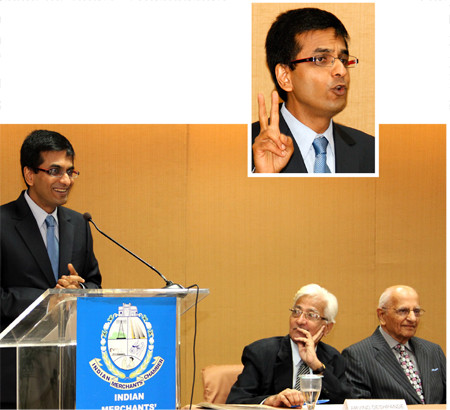
From left: Dr Dha-nanjay Chandrachud (also inset) Arvind Deshpande and Minoo Shroff
The subject of Chandrachud’s talk was on the Constitution of India as a transformative instrument and how the historic document must be adapted to the changing times. "A democracy does not (necessarily) lead to constitutional liberalism” or "to the protection of human rights,” he noted. There was a chasm between democratic ideals and practices. Men like Palkhivala tried to bridge that divide. The Bill of Rights represented "the first generation of human rights” and was termed "the blue rights,” the jurist observed. They ensured equality before the law but "were not enforceable in a court of law.” The second generation of human rights were termed "red rights,” perhaps a reference to the socialistic leanings of the time. They were more of a social nature such as the right to public health, education, information and were enforceable in a court of law. Article 21 of the Constitution speaks about the right not only to existence but a meaningful existence.
The third generation of human rights termed the green (environment) or pink rights looked to the collective rights versus the individual rights; the proliferation of information accompanied by the destruction of individuality. He spoke of how in a "networked society” developments take place faster than the laws can keep pace with them. Taxation, insurance and other such regulatory legislation is often unable to cope with the changing requirements.
The judge, who holds a doctorate in judicial sciences from Harvard University, believed the making of laws is "too important to be left only to the courts.” The responsibility should be "handed over to society.” He called for "a dialog between citizens and the courts.”
When entering the IMC building S. Divakara, director-general of the Forum of Free Enterprise offered to take the judge to the front of the lift queue, which he politely refused saying "we’ll all go together.” Parsiana availed of the opportunity to ask him if Justice Dinshaw Davar’s portrait was to be removed from the Bombay High Court premises as threatened by a member of the state legislative assembly in retribution for Davar passing an imprisonment order aganist Mahatma Gandhi. Chandrachud doubted whether this would be permitted considering that Davar’s portrait "was part of our historic legacy.”
LSE president Minoo Shroff noted that "most citizens don’t know what are their rights.” He believed "citizens should look beyond individual interests. Vigilance is the cynosure of a civilized society.”
◆ ◆ ◆
From the archive