
Cover Story
Gupta’s gumption
Goolrookh Gupta has moved the Ahmedabad High Court to establish her rights as a practicing Zoroastrian
"Is it a sin to be a woman in the Parsi community?” asks Goolrookh Gupta (née Contractor). It would seem to be so allowing for the attitude of the Valsad Parsi Anjuman (VPA) and their sympathizers at the Bombay Parsi Punchayet (BPP). Merely to establish her rights to enter a fire temple in Valsad or even to be present at her parents’ funerals at the time of their death and the subsequent ceremonies she has had to file a case in the Ahmedabad High Court this January 16, 2010. The next hearing was scheduled for April 20, 2010.
In support of the VPA, five trustees of the BPP passed a resolution on March 18, 2010 stating that "the hitherto practice of making available the Towers of Silence for consignment under the dokhmenashini system for the disposal of the dead to (sic) the Parsi/Irani ladies who have undergone inter-caste marriage be and hereby discontinued with immediate effect in case such ladies have changed their Parsi/Irani Zoroastrian names.”
Accordingly BPP trustee Yazdi Desai sent off a letter dated March 19, 2010 to Gupta stating, "The Board of Trustees has decided that in view of your having changed your Zoroastrian name from Goolrookh to a Hindu name Neha, you are not eligible to have your corpse consigned to the Towers of Silence and thereby avail the Dokhmenashini system for the disposal of the dead.”
In turn Gupta’s sister and solicitor Shiraz Patodia replied on March 30, 2010 stating, "This is not only shocking but absurd and thoroughly frivolous. Does that mean that you will refuse every Parsi lady following Zoroastrian faith/religion having so-called ‘Hindu/Christian names’ like Priyanka, Smita (Smita Godrej Crishna), Daisy, Kamal, Rita, Jesita, Natasha, Pravina, etc, and not permit their corpse to be consigned at the Tower of Silence?... Our client states that as recently as March 2010 paidast of one Nandini Durgeshwar Dave, (so called ‘Hindu name’) previously called Naju Jasawala was performed at Doongerwadi and that her body was consigned to Modi dakhma which was permitted by you.
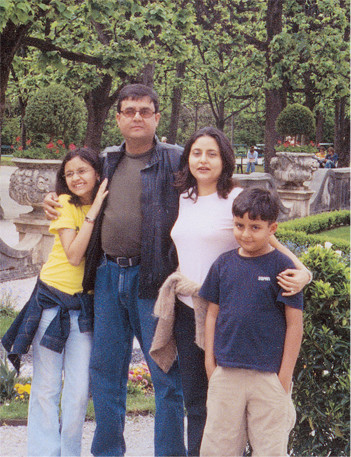
Natasha, Mahipal, Goolrookh and Karan: facing discrimination
"Our client states that the said act of yours, to say the least, is discretionary, insensitive and with ulterior motives and the same is illegal and against the constitutional rights enjoyed by our client who continues to follow her Zoroastrian faith even after marrying a non-Parsi. Please note that every Parsi Zoroastrian woman even after her marriage to a non-Zoroastrian under The Special Marriage Act, 1954, has a fundamental right to freely profess, practice, propagate her Zoroastrian faith/religion and the same includes her freedom and right to practice and attend all Zoroastrian ceremonies like, paidast, baj, jashan, navjote and also have her paidast performed at Doongerwadi which you have expressly permitted over last few decades vide your said notice. Please note that the change of name to so-called ‘Hindu or Christian name’ has nothing to do with the person following his/her religion/faith and our client, as stated above, continues to follow Zoroastrian religion and continues to be a Parsi Zoroastrian. She has never changed her religion from Zoroastrian to Hindu at any point of time.”
"The BPP’s previous letter says there is no objection” to a Parsi woman married to a non-Parsi being consigned to the dakhma if the family submits an affidavit that she married under the Special Marriage Act and continued to profess the Zoroastrian faith, Gupta observed. The policy "changed overnight.”
On November 17, 2009 BPP chairman Dinshaw Mehta had replied to a query from Gupta dated August 10, 2009, "The Bombay Parsi Punchayet (BPP) position over the last few decades has been that a Parsi lady married out, under the Special Marriage Act, 1954, is permitted to be consigned at Doongerwadi, provided that she has not renounced her faith by way of partaking in any marriage ritual of her non-Zoroastrian spouse’s faith and an affidavit confirming that she has not renounced her Zoroastrian religion till her demise. Moreover, the BPP permits the corpses of intermarried Parsi ladies to be consigned to the Modi Tower of Silence, as per a copy of the rules which you have enclosed in your letter to us. We continue to follow this procedure in letter and spirit, when an intermarried Parsi lady’s corpse is brought to the Doongerwadi complex in Bombay by her next of kin, who has to declare on stamped paper, by way of a notarized affidavit, that the deceased lady continued to follow the Zoroastrian faith until her demise.”
"Why do we have to give affidavits?” queries Gupta "Why not men? Because we are women we have to go through so many struggles. When it comes to women, most orthodox people make rules convenient only to men.” Women who have married outside the faith are not permitted in Valsad to attend the festive gahanbars or the Pateti and Navroz dinners.”
In July 2003 Gupta attended the last rites of former VPA president Jehanbux Chavda at his residence. She then accompanied the body to the Towers of Silence and was present for all the subsequent ceremonies at the fire temple. "That was the last time I went. Later on I came to know there were reservations (about outmarried Parsi women). I heard they were insulting girls who went to the Towers of Silence and the agiary. So I do not go.”
Pointing out that the VPA does not have a single woman amongst its nine trustees, Gupta comments, "How can they not have a single woman trustee? There are so many educated women in Valsad. Even the government allots quotas for women.” The VPA trustees are nominated by the existing board. There are no elections for trusteeship.
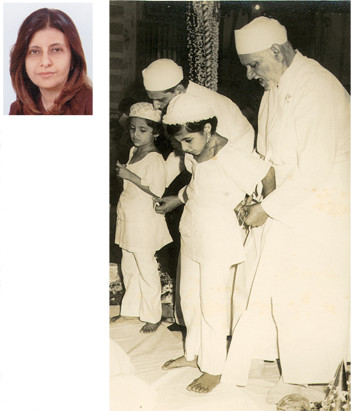
(Top left) Shiraz Patodia and (far right) with sister Goolrookh (left) at their navjotes in 1971
Women were not even permitted to attend the VPA general meetings held once every three years till Gupta’s mother Dinaz Contractor, a lawyer by training and a prominent social worker stormed a meeting. "Mè tofaan kidhu (I raised a ruckus) then we were allowed,” states Contractor, founding chairperson and director of the Mahila Cooperative Bank, president of Astitav, a social service organization to assist women and families, and district assistant state commissioner of the Girl Guides. Women "né equal rights malvu joiyé (should get equal rights). Double standards should not be there. I don’t believe in all this nonsense.”
"She is the first district lady chairperson of the Lions Club,” notes her husband Adi, a trustee of the VPA and a prominent hotelier. "Still they don’t want her as a trustee. They are taking advantage of an old custom.” He notes that around two months back the VPA had given their baug for an interfaith marriage. A navjote of a daughter of a Parsi father and non-Parsi mother also took place there six months ago.
Contractor claims the change in attitude of the trustees came about after new trustees assumed office a few years ago. Even now the trustees are divided five to four on the issue. In her petition Gupta notes, respondents Adi J. Contractor, Bomi Erachshaw Mahernosh, Jahabux Jehangirji Mahudawala and Marzban R. Marfatia were of the opinion "that the petitioner being a Parsi Zoroastrian should be allowed to attend all religious ceremonies” while respondents Burjor Pardiwala, president, Sam Rushi Chothia, secretary, Aspi Sanjana Vakil and Noshir Zaroliwala were of the opinion that "the petitioner should not be allowed to attend the said ceremonies.” Respondent Marzban Dhanbhoora "abstained from giving any opinion on the subject” but subsequently aligned himself with those opposing Gupta, she notes.
Pardiwala states a resolution was passed in 2005 by the general body and not the nine trustees. The VPA is only involved with disbursing trust monies and looking after the properties, says Pardiwala, a lawyer. The Anjuman has nothing to do with religion, he avers. "I told Adi I am helpless” as the matter vests with the general body. "I’m not concerned with it… I openly said call a general body meeting… if the general body says admit her I will not stop her” entering the sacred precincts. He says Valsad has around 400 to 500 Parsis. "I have to be with them.”
Regarding women being appointed trustees, Pardiwala counters, "The trust deed does not say they can be trustees.” On the other hand he admits that there "is no provision women cannot be trustees.” The trust deed was drawn up 1898. "In those days nobody allowed women to do all this.”
The genesis of the Valsad ban has its roots in a 2005 resolution that stated funeral ceremonies must be performed at the dakhma bunglis. Earlier people had the ceremonies performed at home and then on some occasions the body was brought to the Towers of Silence in a truck with the face uncovered and members of the public touching the body and paying their last respects. "After the sachkar ceremony no one can touch the body” save the pallbearers, says Pardiwala. In other places non-Parsis are not permitted to be present in the hall where the funerary prayers are recited. "In Valsad (earlier) everyone was allowed to sit. They (non-Parsis) cannot be permitted (now).” A separate pavilion was built at a cost of eight to nine lakh rupees to accommodate non-Parsis. Contractor alleges because of the treatment meted out to non-Parsis and the distance from the main city to the dakhma grounds, very few non-Parsis attend. As a result the pavilion is barely utilized.
Chothia concurs that the Contractors were advised to call a general body meeting but refrained from doing so. When asked why the trustees did not call such a meeting, Chothia explained, "The matter is sub judice so we cannot call a general meeting now.”
Mahernosh, retired principal of the Seth R. J. J. School in Valsad, believes at the time of bereavement non-Parsis "né hurt nahi karvu joiyé (should not be upset). It is a sad occurrence.” If someone has worked with a person closely to deny them the right to be near the departed is unseemly. He believes there should be an all-India policy on the customs to be followed. "All customs should be the same… I’m not a reformist. I’m not saying all customs are wrong” but he bemoans the lack of "flexibility.”
Contractor contends the general body did not pass a resolution barring interfaith married women from entering the agiary or the Towers of Silence. There was only a "tharav (suggestion)” to the effect that should the trustees come across any such incident in the future the person should be barred entry.
The VPA’s affidavit-in-reply makes no reference to any resolution passed by the general body barring outmarried Parsi Zoroastrians from entering the fire temple or being present at the funerary prayers.
Gupta narrates the case of Dilbar Valvi, a Parsi woman married to Prakash Sukheswala in 1964. When her father passed away in December 1993 she was permitted to attend all the funerary ceremonies. But when her mother died on December 29, 2008 Dilbar was "ruthlessly stopped” from attending the ceremonies. The trustee "did not even allow her to sit at the verandah of the Towers of Silence, as she is married to a non-Parsi… she sat where the non-Parsis are made to sit. This act of the respondents… is inhuman, insensitive and uncalled for and (done) merely to pander to the so-called ‘orthodox views,’ completely ignoring the law of the land,” states Gupta in her plaint.
The VPA counters that Gupta has "falsely stated… that Dilbar was allowed… to attend all ceremonies on her father’s death.”
"You have a right”
Goolrookh met her husband-to-be Mahipal while she was a BCom student at Sydenham College residing at the Government Girls Hostel at Marine Drive and he was studying at H. R. College. They have a daughter Natasha, 17 (see "An Unjust religion”), and a son, Karan, 12. Goolrookh’s father was initially hesitant about his daughter marrying out of the faith but once he met Mahipal he was "very happy,” she says.” Mom was completely okay. Her’s was a love marriage. "Once they met Mahipal they were convinced I must marry him.” They wed on February 1, 1991.
As a child Natasha insisted "maari bee navjote karo (do my navjote also),” says Goolrookh but as she grew older she was turned off by a religion to which you have to "beg” for admission and acceptance. The once liberal VPA started to change colors around 2003, says Gupta. "I did not realize it had started,” she admits till the incident pertaining to Dilbar. At the time of Dilbar’s father’s death she recalled the VPA managing trustee Rusi Shroff enquiring "baahr kai ubha réoch? Andar chalo (why are you waiting outside? Come in).” But when Dilbar’s mother died she was barred entry and Goolrookh fears the same fate awaits her.
The president of the Pardi Parsi Panchayat, Homi Pardiwala, encouraged Gupta to take up cudgels for her cause. "You have a right,” he told her. Her sister Shiraz spoke to lawyer Percy Kavina who told her he was "waiting for a Parsi woman to stand up and fight for her rights.” His wife Parizad also shared his sentiments. Lawyer Suresh Parekh offered his services pro bono as has Kavina.
Contractor says the VPA will not pay for the legal expenses and the five opposing trustees will have to bear the cost. Most likely Areez Khambatta, former president of the Ahmedabad Parsi Panchayat who is taking a keen interest in the matter, will pay the bill.
Gupta gave the impending legal battle thought. Other "Parsi girls can’t go and fight. They don’t have the means, they don’t have the support system I have,” she reasoned. So "why not me?”
"Accept the consequences”
Statement by Dasturs (Dr) Kaikhusroo Dastur Minocher JamaspAsa, (Dr) Peshotan Dastur Hormazdyar Mirza, (Dr) Firoze M. Kotwal and Cyrus N. Dastur:
"Marriages contracted between persons of different faiths may be considered legal by secular state, but recognition of such marriages cannot be forced upon the Parsi/Irani Zoroastrian community. All laws of civil marriage apply only to the civil or legal aspects and not to the religious aspects. In all religious matters the members of a religious community are governed by their religious laws.
"The Special Marriage Act 1954 neither gives any special rights nor privileges to a Zoroastrian entering into a civil marriage with a non-Zoroastrian. It does not and cannot force upon Zoroastrian religion to accept them as Parsi/Irani Zoroastrians after such a marriage. There is no provision in the Act that the woman marrying under the Act shall continue to enjoy the same religious rights and benefits after such marriage. The Special Marriage Act 1954 confers no special rights to anyone in the matter of religion.
"Hence it is clear that Goolrookh M. Gupta, who has changed her first name from Goolrookh to Neha after her said marriage to Mahipal Gupta, is married outside the Zoroastrian religion on her own accord and will, has no rights to visit and pray at dadgah saheb, agiary, atash behram; attend paidast, uthamna and other after-death religious ceremonies, including dokhmenashini. She cannot attend religious ceremonies such as navjote — carrying the shesh (tray), bringing the child on to the stage after nahn (bathing purification) ceremony, etc in baugs. In fire temples, she cannot enter. She cannot stand on the stage during a wedding ceremony, attend jashan, baj, nirangdin, vendidad, ferashta, muktad etc, being performed either at the place of worship or at a private place. Her name cannot be recited in any religious prayers like tandorosti and in farmayashni, etc.
"If Goolrookh M. Gupta was steadfast to her religion and if she had a genuine desire to retain her religion then she would not have decided of her own will to marry outside the community and act contrary to religious injunctions. If she still truly respects the Zoroastrian religion, then she should accept the consequences of her marrying outside the religion rather than creating controversies in the community which divides the community.”
"An unjust religion”
When I was a little girl I was extremely fascinated by the Zoroastrian religion. I used to love watching my mother and grandmother pray, my cousins getting their navjote done but most importantly I used to be fascinated by seeing my cousins, both male and female being treated equally. Little did I know that in future my mother would have to fight and struggle for her basic human rights.

Natasha Gupta: saw her mother "treated shabbily”
Till the age of about nine or 10 even I wanted to have my navjote performed and be a part of this relatively ‘modern’ religion. Though in my family there has never been any discrimination between my brother and me, I still thought that being a part of such a ‘liberal’ religion would be amazing. But as the years passed by I realized how my mother and other women like her were struggling for their basic rights. She has to think twice before going to pray to her own God. How can anyone stop a person from attending their own parents’ last rites? Once a person is dead they are free from all earthly ties, religion being one of them. That means, that the dead body actually has no religion. I think that it is completely inhuman to not let a person enter their own place of worship and to not let them sit for their parent’s funeral. When I saw my mother, a lady born to two Parsi parents, and still following her religion, being treated so shabbily I decided that I would never want to turn into a Parsi. I did not want a "begged” religion to which I am not accepted. I am very happy staying a Hindu and following such a religion in which I am happily accepted and which allows people of other religions to enter their temples and allows us to pray to other Gods and which does not discriminate on the basis of their name and sexuality.
All her life my mother has always maintained the fact that she is a Parsi. I always remember that when people used to call her a Hindu she used to quickly correct them and tell them that she is a Parsi. She has got into many arguments with people regarding this issue but she always said that a person’s religion can never change. She says that she follows the religion thoroughly by praying twice a day and by wearing her sudreh and kusti. She always used to tell me and still says that she is born a Parsi and will die a Parsi. As for me, I would never want to enter such an orthodox, unjust and backward religion.
Natasha Gupta
◆ ◆ ◆
From the archive