
Institutions
Innings and interludes
The sea facing Parsee Gymkhana has had to adapt to the pulls and pressures of a recreation center in the last 125 years
"The allurements of tennis have proved too strong for several cricketers during the off season and (have) induced them to neglect the more manly game.” This comment made by the chairman of the Parsee Gymkhana Jamsetji Tata at the annual general meeting on January 31, 1891 was quoted by the former judge of the Supreme Court Sam Variava who was the chief guest at the 125th anniversary celebrations of the Gymkhana on February 25, 2010. The long-standing member of the Gymkhana admitted that in his case too it was his interest "in tennis and not the manly game” that prompted him to join in 1957 soon after passing school. Once the Parsee Gymkhana’s tennis courts were taken over by the Railways, an alternate arrangement permitted members to practice at the Wodehouse Gymkhana, relegating some like Variava to the ranks of absentee members.
He was happy to learn from the present office bearers that there is an all-Parsi badminton team as also an all-Parsi snooker team but was dismayed that there wasn’t an all-Parsi cricket team for they were "not able to muster youngsters to take up the game, particularly when the Gymkhana offers all facilities” for coaching and practice.
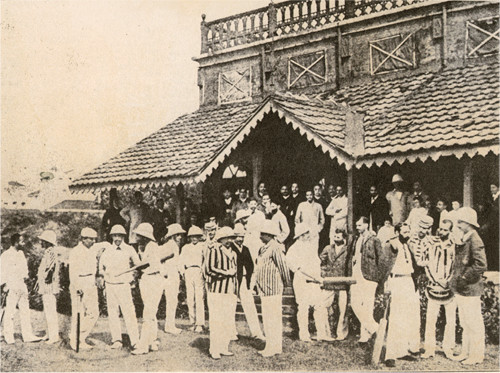
Gymkhana Pavilion, 1886: favorite of cricketers and spectators
That the Parsee Gymkhana is viewed as the forerunner of Indian cricket is a fact universally acknowledged. In fact the 125th anniversary brochure carries messages attesting the allegiance. "From its modest beginning as a facility to encourage sport among the city’s small Parsi community, the Gymkhana has gone on to play a significant role in popularizing sport, particularly cricket in the metropolis of Mumbai,” commented Ratan Tata, the chairman of the Tata Group that has been "associated with the Parsee Gymkhana from its inception in 1885…”
"It is heartening to note that the first two Indian cricket teams to visit England in 1886 and 1888 were from the Parsee Gymkhana. Its heritage building on Marine Drive and the cricket ground speaks volumes of its contribution towards cricket and promotion of cricket players in the city,” remarked former chief minister of Maharashtra Sharad Pawar and present union agriculture minister in the souvenir.
Acknowledging that the Gymkhana has "served as a nursery for producing talented sportspersons for the state and the country,” the governor of Maharashtra K. Sankaranarayanan commented, "The contribution of the Parsee Gymkhana to the sociocultural life of Mumbai has been noteworthy.”
Having surveyed the open grounds and the heritage pavilion, Variava commented, "It was a pleasure to go around… Nothing much has changed although a lot has been renovated.” "In fact, our building and interiors never looked as good as they look today after 125 years,” observed the president of the Gymkhana Marzban Dhanbhoora who was also the chairman of the centenary celebrations committee. He regretted however that "not much could be done in the last 25 years” in terms of improving the amenities like building a swimming pool and a health club as the Bombay Municipal Corporation would only sanction plans if their lease of land (due on January 1, 2000) is renewed.
Driving past Marine Drive as a child Dr Cyrus Poonawalla had learnt early in life that the old colonial structure was the Parsee Gymkhana but had never become a member. With the honorary membership conferred on him at the 125th anniversary, the chairman of the Poonawalla Group deemed it ironic to receive this "great honor.” He realized though that this privilege brought its share of responsibilities too and assured his "support to the Parsee Gymkhana in future.”
Some other eminent sportspersons who were conferred the honorary life membership on the occasion were cricket umpires Dara Dotiwala and Piloo Reporter, judoka Cawas Billimoria and yachtsman Homi Motiwala. Yesteryear cricketer Hoshie Amroliwalla too was presented his honorary life membership certificate. As the vice president of the Gymkhana Rusi Bhumgara announced, the only reason that Amroliwalla could not make it to the national cricket team was because there were already seven or nine players selected from Bombay and there was an embargo on not accepting more from the same region.
The two seniormost members of the Gymkhana today are 97-year-old Homi Kanga and 95-year-old Rusi Kanga. They may be able to vouch for the many interesting nuggets of information regarding the Gymkhana shared in the centenary souvenir.
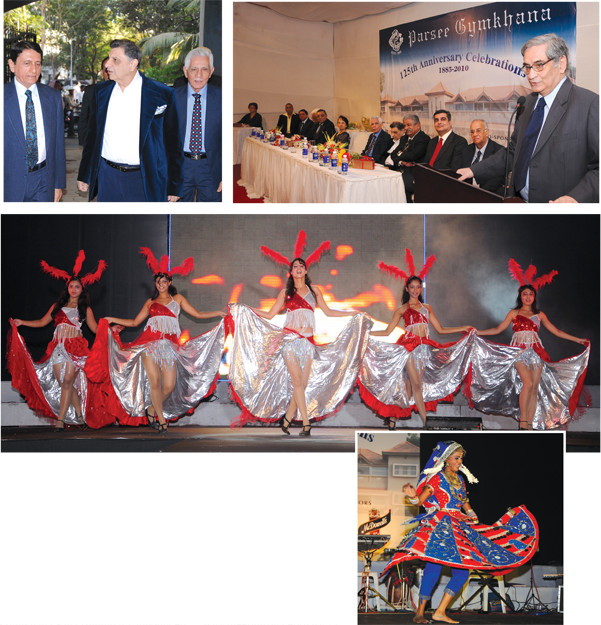
(Top row, from left): Rusi Bhumgara, Dr Cyrus Poonawalla and Marzban Dhanbhoora; Justice Sam Variava (at the mike); (second row and alongside) entertainment by Hormuzd Khambata’s troupe and by Wizent at the 125th celebrations of the Parsee Gymkhana
Cornerstone for cricket
"The idea of the Parsee Gymkhana was born and pronounced in the rooms of the Ripon Club,” notes a write-up in the centenary souvenir providing a historical perspective. At the preliminary meeting on February 25, 1885 the prospectus read by Dorabji J. Tata stipulated: "Much attention having been drawn of late to the physical needs of the Parsi community, it is proposed to start a club where gentlemen of respectable position in society can obtain some sort of healthy outdoor recreation. The club would in the beginning confine its efforts to giving facilities to its members for playing such games as cricket, lawn-tennis and badminton.” It was further agreed that the entrance fee would be five rupees, subscription two rupees, and life membership Rs 250.
The first managing committee comprised president Sir Jamsetji Jejeebhoy Bart, vice presidents Dinsha Maneckji Petit, Sorabji Shapoorji Bengalee, Dosabhai Framji, Sorabji Framji Patel and Pherozesha M. Mehta with members Jamsetji R. Tata (chairman), Limji Banaji, Jehangir B. Murzban, Cursetji Servai, Darasha R. Chichgar, Jehangir Dosabhai Framji, Framji Dinsha Petit (treasurer), Nowroji Wadiya and Dorab Tata (joint honorary secretaries).
Within three months a temporary arrangement was made for a tent on the Oval. Jamsetji Tata, the first chairman of the managing committee, contributed Rs 2,000 towards the construction of a pavilion and assured that if the collections fell short of the actual costs, he would meet the deficit amount. Dinshaw Petit offered Rs 10,000 towards the erection of a swimming "bath” where training lessons would be given to Parsi youth.
In January 1887 the committee decided on a new abode, 160x140 yards between the two gateposts of the B. B. & C. I. Railway near Marine Lines Station. By 1888 the pavilion was ready and the days of tent cricket were over for the Parsee Gymkhana. Modeled on an English county pavilion, it included a verandah for players, an upper verandah for the members of other gymkhanas, dressing rooms and even flag-posts on the turreted roof to display the colors of the Gymkhana and the visiting clubs. Besides playing matches with the neighboring Hindu Gymkhana, the Parsee Gymkhana team played against the Kathiawar Cricket Club as also the team brought by the Maharaja of Nawanagar.
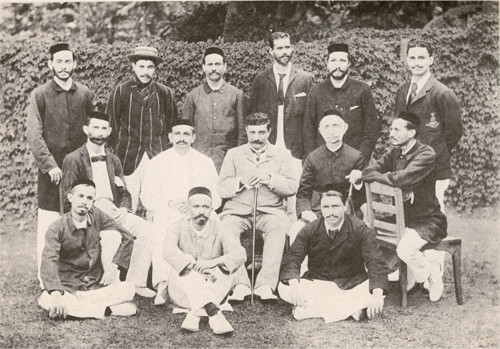
Parsi team of 1898 (standing from left) B. Machliwalla, A. H. Mehta, N. C. Bapasola, K. K. Kharas, J. M. Divecha, K. M. Mistri; (sitting from left) D. D. Kanga, B. D. Gagrat, J. M. Framji Patel, D. R. Chichgar, D. C. Daruwalla; (sitting on the ground from left) C. M. Patel, D. N. Writer, B. M. Billimoria
The Presidency Matches where the Parsis were invited to play against the European team twice a year commenced in 1895. This later progressed to the triangulars when the Parsis and Hindus would play in the opening round and the winners would play against the Europeans in the finals. In 1911 when the Muslims joined in, the match came to be known as the quadrangulars. In 1915 when the Maharaja of Alwar offered a challenge shield to the winners of the quadrangular, the Parsee Gymkhana responded: "We fully appreciate the sporting spirit of His Highness. Our committee however, are of the opinion that high class cricket and more particularly these international fixtures ought always to be played for the love of the game alone. The honor of holding the championship must be the sole and only incentive. In these circumstances, the committee consider any other impetus to be unnecessary and not quite desirable.”
Besides cricket the other games enjoyed at the Gymkhana were tennis, billiards, badminton, football and in fact the Bombay Provincial Hockey Association began at this Gymkhana. For a while there was cycle polo as also annual athletic meets. Bridge continues to be a favorite at the Gymkhana.
In 1942, during World War II, the Gymkhana had to relocate to the Brabourne Stadium and Currimbhoy House on Waudby Road when the government requisitioned the ground and the pavilion. Anti-aircraft guns, war weapons, dug trenches, gas balloons were the new sight on the playground. When the members returned to their premises at the end of the War one of them remarked, "The whole place was in a mess. I do not know what they were doing at the badminton court, but it seemed they were using it for shooting practice.”
Non-Parsis have been admitted as members since 1963 when a government recommendation required all sea-facing gymkhanas to be open to all communities. But admitting women as members took much longer. Until the centenary the Parsee Gymkhana continued to be an all-male bastion although girls under 18 were permitted as sports members. Finally they permitted associate membership to single ladies about five or six years ago on the understanding that their membership cannot be transferred to any family members. Currently they have 22 associate lady members, 435 ordinary members, 860 life members, three youth members and 10 honorary life members with life members paying Rs 1,50,000, regular members Rs 75,000, senior citizens and associate lady members Rs 50,000. Every category of membership is required to pay 10.3 percent as service tax. During the first 50 years the only person to be conferred the honorary life membership of the Gymkhana was J. M. Divecha who had served as joint honorary secretary for an uninterrupted period of 23 years beginning 1898. Over the years honorary membership has been conferred to cricket giants like Nari Contractor and Sunil Gavaskar, as also business magnate Ratan Tata.
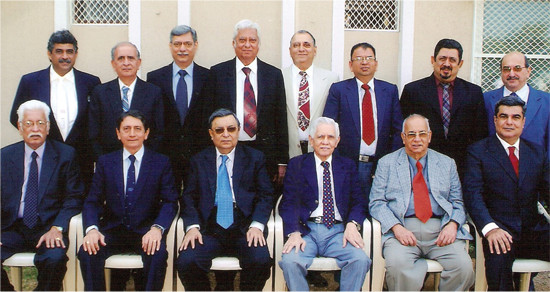
Parsee Gymkhana managing committee as on February 25, 2010 (sitting from left): Minoo Sarkari, Rusi Bhumgara, Hoshang Wania, Marzban Dhanbhoora, Jessie Mistry, Khodadad Yazdegardi ; (standing) Homi Bhagwagar, Minoo Khan, Rustom Antia, Homi Zaiwalla, Adi Pardiwalla, Burzin Bhumgara, Cyrus Pooniwalla and Mehrnosh Surti
Crux of the celebrations
Currently the managing committee of the Gymkhana headed by Dhanbhoora includes vice presidents Bhumgara, Hoshang Wania, Khodadad Yazdegardi and Kaizaad Wadia, joint honorary secretaries Minoo Sarkari and Rustom Antia, honorary treasurer Jessie Mistry with members Homi Bhagwagar, Minoo Khan, Homi Zaiwalla, Adi Pardiwalla, Burzin Bhumgara, Cyrus Pooniwalla and Mehrnosh Surti. Serving on the 125th anniversary celebrations committee were the office bearers, some managing committee members with additional inputs from Kali Patel and Burges Wania.
"In your time you didn’t see so many ladies,” Bhumgara, secretary of the celebrations committee, reminded the chief guest in response to his observation that over the years the ambience at the Gymkhana had not changed. In the course of his vote of thanks Bhumgara had to thank some ladies too: Sooni Bahadurji for her magnanimous donation, Hutoxi Doodhwalla for compering the evening’s function, Tanaz Godiwalla for the dinner delights. Gratitude was also extended to their sponsors: Spenta Builders and Developers, Hilla Builders, Rustomjee (Keystone Realtors), Buildtech INDIA, Premier Construction Company, Sterling and Wilson, McDowell No 1 (United Breweries Group), Pepsi, advertisers, donors, well-wishers, the Press, Vivek Chaphekar and Samani Decorators.
The 125th celebration had extended over three days: On February 20 there was a dance performance by Hormuzd Khambata and his troupe with crooner Siddharth Meghnani impersonating Elvis. Later there was a fashion show coordinated by Doodhwalla. The next evening saw participation from 800 individuals — members of Parsee Gymkhana as also other gymkhanas and clubs in the city — in a Grand Housie followed by a variety entertainment show by Wizent. The third day’s function on February 25 commenced with a jashan.
Enthusiasm for entertainment will continue at the Parsee Gymkhana and so too will recreation and relaxation. Presently the facilities at the Gymkhana that are most in demand are the gymnasium, the badminton court, snooker and billiards tables and of course the catering as in the case of any other club. But there is no knowing whether the commitment to cricket will resurface for it demands discipline. As founder member J. M. Framji Patel, the mainstay of Parsi cricket during his lifetime, would invariably remind: "Our young men should go in for training for test match and should be careful of their diet. They must particularly beware taking rich Parsi food and the effects of diet on nerves and senses cannot be too often stressed.”
◆ ◆ ◆
From the archive