
History
The gift of Bombay
When the Portuguese presented Bombay to the British, they believed the port was somewhere near Brazil
In the 17th century, Bombay was one of a cluster of seven islands a little more than 160 miles down the coast from Surat. The islands, separated from one another at high tide by shallow water and at low tide by dismal salty swamps, were covered with coconut palms and populated mostly by toddy-tappers, who collected the sap of the palms for use in wine-making, and by fishermen. In 1534, Portugal had bought the rights to the islands from the Sultan of Gujarat, and they had subsequently been developed, after a fashion, as a private estate by a succession of Portuguese tenants. For a while, they were owned by Garcia da Orta, a famous physician and botanist, who ran them rather like a South American estancia.
In 1665, the King of Portugal gave Bombay to Charles II of England as part of the dowry of his bride, Princess Catherine of Braganza, but there was some confusion over whether he meant just the one island of that name or the whole group of seven, which by that time had come to be known collectively as Bombay. No matter which he meant, the gift was far from popular with the Portuguese in India, who pointed out that even if they hadn’t yet got around to fortifying the place very well, Bombay and its environs were potentially the best port on the west coast. And their indignation became truly monumental when they learned that the authorities in Lisbon responsible for this dreadful giveaway hadn’t even known where Bombay was — a fact betrayed by a number of official dispatches placing it somewhere near Brazil.
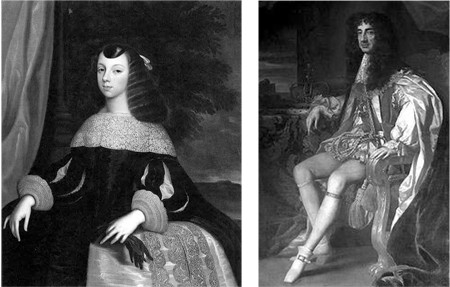
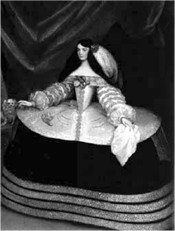
Catherine of Braganza and Charles II of England; below Dona Inez de Miranda: vying for the port island city
At the time Bombay passed into British hands, it was occupied by a wealthy widow, Dona Inez de Miranda, known as the Lady of the Island, and she, of course, was outraged at having her domain suddenly pulled out from under her. So was the Portuguese Viceroy, the administrator of the islands, who felt so strongly about the matter that when the British arrived to accept the gift in the name of their king, he refused to move out. With the fervent backing of Dona Inez, he resorted to every technicality he could think of to delay the transfer, and meanwhile sent repeated protests to his superiors in Lisbon, imploring them to renege on the gift or, if this was impossible, to buy it back. His stalling tactics effectively kept the British out until 1668, and for some time after that the Portuguese retained possession of the largest island, Salsette, contending that it was not included in the dowry.
Contemporary accounts of Bombay’s desirability in those days differ, depending on who was doing the talking. As soon as the British came into possession of the islands, many Portuguese, at home as well as in India, set up a mournful howl, and for years thereafter Portuguese historians continued to lament the loss of what they described as nothing short of an earthly paradise. The British were less enthusiastic about their new acquisition; one English writer called the place "a contemptible patch of mud-flat and fishing-village.” Charles II, however, was apparently unwilling to believe this tidbit his bride had brought with her was as bad as all that, for he ordered officials of the British East India Company at Surat to hurry down there and take over. When, at last, they managed to ease out the tenacious Viceroy, the King sold Bombay outright to the company, which thereupon gave one of its Surat agents, a man named Gerald Aungier, the job of running the new holding.
Aungier’s instructions were to build up the place as a colony and to encourage immigration in order to provide the labor needed for weaving cotton textiles, the company’s principal export at the time, and he energetically proceeded to carry out his orders. All sorts of immigrants — but principally Hindus, Moslems and Parsis — poured in, in such numbers that in 1708 the company transferred its west coast headquarters from Surat to Bombay, where it had a monopoly on nearly all forms business.
At least one Parsi predated the British in Bombay — a certain Dorabji Nanabhai who had been employed by the Portuguese there as an interpreter. In 1692, while Bombay was enfeebled by an epidemic of the plague, pirates attacked, and were successfully repulsed when a son of the interpreter, Rastamji Dorabji, hastily organized an emergency fishermen’s militia and led it against them, thereby achieving the distinction of becoming the first of a host of Parsis who in one way or another have contributed substantially to the city’s welfare. Epidemics were commonplace in Bombay then; for years it had the reputation of being as unhealthy as the notorious Gold Coast. Nevertheless, people kept moving into the city, lured by the prospect of good jobs, and the more the population increased, the higher the death rate grew. Drinking water was a serious problem, and so was drainage; the swamps between the islands stank of sewage, and malarial mosquitoes abounded.
For more than a century, the irreconcilable Portuguese kept up their quarrel with the British, using the mainland town of Bassein as a base from which to delay shipments of provisions to Bombay. Dutch and French privateers joined with the pirates (Captain Kidd was one of these) in making things difficult for the struggling colony, and often the company’s ocean-going vessels had to fight their way both into and out of the harbor. This strife resulted in Bombay’s becoming a shipbuilding center, since London was prepared to launch enough warships to protect the merchant fleet in India. At first, no one in the city knew much about naval architecture, but in 1735 the situation was partly remedied when a Surat Parsi named Lowji Nasserwanji Wadia ("wadia” means "shipwright”) was brought in to help out in the shipyards.
Extract reprinted form The New Yorker volume 34, September-October 1958. Article forwarded to Parsiana by Dinyar Patel, a PhD student in history at Harvard University.
◆ ◆ ◆
From the archive