
Observation
Calcutta cameo
Living a happy but cloistered life in Bombay, a 15-year-old’s stay with relatives in Calcutta opened his eyes to a whole new world
My father always talked with eager anticipation about his "remittance trips.” The Reserve Bank of India for whom he worked as a cashier had to send out currency to different parts of the country to meet shortages. The currency was sent with a cashier accompanied by a police escort — and this was called a remittance trip in their jargon. With my father’s financial condition it was impossible for him or the family to travel for a holiday. A remittance trip was not only an opportunity for travel for my father, but also a source of additional income.
Father’s monthly salary was Rs 75 but the daily allowance on a remittance trip was Rs 15. He could live comfortably in a Parsi dharamshala for as little as two rupees per day and save the rest of the allowance. It was expected that he traveled by rail in the second class, but he traveled third class, saving some more money. A remittance trip was obviously a prize which every cashier coveted.
A few months after independence in 1947, there was an acute shortage of currency in East Bengal, by then a province of Pakistan. The two countries were using the same currency because Pakistan had not yet set up its own Reserve Bank. Pakistan demanded that a huge sum of money should be sent to East Bengal. A perfectly fair request, it became a political issue in an atmosphere charged with emotion and hatred. The Hindu-Muslim riots were a daily occurrence and the exchange of population which took place between the two Punjabs in the west and the two Bengals in the east was accompanied by much bloodshed. After some hesitation, prime minister Pandit Jawaharlal Nehru conceded the demand and it was agreed that Rs 80 crores would be sent to East Bengal. After much jockeying for the coveted trip, my father was selected. It was the largest amount of currency which had ever been sent out by the Reserve Bank.
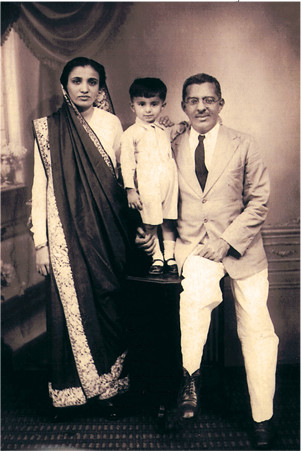
Minoo with his parents Homai and Hormusji Mody
The currency was loaded into several wagons and my father accompanied by a posse of 20 policemen, armed with rifles, set off from Bombay for the two-day journey to Calcutta. I, aged 15, accompanied him. We traveled comfortably — the envy of all, in an otherwise overcrowded train. The journey up to Nagpur under the aegis of the Great Indian Peninsular Railway was uneventful.
At Nagpur the control of the system switched to the Bengal Nagpur Railway (BNR), mostly manned by Anglo-Indians who regarded themselves as a breed apart, superior to the "natives.” When our wagons were switched to the new system a dispute arose. The BNR attached our wagons to the back of the train and not next to the engine as had been the case earlier. My father objected because he feared that while the train was moving robbers could detach the last few wagons and make off with their contents. The law and order situation had deteriorated considerably after the British left. Stories were circulating about wagons being stolen — indeed entire trains carrying goods had gone missing! The communal riots and the carnage in the two Bengals, one in India and the other in Pakistan, where we were going was horrendous.
The BNR remained adamant and my father ordered the police escort to prevent the wagons from being attached to the back of the train. The Anglo-Indian stationmaster was furious and declared, "I will teach you bl…. Indians a lesson. I run the railway as I decide and not according to your wishes.” He ordered the railway police to intervene and we were faced with a platoon of 40 policemen in an eyeball to eyeball conflict with our own. While the argument was going on, I ran for cover to our compartment and hid behind shuttered windows. I was certain that these men belonging to two different police forces were going to shoot at each other and expected shots to ring out at the station. Father seemed to hold his ground, which surprised me because he was a mild and non-violent man. It was uncharacteristic of him to take such an implacable stand. After much argument father diplomatically conceded to the wishes of the Anglo-Indian stationmaster.
I later learned that the reason for his recklessly courageous stand was that he knew that there was no danger of a shootout. It was a long standing British rule that although the police carried rifles, they were not issued ammunition which was safely in my father’s custody! He was sure that the BNR police also had guns without ammunition. For the rest of the journey, an armed policeman traveled atop the roof of each wagon to ensure that no one stole them! As it was the beginning of summer the policemen must have been roasted alive exposed to the sun and seated on iron wagons heated by the sun. In Calcutta father handed over the wagons to the Pakistani authorities and returned to Bombay after a few days.
I stayed on in Calcutta for 10 weeks. Back in Bombay we lived happy but cloistered and blinkered lives. Apart from school there was not much contact with the outside world — no awareness of civic life or of political events. We read no newspapers because we could not afford them. There were no books in the house and we did not know of the existence of a library. Radio was a luxury beyond our wildest dreams. I am ashamed to admit that before India became independent I was not aware of the fact that the British had announced their decision to leave several months earlier.
But Calcutta was like blinkers falling from my eyes. Those two months were the most transforming period in my life. I lived with Noshir mama, my maternal uncle and his wife Roshan, who were young and newly married. Mama was an executive in a big company. Every morning a staff car would come to transport him to the office. The car would also pick up other senior staff members and my mama’s car had several Anglo-Indian secretaries. My eyes popped out seeing such women as I had never seen before — blonde hair, lipstick and make-up, toes and nails painted bright red (the only color in those days). And their legs! I had never seen a woman’s legs exposed — not even my mother’s! Dressed in western style, there was something very attractive about their legs — shimmering and shining in appearance, which I later discovered was due to nylon stockings. I frequently traveled with them and was much cuddled and lionized — they had found a new travel companion. I was small and frail and looked younger than I was. I reveled in their attention and their conversation which was mainly about movies, clothes and office gossip. Mama’s secretary, a very attractive blonde named Marjorie, adopted me as a son, smothering me with chocolates and cookies none of which I had tasted before (bad teeth, father said — but the real reason: they were beyond our means).
Most of my school friends saw movies every week, but until I went to Calcutta I had not seen even one because father said we could not afford them and they were a corrupting influence anyway. Now, for the first time, a whole new world of movies, mostly American, opened up. Today I can recall only Shirley Temple, Humphrey Bogart and Errol Flynn — the names of the movies escape me. Mama had several friends who would come every evening for drinks or dinner. I had never seen people drink socially before. Being too young to be given whisky which they drank, I was occasionally allowed to have a shandy of beer much diluted with lemonade. But the discussions at these social meetings were eye-openers to me. They talked about art, literature, music, civic events and above all politics. I learned for the first time about the carnage which had already taken place in Calcutta between Hindus and Muslims before and during the partition of the country. We talked about Mohandas Karamchand Gandhi, Nehru, Lord Louis Mountbatten. We talked about Israel, which had just been created. Suddenly this frog who had never stepped out of his well had emerged into a huge lake, his eyes wide open to take in a world which he did not know existed.
Another thing I learnt in Calcutta was my appetite for food. With six children to feed we never had enough to eat in Bombay and were perpetually hungry. When my mother went out to visit neighbors, she would lock the kitchen to prevent us from raiding the food cooked for the day. There was no refrigerator, nor was one needed, as we had no food left over. For the first time I was fed properly by Roshan mami, and I found out how much I was capable of eating. I grew two inches taller in 10 weeks and did not stop growing thereafter for another 12 months.
I do not think that mama and mami were aware of what transformation they were bringing into my life — nor was I aware of it until much later. I was like a dry sponge able and willing to absorb everything, reveling in the expansion of my mental horizons, storing up facts and ideas which I had never heard or thought of. Was Nehru a true democrat? Was his vision of India dominated by the narrow conservatism and anti-modern ideas of Gandhi? Was socialism with its apparent success in Soviet Russia the model for a diverse country setting out on the road to development with a democratic system? Sardar Vallabhbhai Patel, the deputy prime minister was the hero of my uncle and his circle of friends. I became aware of Patel’s role in "persuading” the maharajas to fall in line with India’s aspirations and cede their kingdoms to the federal state. Why had Gandhi bypassed Patel in favor of Nehru, and thereby steered the country in the direction of Soviet-style socialism? My uncle and his friends were highly critical of Nehru’s attempt to strut on the world stage as a great leader of the third world. When I returned to Bombay I looked at the world and my immediate family and friends with new and inquiring eyes.
◆ ◆ ◆
From the archive