
A tale of two families
Ardaseer Cursetjee Wadia had a Parsi family in Bombay and an English one in London
"'Life writing’ includes memoirs, autobiographies, letters, diaries and family histories that recount the story of the author’s life or that of his or her family,” notes Mitra Sharafi, associate professor of law at the University of Wisconsin Law School in Madison.
"In the Parsi context, life writing encompasses a rich collection of texts by men and women in British India and beyond... The authors may not frame their texts as Parsi community history, but their works also contribute to the preservation of Zoroastrian heritage,” states the legal scholar.
Parsiana carries extracts from the article "Parsi Life Writing: Memoirs and Family Histories of Modern Zoroastrians” in Holy Wealth: Accounting for This World and The Next in Religious Belief and Practice. Festschrift for John R. Hinnells (Wiesbaden: Harrassowitz, 2017), 251-77 with permission from the author, the editors Almut Hintze and Alan Williams and the publisher.
In our August 7, 2017 issue we carried "The Burmese legacy” pertaining to Burjor Mistry and P. D. Patel and in the August 21 issue, "The valiant and the vain” on the Vakil family. In this issue we carry extracts concerning the Ardeseer Cursetjee Wadia family.
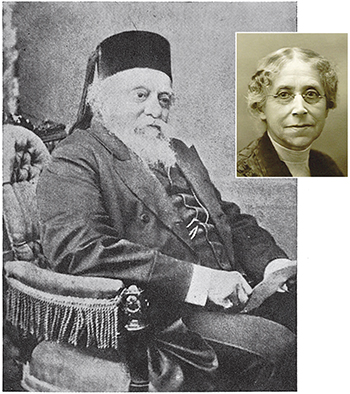
"The 1950s were a time when immigration into Britain was increasing and notions of mixed marriage were generally frowned upon by society. Any references by my mother to a Parsi (never Indian) heritage were generally met by dismissive comments from my father. It was unsurprising that she generally kept quiet on the topic."
A key reason for Southerden to write this family history was to reconstruct the stories suppressed by the racialized (and gendered) dynamics of his parents’ relationship and era. Ironically, the family’s Parsi heritage was dazzling. One could only wonder whether the elder Southerden’s stress upon his family’s perceived ‘property in whiteness’ would have changed had he been aware of the eminence of his wife’s Parsi kin.
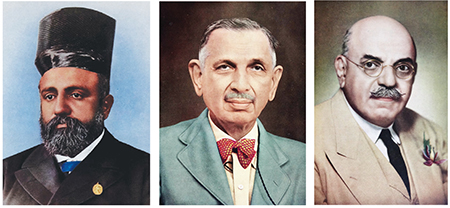
Southerden’s Parsi great-grandfather was Ardaseer Cursetjee, a member of the illustrious Wadia shipbuilding family. The Wadia family rose to fame as shipbuilders for the East India Company. During the Raj, they moved into the business of running (and owning) textile mills and related enterprises like dyeing. By the 20th century, the family’s signature business was the Bombay Dyeing and Manufacturing Company. During the colonial period, Wadia family members acquired colossal wealth and status, making them some of Bombay’s ‘merchant princes.’ They included the founder of Bombay Dyeing (est. 1879), Nowrosjee Nusserwanjee (1849-99), who was responsible for the construction of key engineering and sanitary works in Bombay; his sons Sir Cusrow (Cursetjee Nowrosjee Wadia, 1869-1950) and Sir Ness (Nusserwanjee Nowrosjee Wadia, 1873-1952), who became a leading Bombay philanthropist and Knight Commander of the Order of the British Empire, respectively; and Sir Ness’ son, Neville Wadia (1911-96), who led the Wadia Group of corporate interests to new heights, married Mohammad Ali Jinnah’s only child and later converted from Christianity back to Zoroastrianism.
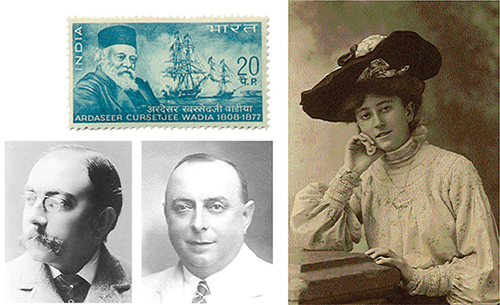
Engineering connected the Wadias’ interests in shipbuilding, textile mills and dyeing across the centuries. The Wadias were great engineer-businessmen, and traveled back and forth between India, Europe, and later America in the quest for technical education and the acquisition of new kinds of machinery and technology. Sometimes other relationships emerged along the way. Southerden’s branch of the Wadia family came about, for instance, because Ardaseer (1808-77) met an Englishwoman named Marian Barber (1817-99) during his travels between Britain and India. Like his Wadia ancestors since the mid-18th century, Ardaseer was a master builder of ships for the East India Company. He was also a pioneer in the use of steam power, and first came to England to study this revolutionary new technology in 1839-40. He was not the first Wadia shipbuilder to visit the imperial metropole. His two cousins had preceded him to England to study naval architecture, and all three young Parsi engineers published memoirs of these trips. On his return to Bombay, Ardaseer was appointed chief engineer and inspector of machinery at the East India Company’s steam factory and foundry in Bombay, becoming the first Indian to be appointed by the Company as a manager of Europeans. He would also be the first Indian elected a Fellow of the Royal Society, and the first Parsi to travel to the United States. Ardaseer was ‘a remarkable man’—a pioneer and innovator in the use of steam power in India and the subject of a commemorative postage stamp in India in 1969.
Ardaseer had a family in Bombay. When he left for his first trip to England in 1839, he described the anguish of saying goodbye to his wife (a distant cousin named Awahbai) and their young children. His relationship with his Bombay family would change over the years. By the time he retired at age 50 in 1857, he moved to England, where he had started a new family with Barber. They never married, and Ardaseer did not divorce his Parsi wife. But Ardaseer and Barber lived together in England for the rest of their lives. Barber used the name Marian Ardaseer, and bore the Parsi engineer three children, namely Lowjee Annie, Gustasp, and Florence Victoria. Blair Southerden’s mother was the granddaughter of Gustasp and his English wife, Florence Emmeline Neal. Upon Ardaseer’s death in 1877 at age 69, the engineer left by will his British property on trust to Marian and then to their three children. He left to his Parsi wife all of his property and possessions in Bombay.
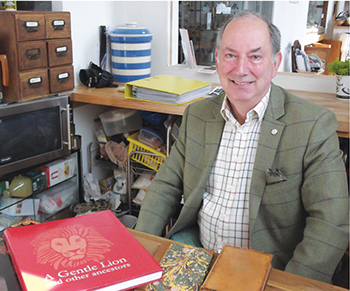
A Gentle Lion hints at one type of stigma: the race-based stigma of non-white ancestry in a British family. But there were other types of stigma that remained unexplored. Cohabiting and raising a family outside of marriage must have been socially difficult in mid-19th century England. Presumably, Ardaseer and Marian presented themselves to British neighbors and associates as a married couple. However, the other Parsis in London would have known about Ardaseer’s first family back in Bombay. He was active in the Parsi community of London. Ardaseer was a founding member and senior trustee of the Zoroastrian Trust Funds of Europe (established in 1861), for instance. He led a delegation of Parsis to meet the Shah of Persia in London in 1873, and lobbied for the lifting of the jazia (Pers. jezīeh), a tax imposed upon non-Muslims like Zoroastrians in Persia. In other words, Ardaseer was hardly trying to avoid other Parsis in Britain because of his extramarital second family.
Of course, Marian was not Zoroastrian. Half a century later, the practice among elite Parsi men of marrying European women would come under attack when these women tried to convert to Zoroastrianism by having the navjote ceremony performed. Marian did not attempt to become Zoroastrian, a fact that may have allowed the couple to avoid conflicts like the one in Petit vs Jijibhai. However, the fact that Marian was not Zoroastrian must have made following the Zoroastrian purity laws difficult for Ardaseer when they were together. When the Parsi engineer first traveled to England, he was careful to eat food prepared only by Zoroastrians, for instance. His adherence to the purity laws must have waned over time.
The fact that Cursetjee and Marian did not marry may have simplified matters. By 1865, the Parsi community in India had criminalized polygamy by its members. The controversial practice of taking multiple spouses (particularly wives) had grown in popularity during the mid-19th century among Parsis, and would have been at its peak around the time that Ardaseer and Marian began their family (1853). Equally, taking a mistress was a protected practice in Parsi matrimonial law until 1936: it would not provide the basis for a Parsi wife’s divorce suit. Ardaseer and Marian were probably lucky to have lived half a century before many controversies over extramarital relationships and European mates escalated among Parsis. And of course, there was Ardaseer’s affluence and status. His wealth and eminence may have enabled him to have a second family with a British woman outside of marriage without condemnation from his own community.
This assumption would be consistent with the fact that there was little tension between Ardaseer’s first and second families. Harmonious relations between the two were obvious at multiple points in the families’ histories. For example, Gustasp (Ardaseer’s son by Marian) had a son named John Grenville Ardaseer. John changed his Parsi surname to Anderson, eliminating any remaining hints of his Parsi heritage. However, he then moved to India and became a business partner with the Wadias—from Ardaseer’s first family’s line. During the First World War, Southerden’s grandmother Beryl Ardaseer was left alone with her young children in England while her husband fought in Mesopotamia. Despite her husband’s modest income, the children were educated at boarding schools. By Southerden’s speculation, descendants of Ardaseer’s Parsi family (particularly Sir Cusrow and Sir Ness) may have helped fund their education.
Most striking of all was a third instance of closeness: a marriage between the two lines. Ardaseer lived with Marian and their children in Lowjee House, Richmond. Through his first family in Bombay, he had a grandson named Rustomjee. At the age of 16, this grandson came for an extended stay with his grandfather’s second family in Richmond in order to study law at the Inns of Court in London. Ardaseer Rustomjee became a barrister, and was called to the Bar at Middle Temple. More unusually, he also married his grandfather’s daughter, Lowjee Annie. In other words, Ardaseer’s grandson by his first family married his daughter by his second. Or from another perspective, the grandson married his father’s half-sister—his own ‘half-aunt,’ who was one year his senior. This marriage caused an uproar in the Parsi community, but more because Annie was Christian than because she was her husband’s half-aunt. The couple moved between Britain and India. Rustomjee became the first Parsi member of the Indian Civil Service, and became an Acting Judge of the Allahabad High Court from 1906 until his retirement in 1911. Annie died in India, but her husband retired to Derbyshire and died there in 1941. The couple had three children, all of whom had English names.
Such close relationships between the Parsi patriarch’s marital and extramarital families suggested mutual acceptance. Perhaps Ardaseer’s status and wealth, and his families’ financial dependence upon him, meant that there was no space for resentment or hostility. Equally, it may have been that the racial dynamics of the day gave the second family an acceptability that it would not have enjoyed had Marian not been white. These issues, coupled with the hidden nature of this family history, make questions of stigma central to A Gentle Lion. By contrast with some of his ancestors, the author clearly takes pride in his Parsi heritage. Southerden has been granted a coat of arms that includes at its crest an East India Company ship. He has also had a wooden box built to hold key family documents using teak from the Wadia-built HMS Trincomalee, the oldest ship still afloat in Britain.
ERRATUM