
Cover Story
Transfer of the torch
With the conclusion of the Ninth World Zoroastrian Congress in Dubai, the focus shifts to Bombay to carry forward the ideals
"Use your leadership quality for the world. The world needs you.” The parting statement by Venu Rajamony, Indian consul general in Dubai, was addressed to the delegates assembled on the fourth and final day of the Ninth World Zoroastrian Congress (9WZC) in Dubai on December 31, 2009. "There is probably no area where the Parsis have not only excelled but contributed to the growth and development of the community and the country. The Zoroastrian community has added immense value to the composite culture of India… India would not be as we know it without the Zoroastrian community.”
In his brief address on the subject of "Unity in Diversity,” Rajamony proclaimed, "This city Dubai and the country United Arab Emirates is the best example of unity in diversity” for living here are "one million Emiratis who welcome and extend hospitality to over five million foreigners.” This spirit epitomizes "great wisdom and statesmanship of the rulers and hospitality of the people of this country.”
He urged every member to "take an oath” towards "spreading compassion… to address the real problems in the world.” Referring to the "misguided teaching… negative ideologies” that create problems, he recommended, "Tolerance and pluralism has to be the mantra of this world.”
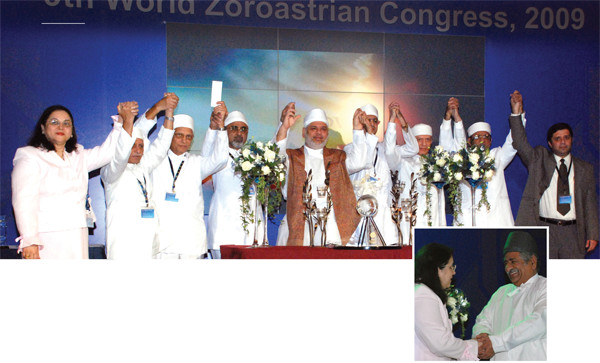
(Top): Singing the Congress anthem at the valedictory session; (inset) Meher Bhesania and Dinshaw Mehta;
In focus for four years
"In a group of motivated, intelligent, strong, dynamic people, there are bound to be differences that we need to keep aside and work for the common good of the community,” declared Sam Balsara, chairman and managing director, Madison World. He then proceeded to delineate the six areas on which the community needs to focus until the next Congress in Bombay in 2013.
A global working group of elected representatives has agreed to come together and arrive at its own action plan in priority areas. One of its priorities is to look after mobeds and make priesthood a "desirable profession… so that we can be sure of sustainable spiritual guidance.”
For a healthier Zoroastrian community, with a focus on the elderly, the Bombay Parsi Punchayet (BPP) with Dr Pilloo Hakim will serve as a nodal agency with links to Parzor and zoroastrians.net website. "While the prime focus will be on India, Pakistan and Iran, other regions could draw support from this program,” mentioned Balsara.
In the area of entrepreneurship the World Zarathushti Chamber of Commerce (WZCC) will be the launch pad for 100 new entrepreneurs before the 10WZC in Bombay in 2013.
The Zoroastrian Women’s International Networking (ZWIN) under Dr Zareen Karani Araoz and Dr Dolly Dastoor will pursue three areas whereby women can balance work and family life: raise children as genuinely good Zoroastrians; prepare support material to raise children; prevent breast cancer.

Bhesania (far left) acknowledges the efforts of the Congress organizing team
The youth will proceed in two areas: leadership (under the Youth Leadership Enhancement Program) with the guidance of role models and mentors to develop a Best Practices manual with its scope and focus outlined; and social interaction (under organizations like Zoroastrian Youth for the Next Generation and Zoroastrian Youth of North America) where projects are underway.
Towards better communication, material will be created on basic religious education, efforts will be made to strengthen the community identity and promote readership of community publications, and websites like zoroastrians.net will be employed "for better exchange of development within the community across geographies.”
Handing over the torch
"It is the first time in the history of Congresses” that a specially created torch was symbolically handed over by 9WZC chair Meher Bhesania to BPP chairman Dinshaw Mehta. The torch comprised the base pillar, the globe resting on it, and the farohar guarding the globe. As explained Bhesania, the pillar represents the strength of the community; the globe indicates the spread of the community around the world with the cities having hosted earlier Congresses being clearly delineated; the farohar is the guardian angel that protects members of the community.
Commending the 9WZC for being "out of this world… it was excellently coordinated,” Mehta spoke on behalf of his BPP team, "Even if we do 50 percent of what they were able to do, it would be great.” He was particularly appreciative of the Congress being conducted "without acrimony or controversy.” Keeping in mind the principles and values of the community "we will come up with our own vision for 2013,” he assured.
The priests who had invoked blessings at the start of the Congress were invited to the dais for the final benediction too. "May we attain salvation through righteousness,” prayed Dastur Khurshed Dastoor ending his recitation with a plea, "Peace, harmony, brotherhood for our community should be the slogan for the next Congress.”
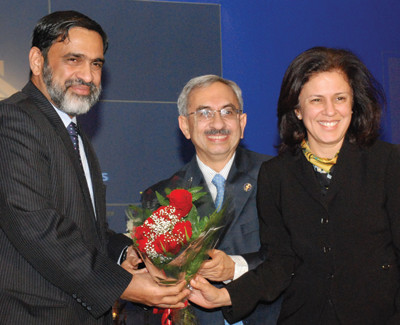
Nadir and Rati Godrej present a memento to Venu Rajamony
The borders of the Round Table
The final morning had commenced with a "Round up of Round Table Meeting,” being the last of the meetings in 2009, with the next due in December 2010 in Houston during the North American Zoroastrian Congress. These sessions provide a platform to elected representatives from different federations to come together. But the Far East has no voice as Hong Kong, Singapore, Australia and New Zealand have yet to form a federation and send two representatives. While hitherto Rohinton Rivetna of Chicago had served as the coordinator, henceforth he will be kept "in the loop” so that he is apprised of the developments that will be made known on Yazdi Tantra’s portal, zoroastrians.net With 15 GB space, Tantra offered, "If an organization does not have a website, we could put it together here.” Firdosh Mehta of USA felt that even the newsletters of different organizations could be uploaded here.
Providing mobeds in India with a living wage was adopted as the goal for the international community. Conveyed Dinshaw Mehta, "We are considering Rs 20,000 per month as the minimum wage with free accommodation.” It was suggested that associations overseas could adopt mobeds in India. Yet another urged Zoroastrians in Iran to send children to the two madressas in Bombay that have adequate facilities but few athornan children availing of them. When Jehangir Sarosh, European president of Religions for Peace, pointed out, "We have not heard the voice of the mobeds at this Congress,” he was reminded that the organizers wanted no religious issues to be brought up.
An ambassadorship project is also on the cards so that individuals get "to appreciate the world through a different lens” whilst simultaneously fostering "a deep sense of understanding of the challenges faced by others.” BPP trustee Khojeste Mistree was of the view that a group of young people could be taken "to experience the spirituality of Iran.” It would also promote "camaraderie and hamazori,” he felt. Similarly a group of youngsters from North America, England, Iran could be brought to India to "expose them to our spirituality… to our rural life.”
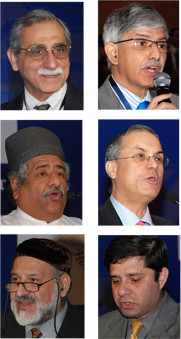
Clockwise from top left: Rohinton Rivetna, Sam Balsara, Dorab Mistry, Cyrus Debara, Khojeste Mistree and Dinshaw Mehta
Respect the brand image
An exclusive half hour time slot was set aside by the organizers for Mistree with the assigned subject "What the Diaspora can do for India and what can India do for the Diaspora?” India may be seen as the earliest diaspora, observed Mistree, but since it has the consecrated fire temples and Towers of Silence, "to preserve and perpetuate these powerhouses of faith” is the community’s duty. "Please be sensitive to India and Iran,” he beseeched those who have "migrated for education and economic benefit.”
Impressing on the community to "do your best to retain your Parsi/Irani nomenclature,” Mistree continued, "If we weaken our ethnic identity I foresee major crises... The brand image will be weakened, if not lost.” If this identity is dropped, "the value system and respect” we command will suffer. "If we know who we are ethnically we can be better human beings… The Parsi/Irani DNA is different from other racial groups…”
Viewing himself as "one of the lone voices in the wilderness” who does not believe that the community is dwindling, Mistree supported his stand by citing the worldwide Zoroastrian strength of 1,30,000 in 1961 as against nearly 1,26,000 today (the government of India census figure for 1961 was 1,06,184 for India alone – editor). As per his current estimate, there are nearly 69,000 Zoroastrians in India, 4,000 in UK, 25,000 card holders in Iran, 20,000 in North America, 3,500 in the Far East, over 2,000 in the Middle East and 1,700 in Pakistan.
Reference to charity invariably has a "bearing on the past… What about modern day Zoroastrians giving back to the community?” enquired Mistree. "We need to put our hands in our pocket and learn to give… to causes and trusts within one’s own community first. If we know how to look after our community, we can look after our religion.”
He sought help from the diaspora to "revamp the Alpaiwalla Museum” such that it can be transformed into a "fantastic folk museum in Bombay.”
For elderly migrants seeking to return to India, Mistree said the BPP is considering facilities along the lines of senior citizens’ service.
Advocating a "live and let live policy,” Mistree continued, "If you choose to go your own way, at least respect years of academic work… Recognize points based on scholarship, not emotions and convenience.”
Brothers and benefactors
To imbue a respect for philanthropy and an appreciation of community benefactors, Dorab Mistry, director of Godrej International, UK, related "The story of Zoroastrian Centre for Europe and the remarkable Zartoshty Brothers.” As mentioned Mistry, "Any visionary project looks impossible,” and gave credit to the legendary Mehraban and the late Faridoon Zartoshty for "talking to us, encouraging and supporting us (until) we could cross the Rubicon.” Alluding to the munificence of the "two remarkable” brothers, Mistry revealed that Mehraban’s hero was Arbab Rustam Guiv.
To inspire other associations he related in detail the sometimes frustrating and other times rewarding efforts of the New Premises Steering Committee to raise £ 1,350,000 to purchase the art deco style Grade II heritage cinema hall premises for the Zoroastrian Centre within a record 17 days in 2000 and develop it to suit the needs of the nearly 4,000 Zoroastrians in UK, the majority of whom live in Harrow. With permission in hand to develop 26,000 sq ft of space, they have presently used 15,000-16,000 sq ft, reported Mistry. "Projects take a long time and wear you out,” he conveyed observing, "The Zoroastrian community is known for its debaters, thinkers, conceptualizers…”
It was only fitting that the 8WZC convened at this Centre in Harrow in 2005 was inaugurated at the hands of Mehraban Zartoshty. CD copies of the proceedings of the 8WZC were distributed to all the delegates on the last day of the 9WZC.
Recognition for the team
"We have worked with each other like a family… Respected each other… Never had a controversy,” remarked Bhesania who wanted to show her appreciation to every team member who had contributed to the success of the Congress from the time the infrastructure was laid four-and-a-half years ago. Each of them was called on stage and presented a memento. She started by acknowledging the core team constituting her husband Kersy Bhesania, Noshir Motiwalla and Russi Patel. Equally important was the role played by the treasurer Barjor Bajan, and the different directors — Hoshi Siganporia (marketing), Nowshir Engineer (Congress events), Porus Guzder (Congress operations), Rumi Sarkari (Congress registrations), Shirrin Sarkaree (welcome program), Katy Madan, Maharuk Dadachanji and Dara Rajwadewala (food and hospitality), Kaizeen Bolar and Tabrez Bolar (advertising support). The program consultants were Cyrus Magol and Sohrab Mistry of Canada. While the exhibition was in the hands of Bobby Khambatta and Keki Tavadia, the visuals for the Congress anthem were by Hanoz Navdar.
Crowne Plaza, Dubai was deemed the official hotel and in fact their chef and catering team were specially called on stage to recognize their efforts. The official carrier was Jet Airways and the official travel agency, Trail Blazer Tours. Local transport and tours were managed by Concord Travels and 1001 Events.
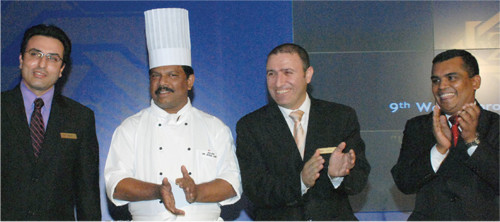
Chef and hospitality team of Crowne Plaza, Dubai
Website creation and management was assigned to Yazdi Tantra of On-Lyne Computer Systems and for the Congress publicity, credit was given amongst others to Burjor Patel of Khaleej Times, Dolly Dastoor of FEZANA Journal, Meher Bhesania of SynergyZ, Mithi Davar of Manashni and Toxy Cowasjee of Hamazor.
Some of the scheduled events required the cooperation of regional directors. Thus coordinating for the WZC Awards program were Deena Motiwalla (UAE), Dolly Dastoor (North America), Mobed Mehraban Firouzgary (Iran), Noshir Avari (UK), Phil Madon (Australia) and Pheroza Godrej (India). For the Youth Leadership Enhancement Program help was made available by Madon, Adi Engineer and Homai Mehta (India), Khodayar Attaie (Iran), Dr Behram Pastakia, Firdosh Mehta, Meher Amalsad and Niloufer Bhesania (North America), Cowasjee (Pakistan), Nowshir Engineer (UAE) and Paurushasp Jila (UK). Pastakia and Shahnaz Tarapore coordinated for the Operation Eyesight Program.
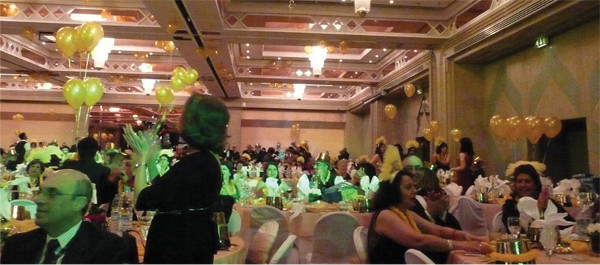
New Year’s eve celebration at the Jumeirah Ballroom, Crowne Plaza Photo: Jasmine D. Driver
Memorable mementoes
Included in the delegate welcome kit on the first day were several perfumes and toiletries courtesy Ajmal Perfumes Manufacturing. On the last morning, laid out on the table for all delegates was a crystal farohar keychain, courtesy Shernaz and Nariosang Antia of the Antia Group of Companies and a copy of the Congress anthem which the delegates nostalgically sang, whilst joining hands to form a human chain.
At the late evening New Year’s eve celebration each lady delegate was presented a pashmina shawl while the men were given a bag. This being the final session, Meher Bhesania personally greeted every delegate walking into the hall, thanking him/her for attending the Congress. The Jumeirah Ballroom wore a festive look with candle lights, balloons, streamers plus multiple distractions on the tables in the form of plastic rattles, horns, garlands, paper hats and feather crowns.
The partying and revelry were so infectious that it was difficult to contain some of them who were busy ‘blowing their own horns,’ not realizing that award winning singer Shayan Italia had taken the stage. Later the suspense-filled magic show did manage to silence the crowd temporarily until they were recharged with music and dancing to raucously bid adieu to 2009 and cheerfully usher in 2010. As master of ceremonies Cyrus Debara had reminded at the onset of the New Year celebrations, while constructive criticisms were welcome, they did not want any delegate to leave the Congress "bad mouthed… As we say goodbye to 2009, let there be no hard feelings… Let us enjoy a beautiful ride to 2010.”
A month later, a Thank You message from Bhesania addressed to the delegates read, "To witness over 700 Zoroastrians, both young and old, bonding and reaffirming their commitment to keep the spirit of the community alive was the best promise we could have ever asked for at the dawn of 2010.”
Future issues of Parsiana will carry detailed reports on select Congress sessions.
◆ ◆ ◆
From the archive