
Zoroastrians Abroad
Population in Pakistan
The Zoroastrian population in Pakistan has come down by nearly 10 percent in the last three years. As compared to the count of 2,039 in 2006, the figure in 2009 was 1,839, it was reported in the Zoroastrians of Pakistan a&t directory 2009 published by the Karachi Zarthosti Banu Mandal (KZBM). The number of Zoroastrian residents reduced from 1,935 to 1,757 in Karachi; from 51 to 40 in Lahore; from 22 to 17 in Rawalpindi; from 21 to 18 in Quetta; and from two to none in Peshawar. There continue to reside two Parsis in Multan and Islamabad now shows a family of five.
According to a significant finding reported in the seventh edition of the Directory, 280 individuals or nearly 16 percent of the Zoroastrians in Pakistan reside alone, with another 16 individuals staying at the infirmary.
The Directory lists the names of the family members with their full residential address, telephone numbers and e-mail contacts on the white pages. There is a separate CLI (caller line identity) listing of residence numbers of those staying in Karachi with the CLI numbers for mobiles featuring separately. The yellow pages are devoted to a listing of community centers and charitable trusts, of practicing mobeds and pallbearers, of hospitals and medical facilities, emergency and other services. The only professionals listed here are the Parsi doctors practicing in Karachi. Also finding place here are the caterers/clubs/hotels/stores and the popular eating places. The pink sheets are reserved for the directory of blood donors listed area-wise under separate blood groups. Listed on the blue sheets are the e-mail contacts of ex-Karachi-ites living abroad.
Acknowledging the contribution of those who have made possible the publication of the 210-page Directory, Toxy Cowasjee named Dilshad Irani, Soonu Kandawalla, Dinaz Divecha, Roshan Kamdin, Farrokh Golwalla, Zarine Byromshaw, Arnawaz Billia, Cyrus Cowasjee, Darayes Divecha, Zersis Birdie, Nader Cowasjee, Farrokh Mavalvala, Dr Zareen Mogal, Roshan Khursigara, Freddy Sethna, Nina Sethna, Perin Boga, Munizah Sidhwa and Niloufer Abadan. The cover design for the Directory was by Tannaz Minwalla.
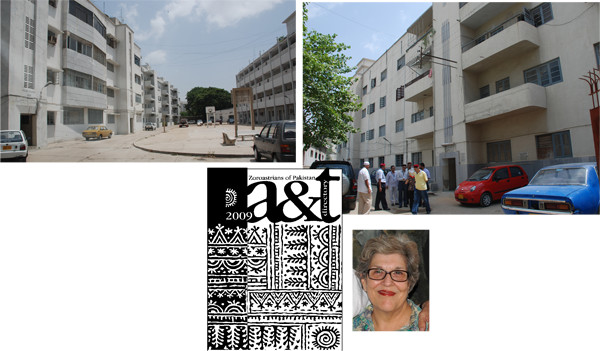
With the Zoroastrian population in Pakistan showing a 10 percent decline, some community enclaves (above left) may appear deserted one day; (far right) Toxy Cowasjee
As pointed out Cowasjee, "Even though most of us use this facility, the request to give your personal up-to-date information in the August What’s On (the newsletter of the KZBM) has been far from satisfactory though forms were attached with the added facility of just handing them over to the appointed person in your residential area.” Expecting that the Directory will be an ongoing effort she welcomes notifications on corrections and missing information.
"In these past few years we have had a few families returning back to Karachi for which we are happy, though some of our community have left for better prospects,” conveyed Cowasjee in the Directory. "Students studying abroad are marked with an (sa) though it may not be accurate as parents do not come forward with this information. In the near future some seniors will be leaving us though their names have been listed for now, and happily we have a few forthcoming marriages as well,” she adds in her note dated November 13, 2009.
"Almost 95 percent of the younger generation (is) moving away,” mentions a write-up by Akbar Ahmed in Newsline. He quotes KZBM vice president Kermin Parakh’s estimates that a maximum of five percent of the students sent abroad have returned in the last decade. "The real reason is that they are worried about Talibanization,” Ahmed quotes Byram Avari, president of the Karachi Parsi Anjuman and refers to "the frustration that members of his community feel watching the Islam they have been ‘very comfortable with’ being pushed aside by extremism.”
Another "push factor is the lack of professional mobility Zoroastrians and talented young people in general face in Pakistan.” Further, with the nation moving towards a "more closed society,” the youngsters experience an "obvious disconnect between the liberal upbringing they have been given and the values of the culturally restricted areas they live in.” With most of the enterprising ones migrating, those who have stayed behind "face the unique problem of attempting to find a match within the increasingly dwindling community.” Moving to the West is not entirely a personal decision. "All the young Zoroastrians Newsline spoke to revealed that their parents actually wanted them to move abroad,” states the article.
Yet another feature on the yesteryear Parsis of Pakistan is relevant here. "The Parsis of Lahore, like its Anglo-Indians, were like an ornament that the city wore. Their disappearance has left it poorer in more ways than one,” wrote Urdu novelist and short story writer A. Hamid in his weekly column reminiscing of old Lahore. This write-up that has been translated into English by Khalid Hasan was recently forwarded to Parsiana by our reader Rashid Medora who had seen it some years ago.
He refers to the liquor business in Lahore that was a Parsi monopoly. On McLeod Road stood the Gandhi Wine Shop whose owner would refuse to sell liquor to anyone unless the person had a government permit. Among the others in the business were Edulji in Commercial Building, the English Wine Shop in Regal and the French Wine Shop next to the Shah Din Building…
Another landmark was the Parsi Bank in an old two-storey building with a sign outside showing an evenly balanced pair of scales held by a woman who resembled a mythological figure.
Among the individuals who stood out in the author’s memory were Dr Bharucha, a pediatrician on McLeod Road who was known to have the healing touch; the owner of the laundry who sat behind his wooden counter, scribbling in an old register; the gatekeeper at the Plaza Cinema who supervised entry to the second class…
◆ ◆ ◆
From the archive