
Events & Personalities
Human Rights message
Religion is "a matter of personal belief and should be kept at home,” noted Justice Sarosh Homi Kapadia at a function for senior advocates in New Delhi to mark Human Rights Day, December 10, 2009 reported The Indian Express (IE) of the next day. Kapadia, the senior-most sitting Supreme Court judge is slated to take over as Chief Justice of India when the present incumbent, Justice K. G. Balakrishnan, retires in May 2010.
Kapadia’s statement was particularly significant because the Supreme Court had earlier observed, following the flak faced by Justice M. S. Liberhan on his report on the 1992 demolition of the Babri Masjid, that perhaps it is time for judges to distance themselves from controversy by heading enquiry commissions into such incidents. "The existence of poverty is a violation of human rights in this country. The real issue we have to tackle is the economic issue,” IE reports Kapadia as stating.
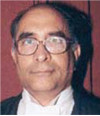
Justice S. H. Kapadia: "tackle economic issue”
Regarding terror, Kapadia explained, "I am a follower of Advaita (a Hindu school of philosophy that believes in non-dualism). I believe the main problem which generates terror is duality... If a religion is based on concepts like fear, greed, heaven, hell — all these fears will eventually be exploited by certain entities or persons. And finally this will lead to terror acts.” As a "solution” to terror, the judge, one of whose hobbies is Theoretical Physics, prescribes "quality education.”
The judge admitted that the Supreme Court faces a "dilemma” when dealing with public interest litigation in which the issues are economic development versus ecological preservation. "This is the most difficult challenge faced by courts” and since there is substance in the arguments of both sides — the NGO (nongovernmental organization) fighting for ecology and the government for an important public project — "balancing is an integral part of a judicial decision.” Then there is the matter of "distribution of resources,” where the "benefit goes to the 300 million rich people and not the 700 million poor... Displaced people who live in those areas (earmarked for public projects) live on grass. There are no jobs, no medical facility — they all live in abject poverty. It is here that the courts have a role to play... We judges should not give NOCs (non-objection certificates) unconditionally to public projects unless companies provide jobs, medical facilities, basic amenities to those people. The courts should ensure that these poor people get jobs in the very areas where their own resources are exploited,” Kapadia exhorted.
Concluding on a positive note, Kapadia felt confident that "many of the problems of ground reality can be solved in courts,” the IE report reveals.
◆ ◆ ◆
From the archive