
Health
Mental healthcare helpline
The Cyrus and Priya Vandrevala Foundation is reaching out to counter the stigma attached to mental illness and help sufferers overcome it with modern, effective therapy
"People living with mental illness say that the most devastating impact on their lives came not from the illness itself, but from the way others began to treat them,” states Priya Hiranandani-Vandrevala. This is one of the reasons why the Cyrus and Priya Vandrevala Foundation decided to launch its Mental Healthcare-India Initiative, reveals a press release sent by the Foundation.
Endowed by the Vandrevalas, well known international entrepreneurs who have started and are operating a number of companies in various parts of the world, the Foundation is a vehicle for their philanthropic activities, states its website, www.vandrevalafoundation. com Cyrus is a leading private equity investor with business interests in the USA, Russia, India and the Middle East. Priya, chief executive officer of Hirco plc which is listed on the London Stock Exchange, has also founded Zenta, a business process outsourcing company. Cyrus is a well-known philanthropist and Priya too is involved with several charities in the US and UK, reveals the website. In India their Foundation will focus on mental healthcare. The first step of the long-term program is a round-the-clock mental healthcare helpline which was launched in August 2009 on a pilot basis and is now fully operational covering the entire Greater Bombay area.
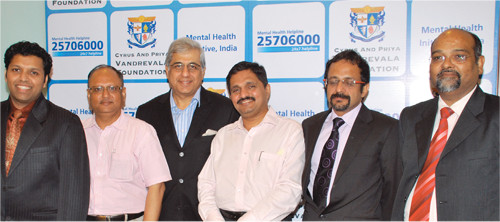
Core team for the project (from l): Dr Fabian Almeida, Dr Sanjay Kumavat, Firdose Vandrevala, Dr Harish Shetty, Dr Kersi Chawda and Dr Arun John
"Many times an individual knows he/she needs help to address a mental issue but does not know where to turn. This is the gap we fill,” explains Dr Arun John who heads the Foundation’s Mental Healthcare-India Initiative. The helpline is manned by specially trained clinical psychologists, backed by two tiers of experienced psychiatrists ready to take calls at all times. The helpline enables all cases to be referred to eminent psychiatrists of the city who have been empanelled, the press release mentions. Arrangements are in place for an ambulance service should there be any psychiatric emergency.
Envisioned for the future are plans to expand the helpline beyond Bombay, initially to Maharashtra and subsequently pan India.
"With modern advances most of the mental illnesses are treatable and curable,” according to John. "Aggressive follow-up is planned because the drugs that are now available to treat mentally ill patients are so advanced that very little innovation is now required. It is simply a matter of execution. Unfortunately, in our country people are not aware of this. A large part of the Foundation’s work will focus on educating people about mental illness and treatment,” John explains. The Foundation’s future plans include unique guidance and counseling centers, indoor facilities, education and advocacy.
Speaking about the public response to the pilot project in the Afternoon Despatch and Courier (ADC) of October 17, 2009, John described it as "tremendous and overwhelming.” The helpline received about 1,000 calls within 77 days of its inception on August 3. But numbers don’t matter, he explains, because often the calls last for as long as three hours. "Our aim is to provide complete service to every caller. We see to it that a follow-up to track the wellness of the caller is made in order to ensure that there are minimum dropouts,” the doctor said. About 70 percent of the calls are from those who are depressed and want to share their problems, ADC reports. The helpline addresses problems of all age groups varying from stress, distress, despair, domestic violence, fears, child and adolescent problems, dejection, depression after loss of job and marital conflicts, as per the ADC.
Adds Priya, "We know how difficult it will be to improve the lives of people living with mental illness. We know it will be tougher still to change deep seated public attitudes and reduce the stigma and discrimination they face. To put each of them on the road to recovery will be an extraordinary challenge. Yet we are optimistic that the time has come when meaningful change can, and will, be made. We are willing to make change a reality, to help bring people living with mental illness into the mainstream of society.”
The Foundation’s background document for the project is revealing: "When we started out with a mission to improve mental health in India over a year ago we were hoping to be able to write cheques to a couple of NGOs (nongovernmental organizations), be able to review their results four times a year and pat ourselves on the back for making a difference. What... ensued was a discovery into the dark corners of the disease, the discrimination and the realization that we had no idea as to what we were trying to achieve.”
The document further states that there are 43 mental hospitals in India, none of which were set up after 1947 (Source: WHO Country Profiles: India 2001). Most of these are abysmal, akin to jails, and people are afraid to approach them lest they be incarcerated there. A National Human Rights Commission study reveals that there are two types of hospitals. "The first type does not deserve to be called ‘hospitals’ or mental health centers. They are ‘dumping grounds’ for families to abandon their mentally ill member, for either economic reasons or a lack of understanding and awareness of mental illness.” The second type "are those that provide basic living amenities. Their role is predominately custodial... Medical treatment is given to keep patients manageable and very little effort is made to preserve or enhance their daily living skills. These hospitals are violating the rights of the mentally ill persons to appropriate treatment and rehabilitation.”
But there is light at the end of the tunnel. Providing hope for sufferers is an encouraging revelation in the background document about the power of drug therapy: "It is startling to note that if you have cancer, a drug works 25 percent of the time; if you have a headache, an analgesic works 80 percent of the time and if you have schizophrenia, the drugs work 100 percent of the time. The idea of the helpline is to demonstrate the power of medicine in situations that were previously considered irreversible.”
The helpline can be reached on the telephone at 022-25706000 and its e-mail is help@vandrevalafoundation. com Dr Arun John can be reached at 91-22-25719000 or on e-mail at ajohn@ vandrevalafoundation.com Further information is available on the Foundation’s useful website: www. vandrevalafoundation.com
◆ ◆ ◆
From the archive