
Cover Story
Visionary’s views
Architect Nari Gandhi questioned all the basic assumptions about form that architects and lay people take for granted
Adil Jussawalla interviewed Nari Gandhi in 1975 for a publication that failed to take off. The interview remained unpublished to date when Jussawalla offered it to Parsiana. Gandhi died in a motorcar accident in 1993, aged 59.
Nari Gandhi didn’t relish publicity. Nor was he willing as an architect and a designer, to reach the kind of compromises with his clients that led to anything other than what he believed was right. This might explain why an awareness of his work was slow to grow in professional circles, and why clients were slow to come.
There can be no lukewarm reaction to his work. It either captivates or repels. The five buildings and four interiors he had worked on till then contain such pieces as a three dimensional mural of cotton reels on a stunningly simple fabric, magnificent doors made of wood and glass, and a controversial stairway seemingly designed to give its regular users a permanent limp.
"Up the down staircase” was how he himself described his seven years in Bombay after his return from the US. He studied under (American architect) Frank Lloyd Wright between 1956 and 1961 and then studied craft — pottery, weaving, etc — at Kent, Ohio, where he also became a part-time vegetable farmer. For the first five years after his return from the States, Gandhi hardly had clients.
There can be no lukewarm reaction to his work. It either captivates or repels. The five buildings and four interiors he had worked on till then contain such pieces as a three dimensional mural of cotton reels on a stunningly simple fabric, magnificent doors made of wood and glass, and a controversial stairway seemingly designed to give its regular users a permanent limp.
"Up the down staircase” was how he himself described his seven years in Bombay after his return from the US. He studied under (American architect) Frank Lloyd Wright between 1956 and 1961 and then studied craft — pottery, weaving, etc — at Kent, Ohio, where he also became a part-time vegetable farmer. For the first five years after his return from the States, Gandhi hardly had clients.
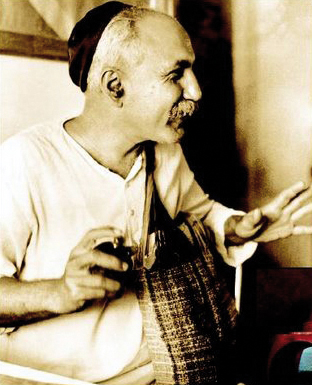
Nari Gandhi
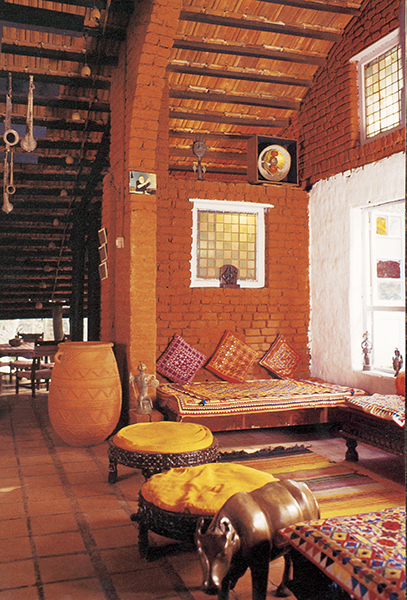
Farmhouse in Revdanda, reprinted with permission of Pranav Upasani
from a monograph of his work titled Nari Gandhi
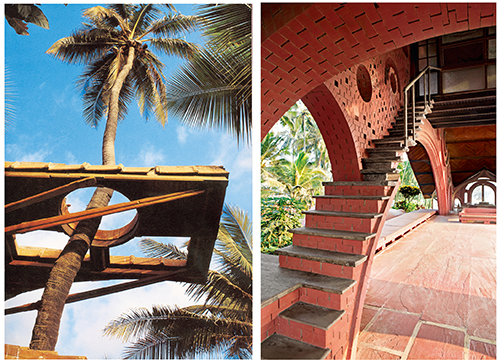
Top l: Gandhi’s respect for nature at a house in Versova Photo: Pranav Upasani;
staircase in Alibaug home Photo: Architectural Digest, Conde Nast India, Rajesh Vora
This did not make him bitter. Though thoroughly nonconformist in his views, he stated them with the mellowness and throwaway authority of a much more successful person. He was totally without pretension, and smiled a lot. With his long hair, his stoop, his noiseless walk, his habit of dressing in white and his reluctance to push himself forward in company, I thought that outside professional circles, Gandhi would be everyone’s favorite uncle.
We were on the 18th floor of a relatively new block of flats in Cuffe Parade, in fact, the flat I lived in. From over the decaying bungalows on the seafront, the chawls, the tarred terraces, we could look across the waters to where New Bombay had been promised. Gandhi wasn’t pleased at the prospect.
"I don’t believe in planning a city. A way of life should lead rather than follow. Our basic values must change, otherwise we are going to repeat the same mess everywhere. What are you going to do with New Bombay in the first place? Proper planning would at least have left us with more open space.”
He looked down at the city. "As long as you have tenement living, you can’t have open space. The individual should be allowed to have a large lawn to himself.”
I was more surprised, no longer mildly. "But how can you solve Bombay’s housing problems without some kind of tenement living?”
"Housing is not such an important problem,” he said. I held my breath. As he didn’t elaborate, I asked him if he was against tenement living on principle, or if he didn’t think imaginatively designed tenement buildings were possible.
"Practically everything’s possible,” he said. "I need not subscribe to tenement living but if it has to come, we should be prepared to change some of our ideas first. People talk of slums but there are some they don’t even see. Poverty of thought is a slum. The whole of Sachivalaya (now Mantralaya) is a slum. Look at the people who work there. They don’t have vision.”
I thought we had got to the essential Gandhi very quickly. Having a vision and a respect for the individual were, to him, qualities vital to our very existence. He had both. The vision enabled him, among other things, to carve circular spaces out of the tedious rectangles of most flats, to echo the sweep of a balcony in the furniture inside, to fill up the spaces of an interior with the heavy stubborn creations of what, at times, seems to be an imagination wilfully at odds with the function — alien of our times. His respect for the individual, on the other hand, was responsible for his hatred of all kinds of authority and something he disliked greatly — socialism.
I asked him what he had against socialism.
"I hate the idea that individuals should be given anything. I would much prefer them to fight for it. I am for a robust kind of individuality, not this levelling down for the so-called good for all.”
I asked him to elaborate a bit more on this "robust individuality.”
"Well, Mahatma Gandhi had it — and (American naturalist Henry David) Thoreau. When I was with Wright at Taliesin, what impressed me greatly was his fight for the survival of the individual, the fight so that the individual could live with grace. He had a philosophy — which is something not many architects have. If you have philosophy, technology will catch up with you. Here we are doing it the wrong way round.”
 He looked out over the old city. A few people were walking desultorily down the seafront. A boy began chasing a dog, then stopped abruptly to join a group of people smoking round a stall.
"This is drudgery, living in a kind of quiet desperation. Why do so many people come here? When Wright said as early as in the 1920s that our cities would destroy us, he was told to shut up as a stupid farm boy. Who is right now?”
Gandhi suddenly stopped speaking to stare in amazement at a form far to the right of us.
"What on earth’s that?” he asked.
It looked like a ship that had accidentally backed into the coast and stayed there. In fact it was a building.
I said it belonged to the Navy.
"Then the Navy should turn its own ships on it and blow it up,” he said. He continued to stare at it in amazement. "Do you see any reason for putting up something like that?”
I said I didn’t and that he must be aware Bombay was full of such follies. Then, judging from the groups of high-rise buildings already put up, we tried to imagine the future development of the area we were in. The prospect was forbidding. I said a 120-ft-wide road had been planned to pass in front of the building we were in.
"By the time you get your 120-ft-wide road,” Gandhi said, "you won’t have any cars. You’ll have socialism.”
I wasn’t very satisfied with the way he had dealt with what after all was a fundamental right in any society — the right to shelter. I asked him if he had any ideas for providing alternative accommodation to slum dwellers.
"Do you know,” he said, pointing out a man who was selling fruit on a street corner, "that fruitwalla earns Rs 80 a day? He probably lives in a slum. Slum dwellers often don’t want to get out from where they are. I know of a building site in Vile Parle. A fellow asked permission to put up a small canteen for the workers and the builder let him. A few months later he demanded Rs 22,000 to move out. And the builder had to pay! I don’t blame the slum dwellers for this state of affairs but there are a lot of people instigating them.”
We began talking about his work. He often spoke in Gujarati. I told him I hadn’t seen him work with any traditional Indian forms. Was there nothing in them that interested him as a basis for his designs?
"We have a wonderful tradition,” he replied. "I don’t think anyone can question that. But I am more interested in using local material — certain kinds of wood and stone, rather than repeating the shapes of yesteryears.” He thought a bit. "I don’t give much importance to this or that form. Light and air forms an interior. The air itself should come to life. Of course, certain basic assumptions about form need to be questioned. Does a chair have to have legs? Can’t there be a saucer with a hole in the middle to hold the cup? People don’t question the basicality of things enough. They just copy. When asked to design a shirt, they copy something from Vogue. Do you know Ms M, chairman of a big shipping company, wants arches on her ship? Like the ones on Air India’s Jumbos? But can anything be more absurd than having painted arches on ships and aeroplanes? If Mr Tata had any sense of formal dynamism, he would scrap them all. (Air India was run by the government since 1948, not the Tatas — Editors) And what’s the point of saying they’re something Indian? If they are something Indian then India doesn’t amount to much. And take a look at the interior of the Jumbos, horrible. I mean, they call the plane Emperor Ashoka and have a Krishna Leela inside. Where’s the connection? The inside and the outside of any form or structure should be one overall whole, a one-purpose organism.”
From time to time during our conversation I had been offering Gandhi something to drink — beer, coffee, tea. Each time, he had refused. Now, once again, I offered him something — this time to cool his indignation. Again, he refused. I wondered if this had anything to do with the influence of his ascetic namesake, but I didn’t ask.
Instead, I asked him how he managed to get his designs made by carpenters who were notorious for not working to specification. "I sit and do it myself,” was his answer. "The first house I built in Lonavala — I literally lived there and built the damn thing stone by stone, otherwise it would never have been built. Mind you, some carpenters are much more intelligent than architects. But I agree, getting work done to specification is still a problem.”
He peered over the balcony, his huge jaw resting on the railing. He had spotted a tree he liked.
"It takes 60 years for a tree to grow like that. It takes 60 minutes for someone to knock it down. I like trees, but there is nothing worse than seeing a mutilated tree. There it is, growing beautifully, when someone cuts a branch off for a goat, someone for the BEST (Bombay Electric Supply and Transport Undertaking), someone for his wife. In the meantime, the poor tree…” He became very serious. "We have only one life and we throw it away so thoughtlessly.”
The city lights were coming on as we continued looking out over the balcony. I pointed out some of the landmarks in the area. I said the building a little way from the displaced "ship” was a fire temple. He was delighted. "Then I can go and finish my prayers there,” he said, smiling.
"Do you go to the fire temple every day?”
"Yes,” he replied, beaming broadly.
"You don’t have any regrets coming back to India?”
"No regrets at all.”
"What’s the most rewarding work you have done after coming back?”
"Teaching. I taught at Baroda University and at the J. J. School of Architecture. But I left JJ as I didn’t want to pass someone whose father was important. But I am very pleased I may soon be teaching at Baroda.” At that moment Gandhi seemed very content.
But he was leaving Bombay. He planned to build a house for himself at Lonavala where, owing to its situation on the edge of a sheer cliff, he would be virtually inaccessible. The house would also be his workshop. He wished to farm there as he did in Kent, and occasionally commute to the city. He said he preferred the old idea of workshops to offices.
It all fitted. Putting down "roots,” farming, a many sided organic development rather than a single minded rush to get to the top of his profession. His philosophy and a certain moral conviction about the rightness of his work, had perhaps kept Gandhi going in an environment that does its best to destroy originality and block the nonconformist.
"We are the form givers — that is the basis of being an architect,” Gandhi said, as he looked out over the city once more. "A lot can be done here. It’s just a matter of time. If I don’t succeed, others will.”
It was time to go. We descended to the ground level, from where it seemed more than ever that most of the forms should not have been given at all. As people prepared to sleep in their corners and crowded buses went by, I wondered whether, in a city whose citizens seemed forever to be reaching new lows of indifference and apathy, Gandhi’s ideas would not be dismissed as those of a crank. The vision was surely there. But even allowing for political differences, it was difficult to see many of the middle class accepting this vision as something that filled the gap in our architectural practice — the moral vacuum in which speculating builders who passed off as architects, and unscrupulous adventurers who exploited every scrap of available land to put up ill-conceived monstrosities functioned. Gandhi’s words served as both a warning and an epitaph.
"If you don’t have morals, your foundations will collapse,” he had said. "If you don’t have vision, you will collapse. What more is there to say?”
◆ ◆ ◆
From the archive