
Institutions
For the sunset years
Aged inmates find security and camaraderie in the new Pallonji Shapoorji Home for Senior Citizens of the B. D. Petit Parsee General Hospital
A chance encounter with an intermarried couple at a restaurant in New York some time ago had set Patsy and billionaire builder Pallon Mistry, of Shapoorji Pallonji and Company, thinking. The husband wanted to bring his widowed mother to live with them. The non-Parsi wife, still smarting from discrimination and humiliation experienced as a young bride and in the years thereafter, repeated a single question: "Why should I now look after my mother-in-law?” Was there an equitable solution to this problem?
Patsy says the incident played on their minds, prompting him into a long time search for a suitable spot for a facility the community obviously needed; prompting her to visit such institutions in other parts of the world, research the project in books and journals. So when talk with the management board of the B. D. Petit Parsee General Hospital (PGH) yielded an offer for this sylvan spot on the ferny slope near the entrance to the Hospital grounds, the Mistrys, in Patsy’s words, launched into their plan to put up "a beautiful home for seniors to match these wonderful surroundings.”
The three-storied Pallonji Shapoorji Home for Senior Citizens (PSH) of the B. D. Petit Parsee General Hospital, designed by architect Hafeez Contractor, opened its doors to the community on January 1, 2007, Patsy Mistry informed Parsiana during a site visit on March 29, 2007. Also part of the team answering Parsiana’s queries were PGH vice president Aban Petit, Aloo Tata (née Mistry) senior engineer with Shapoorji Pallonji and Company Dhunji Dadachanji and SPH live-in matron Shirin Wadia.
Serviced by two entrances, two elevators — one each for the ground and first floors and the second for the upper floors — and a grand central stairway plus a fire exit at each end, the high ceiling common areas boast of meticulously selected fixtures adding to the aesthetics of the structure which has an inbuilt provision to add two more floors at a later date, as notes Dadachanji. Lounges provide for private tête-à-têtes with visitors or just peaceful areas beyond the confines of one’s room to leaf through a replenishing store of magazines or read a book. On Mistry’s agenda is the provision of books for a library that would interest the elderly – intellectual and otherwise.
Jointly managed by four representatives of the PGH executive committee and four representatives of the Pallonji Shapoorji Charity Trust, the ground and first floors together provide accommodation for about 48 inmates. On the ground floor four to six individuals share a room, each provided with a bed, Godrej cupboard and shelves. The first floor provides for three to a room. There are separate wings catering for men and women, well endowed washroom facilities and drinking water coolers fed with Aquaguard water in each wing. Elderly couples have also been encouraged to move in and have a room to themselves on the first floor, though they must avail of separate washrooms. The washrooms, corridors (equipped with grab rails for the security of elderly traffic) and common areas are cleaned twice daily and an attendant is present in each wing at all times, but, says Mistry, "the residents are proud of their home, they keep everything so clean!”
The perquisites include full board, bed and bath linen changed weekly, cleaning and maintenance and round the clock security. Wadia is a qualified nurse who sees to all their health requirements and general physician Dr Shilpa Mukhtyar provides a free weekly checkup for inmates of the ground and first floors. Occupants of the two upper stories pay a nominal amount for the service.
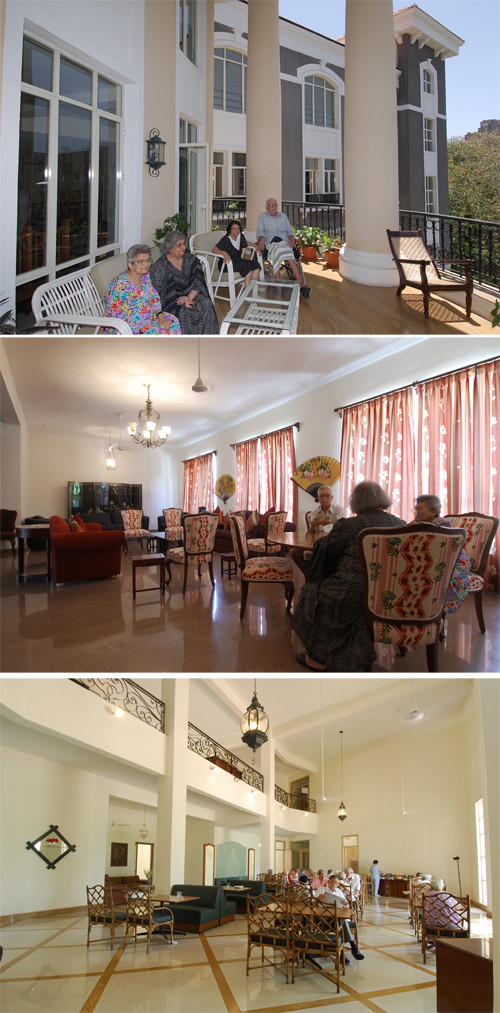
Left and below: second floor sit-out and cards in the lounge Bottom: Ground floor dining room
The two floors share a common dining and sitting room, a wide screen TV and a spacious verandah overlooking the manicured garden with its paved walkways. Mealtimes are regimented: Morning tea between 7 and 7.30 a.m.; breakfast comprising a bowl of cereal varied daily, two eggs cooked as per the day’s menu, toast, butter and jam, tea or coffee between 9 and 10 a.m.; lunch providing two vegetables and a lentil, one non-vegetarian item plus a salad, rice, chapatti and dessert as per the day’s fixed fare between 12.30 and 1.30 p.m.; evening tea accompanied by a couple of biscuits between 4 and 4.30 p.m.; dinner between 8 to 9 p.m. comprising a soup, a non-vegetarian dish, potatoes, vegetable, salad and dessert as per the day’s menu. Despite the food on offer, Mistry says she warns vegetarians "to think well before coming!”
The difference between the inmates of the two floors is that the ground floor residents are hosted totally free of cost while those on the first floor pay Rs 3,500 each per month – a subsidized amount. Mistry was happily surprised with the community ethic that prompted "more to opt for the first floor” than for the free provision on the ground floor.
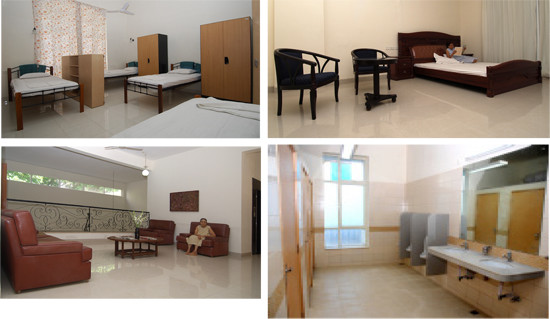
Facing page (clockwise from top left): Section of ground floor dormitory; sleeping area — second floor double room; common washroom and common area for receiving visitors on first floor
The second floor is equipped with three single rooms and eight double rooms, fully furnished, each with an attached bath where the inmates pay Rs 12,000 per month for the single room and Rs 18,000 for the double room which even a single person can occupy. Electricity is extra as per the separate meter provided and food is not included though they can avail of the meals from the institution’s kitchen at the rate of Rs 40 per breakfast and Rs 65 each for lunch or dinner for themselves or guests. Though they are at liberty to order meals from elsewhere, they have been provided with their own pantry with a microwave oven and refrigerator and an assigned cabinet to store their pots and pans, etc. A dining room, sit out verandah above the portico with a view of the PGH garden, TV, lounge with guest toilet and an attendant’s room with toilet are other facilities catering to the residents of the second and third floors. With the exception of two double rooms, this floor was fully occupied, noted Mistry.
The third floor boasts six, bare (except for a dining table and four chairs), well designed flats with a living room, separate bedroom, large verandah and a substantial kitchen which the occupant, at Rs 50,000 per month, is at liberty to furnish to his/her satisfaction. Here too, electricity is charged extra as per the separate meter provided. The higher rates of the two upper floors are meant to subsidize the two lower floors, keep the institution self-financing, note the ladies. Two flats were occupied and two others were booked for a couple from the US and a lady from London, added Petit.
Cleaning and maintenance are provided on both these floors and Parsiana noticed that the common areas were under constant attention. An attendant is present on each floor day and night. There is a water purifying plant installed for the borewell water used for toilets and washrooms; municipal water is used for cooking and drinking.
Eschewing labor appointments on their staff, the PSH has out-sourced all services including cleaning, housekeeping and security. The catering is provided by six cooks, three utility staff and three stewards, similarly out-sourced.
The facility is meant to house inmates "65 years old and above, able in body and mind, mobile and continent,” as notes Mistry. Petit described it as a facility for "assisted living,” adding, "There is a 90-year-old lady on the second floor!” What happens if people lose their mental or physical faculties after moving into the SPH, we ask? If it is due to an illness, the family needs to take them away, responds Mistry. "We have said we’ll keep the bed for three months…We tell them to keep their homes, not dispose them off,” she notes, adding, "Some families are very nice but they have no room or facilities to tend to the aged.” There are those who try to palm off their responsibility but Mistry and Petit say they can see through them. Such cases are not encouraged, they maintain.
By the time of the interview, 26 inmates had moved into the two lower floors while others were awaiting interviews. The management has sought the help of the Liaison Committee to check on the bonafides of the applicants, says Mistry. And she will not tolerate any rudeness to any of them.
Unlike some other homes for seniors, notably the World Zoroastrian Organisation (WZO) facilities in Navsari, where the inmates are encouraged to help out with cooking, in view of the PSH’s policy of outsourced kitchen crew, it is not feasible here. Moreover, the residents who were requested to answer the phone while the matron was otherwise occupied, were not enthused. They say, "Hamé tau aaram né varé aayanch (we are here for rest),” it was reported. A few indoor games, cards, etc provide for recreation. A meditation class is conducted by a Parsi girl once a week, though there is no compulsion to attend. There is a birthday party every month as a combined celebration for those born that month. A jashan conducted by mobeds from the Saher Agiary marked Jamshedi Navroz and a substantial group had gone shopping before the occasion to fetch the items required for the Navroz table. A barbecue dinner, a musical night and skit were part of the celebration.
Togetherness is the key, notes Tata: "The loneliness is taken care of.” People from the top floors come down to watch TV. "Some are well cared for when they come, some are quite disoriented,” says Mistry, but within a few days the camaraderie helps them settle down. "There has been only one old lady from a village who couldn’t cope…She couldn’t handle a tap, had never known running water! Her daughter had to take her away.”
Nor are the residents prevented from leading a normal life. They can go out as they wish so long as they are back by dinner time. And if they need to be out late for a function or overnight stay, they are required to enter the particulars in a register so that the concern and worry that led Mistry to rush to the center one night, when an old gentleman failed to return, is avoided. He had forgotten to inform the matron or enter the register! "After all, we are responsible for them!” smiles Mistry, obviously relieved that it was only a case of absentmindedness.
The Mistry family is "open to suggestions” for further community involvement. "I would like to have something to do with children, give them a new start in life,” she says. "Maybe we need a nursing home for old people who are immobilized or infirm,” ventures Petit, referring to an old lady in the PGH who has been in coma for 16 months. "There is no one to take her home…They need a place where they are comfortable to the end.”
Reminiscing about such a place in Dadar Parsi Colony in the old days, Dadachanji wondered, "Why can’t the Bombay Parsi Punchayet (BPP) have a building — or even a flat — in each colony where the old can be maintained? There are always a lot of people who provide food.” He said he decided to remain in India to take care of his aged parents when all his siblings migrated.
"I am enjoying this work so much, I love these people,” admitted Mistry. She had never been one to sit and talk to old people, she said, but has found it "a happy experience.”
◆ ◆ ◆
From the archive